Four Neotropical frog species exhibit shared and distinct skin bacterial communities in a laboratory setting
Viraj Jansari, Daniela A. Castro-Martinez, Melody J. Dailey, Olivia Roti, Morgan R. Seibert, Baraa J. Abdelghne, Gwendolyne K. Aguilar, Anna Amine, Kaya Ben-Efraim, Riley E. Carolan, Ashley N. Carter, Melody Chang, Nicole J. Dye, Chantal A. Le, Massiel Melian, Keira C. Nakamura

TL;DR
Four Neotropical frog species share some skin bacteria but also have unique ones, showing diversity in their microbiomes.
Contribution
Demonstrates variability in amphibian skin microbiomes and integrates education with scientific research.
Findings
Frog skin microbiomes were dominated by Pseudomonas and Chryseobacterium.
Each frog species had at least one unique bacterial genus in its microbiome.
Undergraduate students conducted the research as part of a laboratory course.
Abstract
Amphibian skin microbiomes are an essential part of host physiology and pathogen defense. In this study, we identified common and distinct microbiota across four Neotropical frog species in laboratory conditions. Across frogs, we found communities dominated by Pseudomonas and Chryseobacterium . However, each frog species had a unique bacterial profile with at least one unique bacterial genus, highlighting the variability of naturally occurring amphibian skin microbiomes. These experiments were conducted by undergraduate students in an upper-division laboratory course, demonstrating how curiosity-based science education can lead to practical research experiences and new scientific insights.
Genes, proteins, chemicals, diseases, species, mutations and cell lines named across the full text — each resolved to its canonical identifier and authoritative record.
Click any figure to enlarge with its caption.
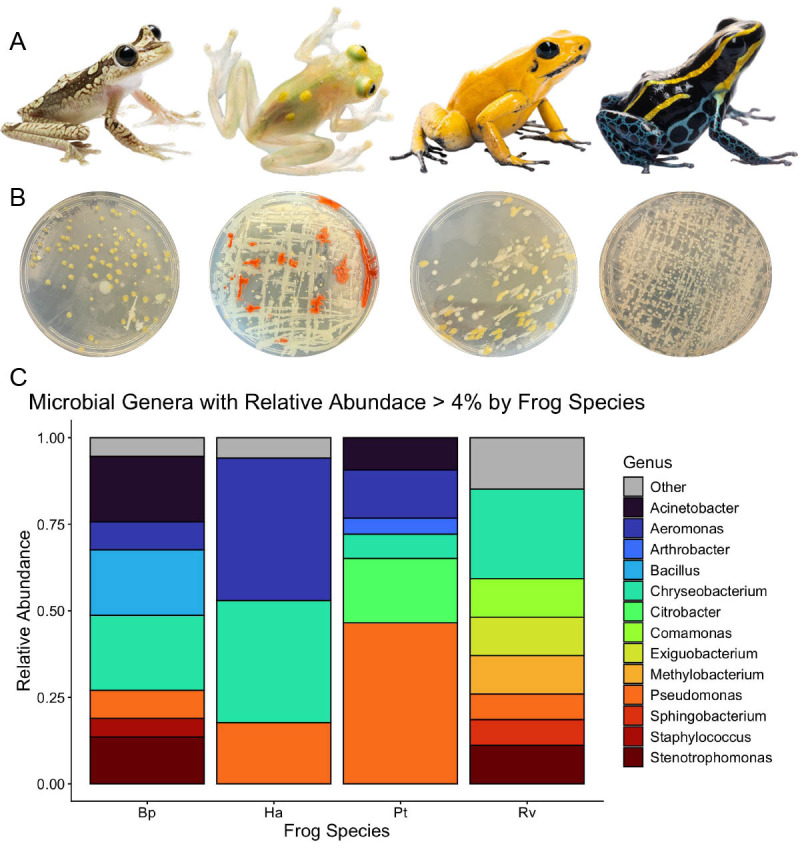 Figure 1
Peer Reviews
No public reviews on file for this paper yet. If you reviewed it on a platform where reviews are public (OpenReview, ICLR, NeurIPS, ICML), you can paste yours below so the community can read it here.
Videos
No videos yet. Explain this paper in a talk, walkthrough, or lecture? Add one.
Taxonomy
TopicsInfections and bacterial resistance · Bacterial biofilms and quorum sensing · Building materials and conservation