Association between bedtime snacking and subclinical hypothyroidism
Yuji Shimizu, Nagisa Sasaki, Asuka Oyama, Yuko Noguchi, Mutsumi Matsuu-Matsuyama, Koichiro Hamada, Shin-Ya Kawashiri, Hirotomo Yamanashi, Seiko Nakamichi, Yasuhiro Nagata, Takahiro Maeda, Naomi Hayashida

TL;DR
The study found that bedtime snacking is linked to subclinical hypothyroidism, possibly due to increased demand for endothelial repair.
Contribution
This study is the first to establish a link between bedtime snacking and subclinical hypothyroidism through endothelial repair mechanisms.
Findings
Bedtime snacking was associated with a 1.93-fold increased odds of subclinical hypothyroidism after adjusting for multiple factors.
The association remained significant even after controlling for conditions like CKD, hypertension, and diabetes.
The study suggests that bedtime snacking may increase physiological demand for endothelial repair, contributing to thyroid dysfunction.
Abstract
Thyroid hormones support endothelial repair, whereas bedtime snacking is linked to a higher risk of chronic kidney disease (CKD). Since endothelial dysfunction is a core feature of CKD, bedtime snacking could potentially contribute to subclinical hypothyroidism (SCH) by elevating the demand for endothelial repair. This study aimed to explore the association between bedtime snacking and SCH. In this cross-sectional study, 1,478 Japanese individuals aged 40–69 years with normal thyroid function were enrolled; normal thyroid function was defined as free triiodothyronine (T3) and free thyroxine (T4) levels within the reference ranges and the absence of thyroid-related medication use. Individuals with elevated serum concentrations of TSH (>4.01 µIU/mL) were defined as having SCH. Bedtime snacking was determined in the basis of participants’ affirmation to the question “Do you consume a…
Genes, proteins, chemicals, diseases, species, mutations and cell lines named across the full text — each resolved to its canonical identifier and authoritative record.
Click any figure to enlarge with its caption.
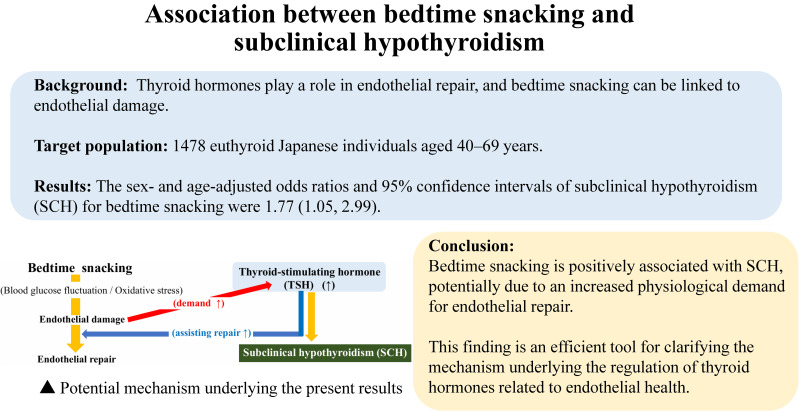 Figure 1
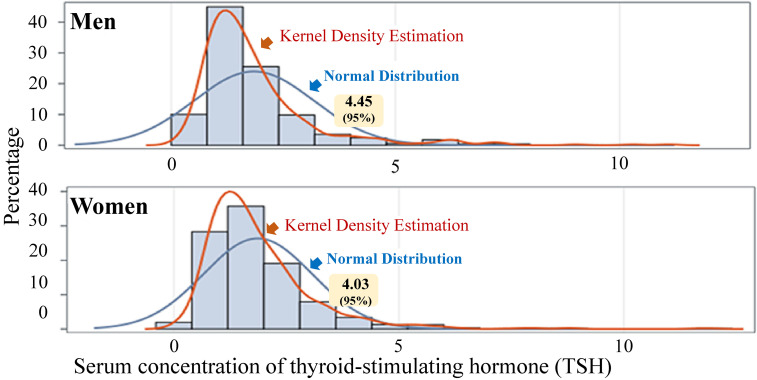 Figure 2
Peer Reviews
No public reviews on file for this paper yet. If you reviewed it on a platform where reviews are public (OpenReview, ICLR, NeurIPS, ICML), you can paste yours below so the community can read it here.
Videos
No videos yet. Explain this paper in a talk, walkthrough, or lecture? Add one.
Taxonomy
TopicsThyroid Disorders and Treatments · Body Composition Measurement Techniques · High Altitude and Hypoxia