Hybrid and conjugated antimicrobial peptides: new tactics to counter bacterial resistance
Yuanyuan Zhang, Cui Bao, Jiao Feng, Xiuwen Hong, Nan Gao, Ganzhu Feng

TL;DR
This review explores hybrid and conjugated antimicrobial peptides as new strategies to overcome bacterial resistance and improve clinical effectiveness.
Contribution
The paper introduces hybridization and conjugation methods to enhance antimicrobial peptides' efficacy against drug-resistant bacteria.
Findings
Hybridization improves antimicrobial spectrum and reduces toxicity of AMPs.
Conjugation with molecules like antibiotics and nanoparticles enhances AMPs' effectiveness against resistant strains.
AMPs show promise in the lab but face challenges in clinical translation due to pharmacokinetics and safety issues.
Abstract
The phenomenon of bacterial resistance has emerged as a significant challenge to global public health. Due to the increasing prevalence of antibiotic resistance, there has been interest in developing antimicrobial peptides (AMPs) as alternative antimicrobial therapies. However, AMPs resistance is not uncommon; it is simply subject to complex ecological and physiological limitations. While AMPs demonstrate potent antimicrobial activity in experimental and preclinical studies, their clinical efficacy remains limited. This review mainly summarizes the two methods of peptide hybridization and conjugation to combat drug-resistant bacteria. Hybridization has given AMPs new vitality, which overall enhance their antimicrobial spectrum, reduce toxicity, and enhance the bactericidal effect on drug-resistant strains. We also reviewed the conjugation of AMPs with various active molecules, such as…
Genes, proteins, chemicals, diseases, species, mutations and cell lines named across the full text — each resolved to its canonical identifier and authoritative record.
Click any figure to enlarge with its caption.
 Figure 1
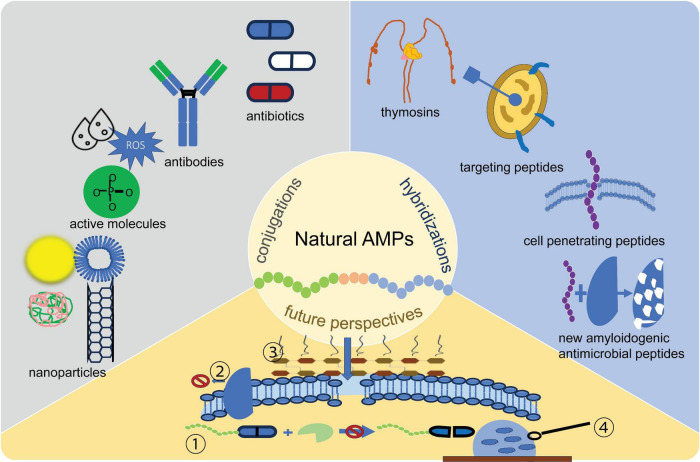 Figure 2
Peer Reviews
No public reviews on file for this paper yet. If you reviewed it on a platform where reviews are public (OpenReview, ICLR, NeurIPS, ICML), you can paste yours below so the community can read it here.
Videos
No videos yet. Explain this paper in a talk, walkthrough, or lecture? Add one.
Taxonomy
TopicsAntimicrobial Peptides and Activities · Peptidase Inhibition and Analysis · S100 Proteins and Annexins