Isotopically Selected Co‐Doping of 121Sb and 123Sb Pairs in Silicon
Mason Adshead, Maddison Coke, Evan Tillotson, Tomas F Bouvier, Artem Mkrtychyan, Kexue Li, Sam Sullivan‐Allsop, Ricardo Egoavil, William Thornley, Yi Cui, Christopher M. Gourlay, Katie L Moore, Flyura Djurabekova, Sarah J Haigh, Richard J Curry

TL;DR
Scientists developed a method to precisely place pairs of antimony isotopes in silicon, which could help build quantum computing systems.
Contribution
A new method for deterministic doping of isotopically defined antimony pairs in silicon is demonstrated.
Findings
Pairs of 121Sb and 123Sb atoms are substitutionally incorporated into silicon with ≈2 nm separation.
Molecular dynamics simulations confirm lattice site preference and fast self-annealing at room temperature.
Single ion cluster detection efficiencies of 94% are achieved with compatibility to low 29Si silicon processing.
Abstract
A reliable route to the deterministic fabrication of impurity ion donors in silicon is required to advance quantum computing architectures based upon such systems. This paper reports the ability to dope isotopically‐defined unique (121Sb123Sb)2+ molecular ions into silicon with measured detection efficiencies of 94% being obtained. Atomically resolved imaging of the doped Sb ions reveals substitutionally incorporated atoms with a Sb‐to‐Sb separation of ≈2 nm post‐implantation, thus indicating suitability to form coupled qudit systems. Molecular dynamics simulations support the preference for doped Sb atoms to occupy lattice sites, driven by fast (≈1s) re‐crystallization of localized ion implantation induced damage at 300 K. The Sb doping method used is fully compatible with integration into processing that includes pre‐enrichment of the silicon host to sub‐3 ppm 29Si levels. As such, we…
Genes, proteins, chemicals, diseases, species, mutations and cell lines named across the full text — each resolved to its canonical identifier and authoritative record.
Click any figure to enlarge with its caption.
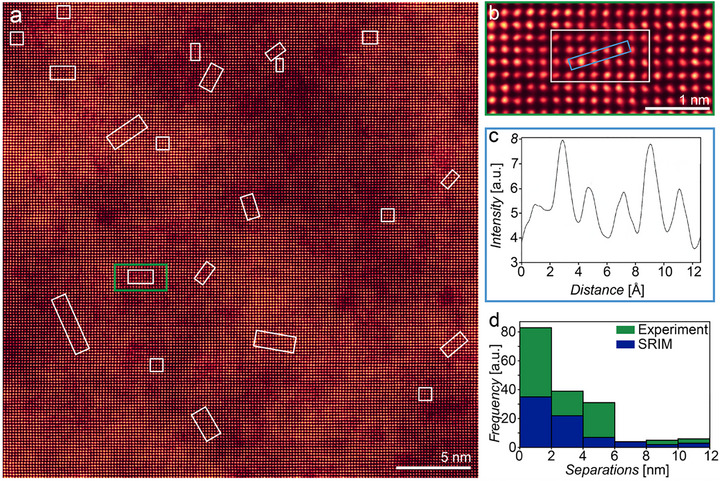 Figure 1
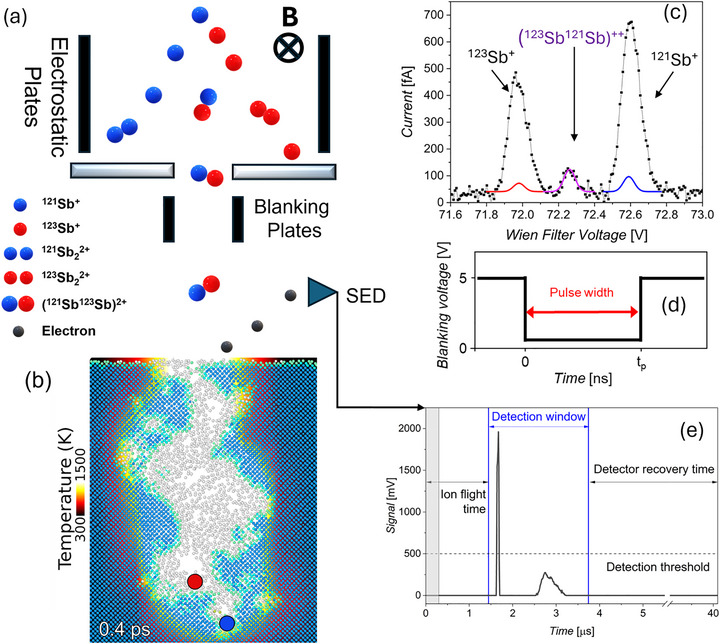 Figure 2
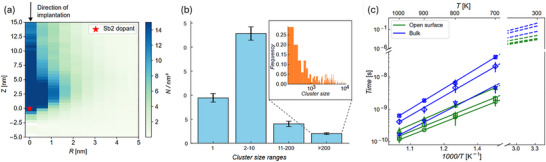 Figure 3
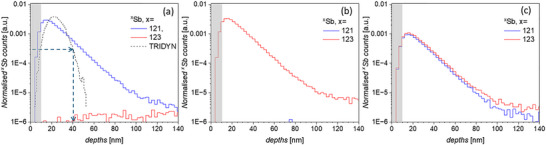 Figure 4
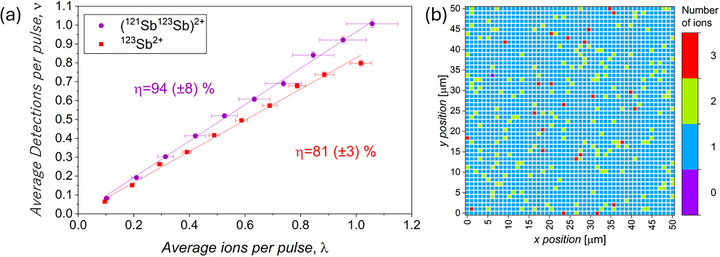 Figure 5
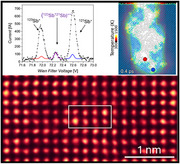 Figure 6
Peer Reviews
No public reviews on file for this paper yet. If you reviewed it on a platform where reviews are public (OpenReview, ICLR, NeurIPS, ICML), you can paste yours below so the community can read it here.
Videos
No videos yet. Explain this paper in a talk, walkthrough, or lecture? Add one.
Taxonomy
TopicsSilicon and Solar Cell Technologies · Silicon Nanostructures and Photoluminescence · Semiconductor Quantum Structures and Devices