Intrinsically chiral exciton polaritons in an atomically-thin semiconductor
M. J. Wurdack, I. Iorsh, S. Vavreckova, T. Bucher, M. Król, Z. Fedorova, E. Estrecho, D. Ilin, S. Klimmer, L. P. L. Mawlong, H. Deng, Q. Song, T. van der Laan, G. Soavi, T. Pertsch, F. Eilenberger, I. Staude, Y. Kivshar, E. A. Ostrovskaya

TL;DR
Researchers created chiral exciton polaritons in a thin semiconductor by coupling light and electron-hole pairs, enabling control over their spin with polarized light.
Contribution
A novel method for inducing strong coupling between chiral photons and valley excitons in atomically-thin semiconductors is demonstrated.
Findings
Intrinsically chiral exciton polaritons are formed with enhanced circularly polarized photoluminescence.
The spin alignment of polaritons can be controlled using σ+ and σ− circularly polarized optical excitation.
A microscopic model explains the energy relaxation dynamics via Brillouin zone folding.
Abstract
Photonic bound states in the continuum (BICs) have emerged as a versatile tool for enhancing light-matter interactions by strongly confining light fields. Chiral BICs are photonic resonances with a high degree of circular polarisation, which hold great promise for spin-selective applications in quantum optics and nanophotonics. Here, we demonstrate a novel application of a chiral BIC for inducing strong coupling between the circularly polarised photons and spin-polarised (valley) excitons (bound electron-hole pairs) in atomically-thin transition metal dichalcogenide crystals (TMDCs). By placing monolayer WS2 onto the BIC-hosting metasurface, we observe the formation of intrinsically chiral, valley-selective exciton polaritons, evidenced by circularly polarised photoluminescence (PL) at two distinct energy levels. The PL intensity and degree of circular polarisation of polaritons exceed…
Genes, proteins, chemicals, diseases, species, mutations and cell lines named across the full text — each resolved to its canonical identifier and authoritative record.
Click any figure to enlarge with its caption.
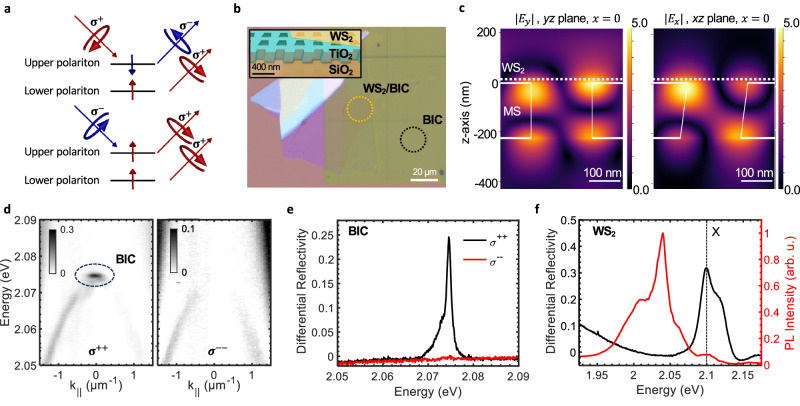 Figure 1
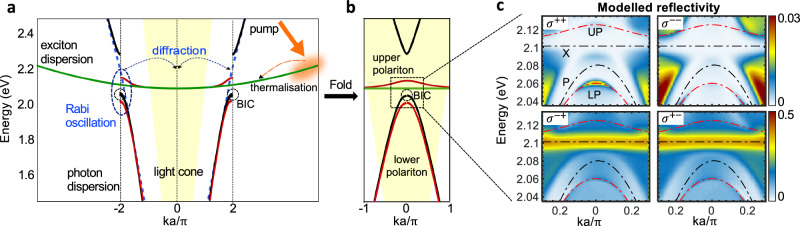 Figure 2
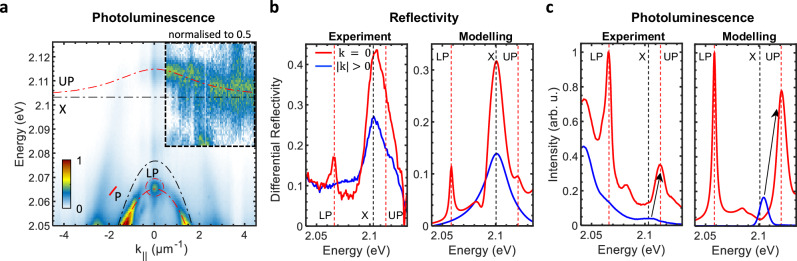 Figure 3
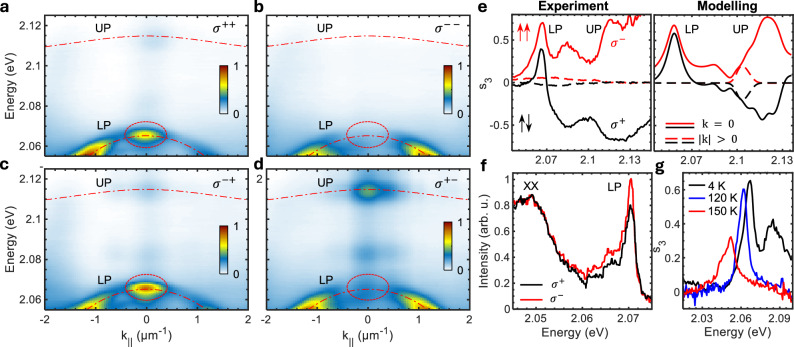 Figure 4
Peer Reviews
No public reviews on file for this paper yet. If you reviewed it on a platform where reviews are public (OpenReview, ICLR, NeurIPS, ICML), you can paste yours below so the community can read it here.
Videos
No videos yet. Explain this paper in a talk, walkthrough, or lecture? Add one.
Taxonomy
TopicsStrong Light-Matter Interactions · Plasmonic and Surface Plasmon Research · Metamaterials and Metasurfaces Applications