Real-world effectiveness of avelumab, pembrolizumab, and enfortumab vedotin in patients with advanced urothelial carcinoma with squamous differentiation (ARON-2EV)
Veronica Mollica, Francesco Massari, Kazutoshi Fujita, Patrizia Giannatempo, Enrique Grande, Thomas Büttner, Maria T. Bourlon, Tarek Taha, Wataru Fukuokaya, Zin W. Myint, Renate Pichler, Kirstin Binz, Javier Molina‑Cerrillo, Jindrich Kopecky, Alfonso Gómez de Liaño

TL;DR
This study compares the real-world effectiveness of three cancer treatments in patients with advanced urothelial carcinoma with squamous differentiation, finding that outcomes are generally worse than in patients with pure urothelial carcinoma.
Contribution
The study provides real-world evidence on the effectiveness of avelumab, pembrolizumab, and enfortumab vedotin in a rare urothelial carcinoma subtype with squamous differentiation.
Findings
Patients with urothelial carcinoma with squamous differentiation had shorter overall survival compared to those with pure urothelial carcinoma across all three treatment cohorts.
Time on treatment was also shorter for patients with squamous differentiation in two of the three treatment groups.
Response to therapy was negatively correlated with squamous differentiation in two treatment groups but not in avelumab-treated patients.
Abstract
Avelumab, pembrolizumab, and enfortumab vedotin (EV) demonstrated efficacy in mUC following platinum-based chemotherapy. However, real-world data in patients with urothelial carcinoma with squamous differentiation (UCSD) are limited. The aim of this study is to assess the real-world clinical outcomes of avelumab, pembrolizumab, or EV in mUCSD patients. The ARON-2EV study is a retrospective, international, multicenter analysis in patients with mUC treated with avelumab, pembrolizumab, or EV across 79 centers in 21 countries. Patients were divided into three cohorts: 1 (avelumab), 2 (pembrolizumab), and 3 (EV). Primary endpoints were overall survival (OS) and time on treatment (ToT). Secondary objectives included evaluating clinical factors associated with outcomes and exploring the impact of UCSD histology on response to therapy. Statistical methods included Kaplan–Meier estimates,…
Genes, proteins, chemicals, diseases, species, mutations and cell lines named across the full text — each resolved to its canonical identifier and authoritative record.
Click any figure to enlarge with its caption.
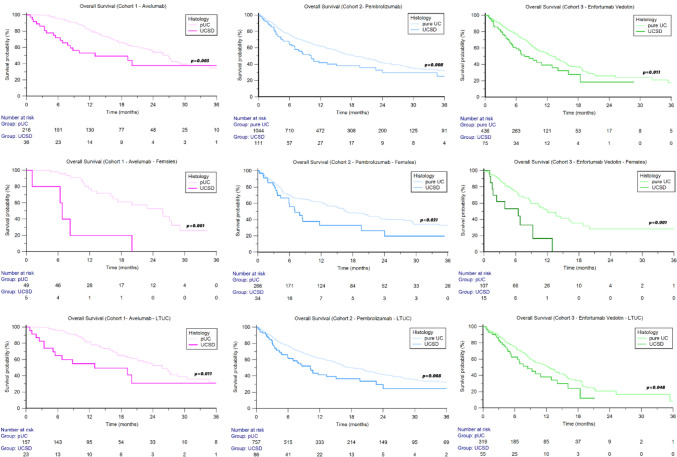 Figure 1
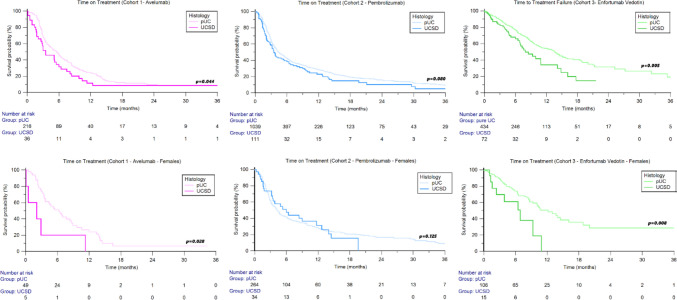 Figure 2
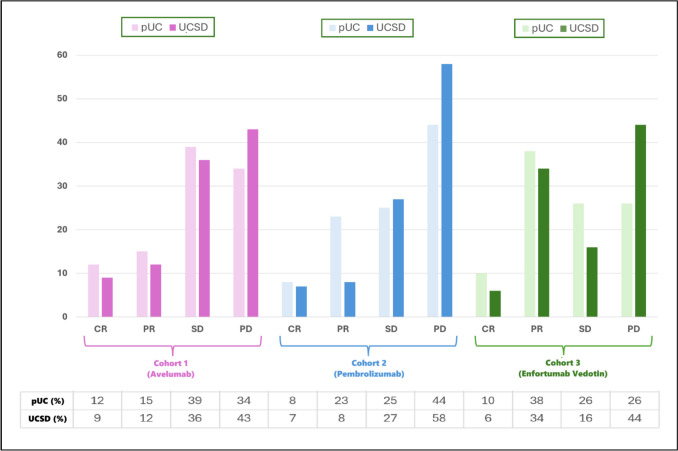 Figure 3
Peer Reviews
No public reviews on file for this paper yet. If you reviewed it on a platform where reviews are public (OpenReview, ICLR, NeurIPS, ICML), you can paste yours below so the community can read it here.
Videos
No videos yet. Explain this paper in a talk, walkthrough, or lecture? Add one.
Taxonomy
TopicsBladder and Urothelial Cancer Treatments · Esophageal Cancer Research and Treatment · Cancer Immunotherapy and Biomarkers