Differential neural responses to rhythmic and patterned TMS protocols: Insights from EEG spectral analysis
Thomas E. Valles, Mohamad Shamas, Hope Hawkins, Cole Matthews, Doan Ngo, Hrag Peltekian, Hewa Artin, Margaret G. Distler, Dustin Z. DeYoung, Evan H. Einstein, Nathaniel D. Ginder, Ralph J. Koek, David E. Krantz, Michael K. Leuchter, Hanadi A. Oughli, Aaron R. Slan

TL;DR
This study compares how rhythmic and patterned TMS protocols affect brain activity in people with depression, revealing distinct neural responses.
Contribution
The paper introduces a novel TMS–EEG interrogation paradigm to compare the neural effects of rhythmic and patterned stimulation protocols in MDD patients.
Findings
Patterned stimulation increased beta band power and activated distinct cingulate subregions.
Rhythmic stimulation increased alpha and beta power and connectivity near the stimulation site.
Both protocols enhanced connectivity to the orbitofrontal cortex in theta and beta bands.
Abstract
Repetitive Transcranial Magnetic Stimulation (rTMS) engages brain networks for the treatment of Major Depressive Disorder (MDD), using either rhythmic (e.g., 10 Hz) or patterned (e.g., intermittent Theta Burst, or iTBS) stimulation protocols. The distinct effects of these protocols on brain function are not well understood. Sixteen subjects with MDD underwent a TMS–electroencephalography (TMS–EEG) “interrogation” paradigm, in which a broad range of rhythmic and patterned stimulation frequencies were administered in a randomized order to the left dorsolateral prefrontal cortex (L-DLPFC). rTMS-induced changes in oscillatory activity and effective connectivity to the DLPFC were examined at each frequency. Linear mixed-effects models revealed widespread changes in power and connectivity, with magnitude and regional distribution of change dependent upon both protocol and frequency of…
Genes, proteins, chemicals, diseases, species, mutations and cell lines named across the full text — each resolved to its canonical identifier and authoritative record.
Click any figure to enlarge with its caption.
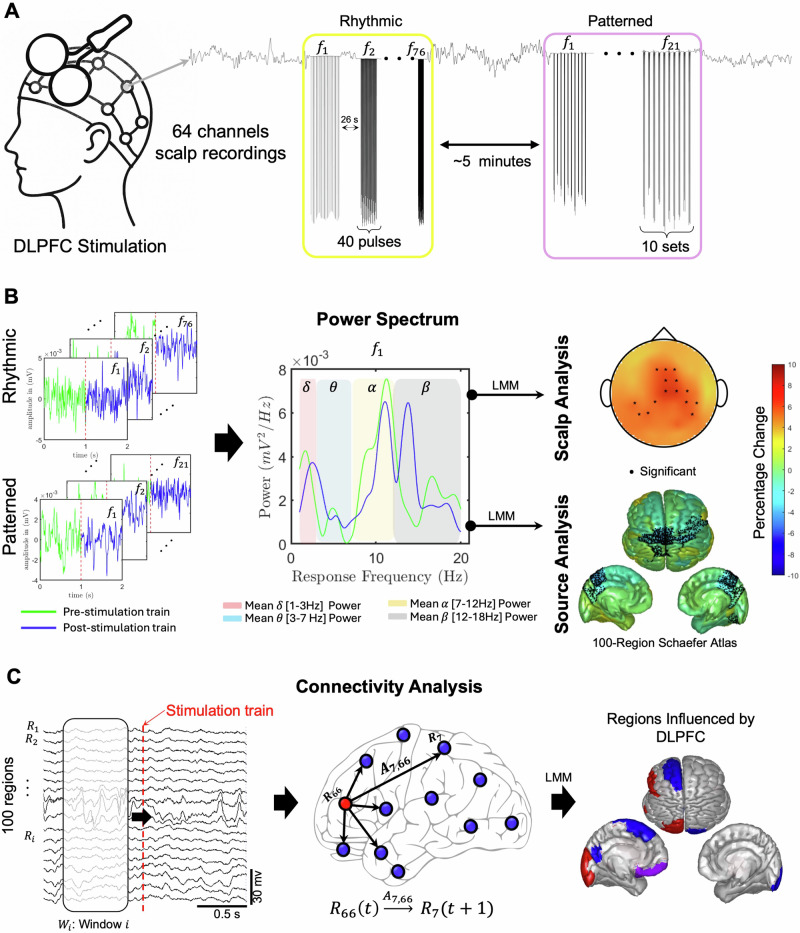 Figure 1
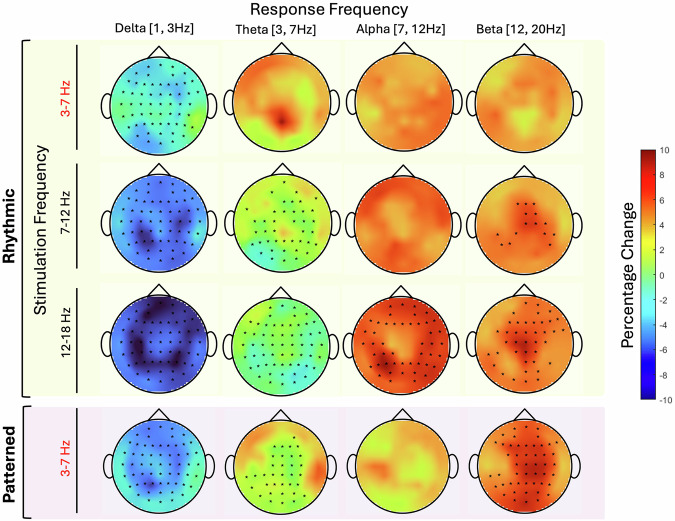 Figure 2
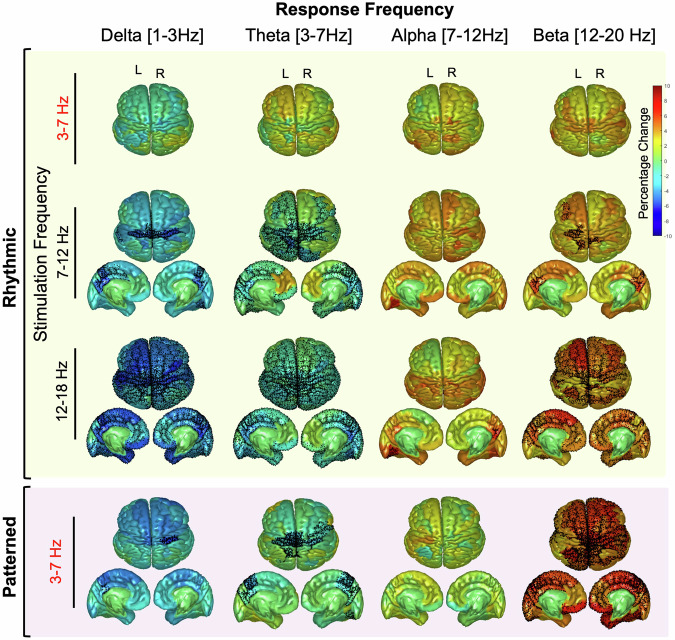 Figure 3
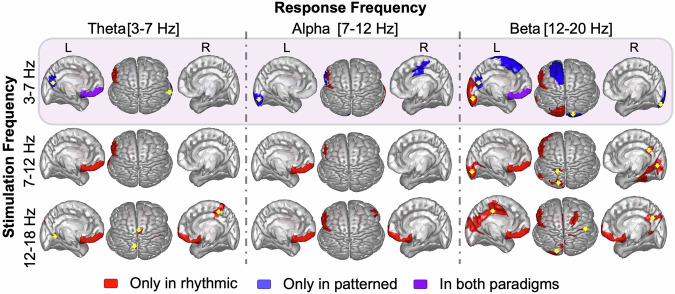 Figure 4
Peer Reviews
No public reviews on file for this paper yet. If you reviewed it on a platform where reviews are public (OpenReview, ICLR, NeurIPS, ICML), you can paste yours below so the community can read it here.
Videos
No videos yet. Explain this paper in a talk, walkthrough, or lecture? Add one.
Taxonomy
TopicsTranscranial Magnetic Stimulation Studies · Functional Brain Connectivity Studies · Digital Mental Health Interventions