Association of anti SITH 1 antibody titer with mental stress and intracranial aneurysms
Michiyasu Fuga, Hirokazu Koseki, Nobuyuki Kobayashi, Toshihiro Ishibashi, Azusa Ishii, Naomi Oka, Tohru Sano, Naoki Kato, Ken Aoki, Shota Sonoda, Kyoko Ito, Toshihide Tanaka, Yuzuru Hasegawa, Shogo Kaku, Minoru Kogiku, Kazuhiro Kondo, Yuichi Murayama

TL;DR
The study found that higher anti-SITH-1 antibody levels are linked to unruptured aneurysms but not their rupture, suggesting chronic stress may not directly cause aneurysm rupture.
Contribution
This study is the first to investigate the association between anti-SITH-1 antibody titers and intracranial aneurysm rupture in a prospective multi-center cohort.
Findings
Anti-SITH-1 antibody titers were highest in patients with unruptured intracranial aneurysms.
Chronic mental stress, as indicated by antibody levels, does not appear to directly cause aneurysm rupture.
Antibody titers correlated with time since aneurysm diagnosis in unruptured cases.
Abstract
The role of mental stress in intracranial aneurysm rupture remains unclear. Serum anti–SITH-1 antibody titers have been proposed as a potential biomarker of chronic mental stress. This study investigated the association between serum anti–SITH-1 antibody titers and intracranial aneurysm rupture. Between June 2021 and September 2023, patients with ruptured intracranial aneurysms (RIAs), patients with unruptured intracranial aneurysms (UIAs), and healthy controls were prospectively enrolled from five institutions. Baseline characteristics, aneurysm morphology, and lifestyle factors were recorded. Serum anti–SITH-1 antibody titers were quantified using a fluorescent antibody technique. Blood samples were obtained once in each participant: within 1 month after enrollment in the UIA and Control groups, and within 24 h of subarachnoid hemorrhage onset in the RIA group. The primary outcome was…
Genes, proteins, chemicals, diseases, species, mutations and cell lines named across the full text — each resolved to its canonical identifier and authoritative record.
Click any figure to enlarge with its caption.
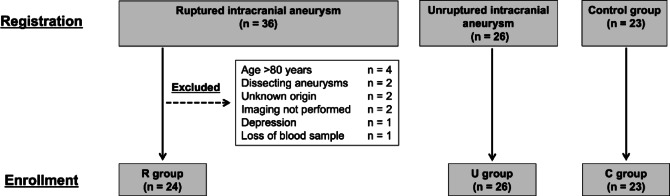 Figure 1
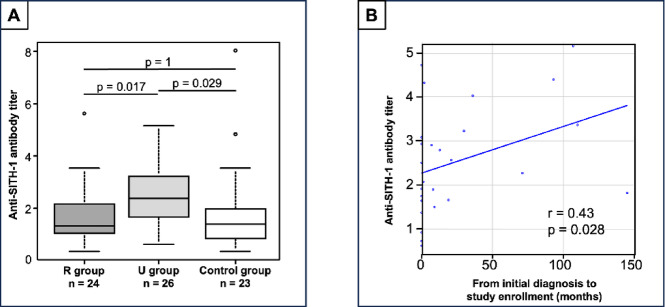 Figure 2
Peer Reviews
No public reviews on file for this paper yet. If you reviewed it on a platform where reviews are public (OpenReview, ICLR, NeurIPS, ICML), you can paste yours below so the community can read it here.
Videos
No videos yet. Explain this paper in a talk, walkthrough, or lecture? Add one.
Taxonomy
TopicsIntracranial Aneurysms: Treatment and Complications · IgG4-Related and Inflammatory Diseases · Autoimmune Neurological Disorders and Treatments