Determinants of AI Adoption in Healthcare: Insights From a Unified Theory of Acceptance and Use of Technology (UTAUT) Study Among Doctors and Nurses in a Tertiary Care Hospital in North India
Sushila Kataria, Rhea Aggarwal, Anuja Ashok Ardhapure, Vinod Krishnankutty, Pooja Sharma, Adarsh Keshari, Pranshul Kataria

TL;DR
This study explores how doctors and nurses in a North Indian hospital perceive and intend to use AI tools, finding that prior experience and training strongly influence adoption.
Contribution
The study applies the UTAUT framework to identify profession-specific factors influencing AI adoption readiness among healthcare professionals in a developing region.
Findings
Only 21.6% of doctors and 19.3% of nurses had prior AI experience, primarily using clinical decision support tools.
Nurses showed higher baseline acceptance of AI, while doctors with AI experience were more likely to trust AI for high-risk tasks.
Formal training and institutional support were key enablers, with only 3.5% qualifying as strict AI early adopters.
Abstract
Background Artificial Intelligence tools are increasingly entering clinical practice, yet their adoption depends on how healthcare professionals perceive, experience, and intend to use them. Understanding factors associated with adoption is critical for designing targeted AI education. Objectives To assess acceptance of AI-based tools among doctors and nurses in a tertiary hospital in North India using a tool based on the Unified Theory of Acceptance and Use of Technology (UTAUT), and to identify early and late adopters based on prior AI exposure, training, and behavioral intention. Methods A cross-sectional mixed-methods study was conducted among 256 healthcare professionals (116 doctors, 140 nurses) at a multispecialty tertiary-care hospital. Prior to the administration of the questionnaire, an informative video introducing key concepts and applications of artificial intelligence…
Genes, proteins, chemicals, diseases, species, mutations and cell lines named across the full text — each resolved to its canonical identifier and authoritative record.
Click any figure to enlarge with its caption.
 Figure 1
 Figure 2
 Figure 3
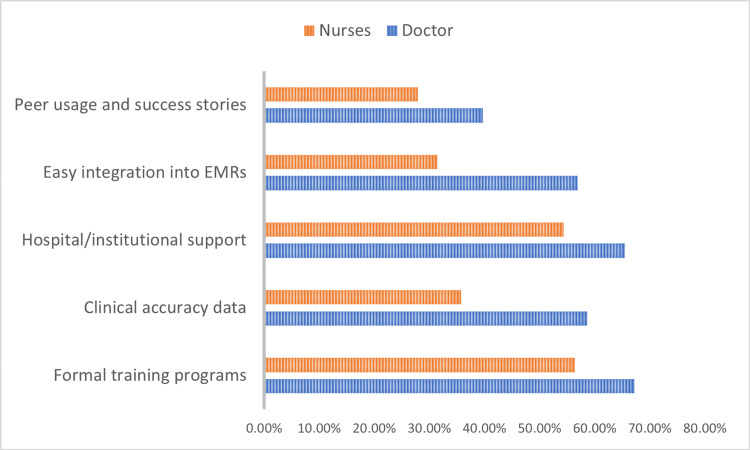 Figure 4
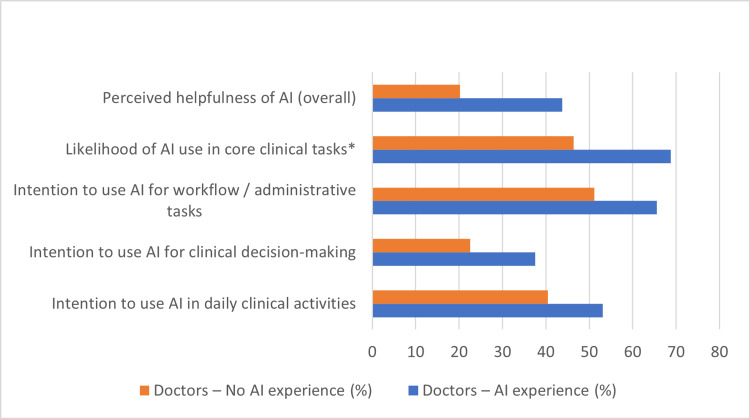 Figure 5
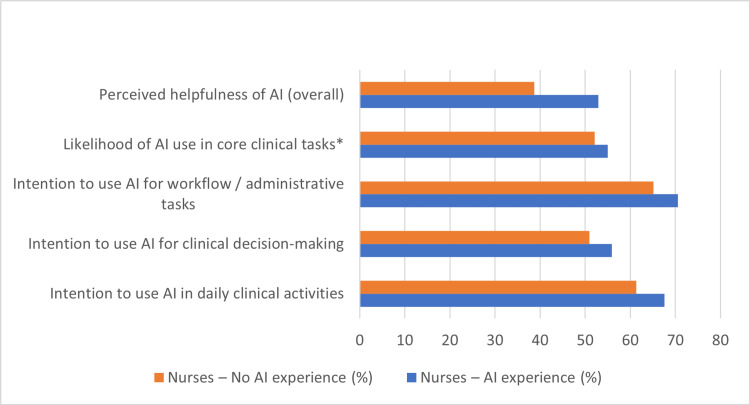 Figure 6
Peer Reviews
No public reviews on file for this paper yet. If you reviewed it on a platform where reviews are public (OpenReview, ICLR, NeurIPS, ICML), you can paste yours below so the community can read it here.
Videos
No videos yet. Explain this paper in a talk, walkthrough, or lecture? Add one.
Taxonomy
TopicsArtificial Intelligence in Healthcare and Education · Digital Mental Health Interventions · Mobile Health and mHealth Applications