Reframing “flat affect” and withdrawal in severe mental illness: a within-subject, culture- and medication-sensitive heuristic for social psychiatry
Eik Niederlohmann

TL;DR
This paper suggests rethinking 'flat affect' in mental illness as a flexible state influenced by context, culture, and medication, rather than a fixed trait.
Contribution
The paper introduces a within-subject, culture- and medication-sensitive heuristic for understanding and managing social interactions in severe mental illness.
Findings
Labels like 'flat affect' can lead to stigma and limit clinical understanding.
A three-zone pacing heuristic helps manage autonomic load and interpersonal demands.
The COPEDS screen and co-regulation tools support better clinical documentation and continuity of care.
Abstract
Low facial expressivity and withdrawal in severe mental illness are often read as trait-like “flat affect” or enduring “negative symptoms”. In social-psychiatric and rehabilitation services, such labels can be pragmatically useful but clinically risky: they may narrow staff expectations, amplify stigma and self-stigma, and inadvertently shift the person’s narrative from participation and agency to deficit identity. This article proposes a service-level reframing: treat apparent flatness as a potentially state-dependent capacity signal that varies within-person across autonomic load, interpersonal context (including threat attribution to others), culture, and medication. Instead of anchoring interpretation in between-person norms, teams are encouraged to establish within-subject baselines (across contexts and time) and to document function-first impacts using International Classification…
Genes, proteins, chemicals, diseases, species, mutations and cell lines named across the full text — each resolved to its canonical identifier and authoritative record.
Click any figure to enlarge with its caption.
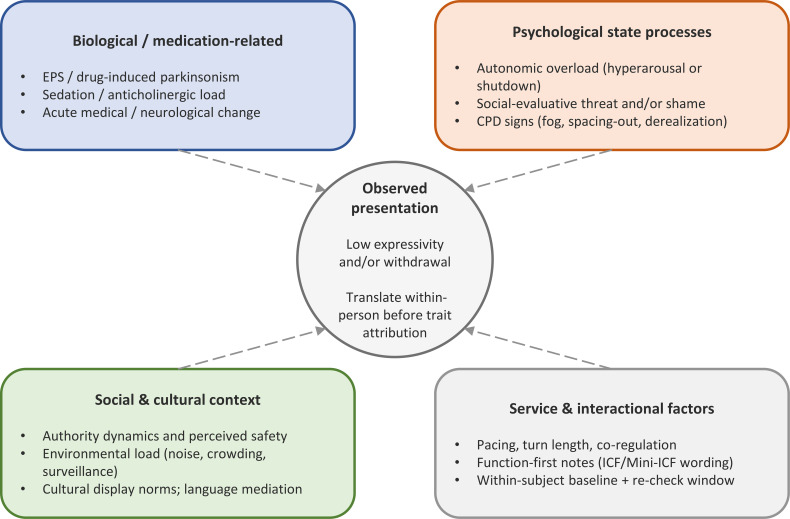 Figure 1
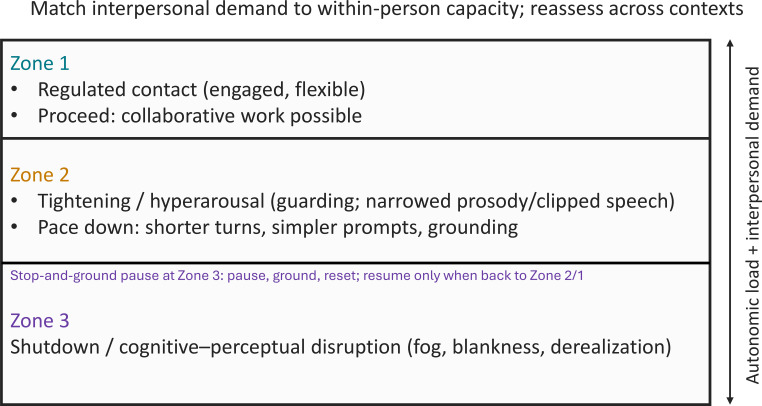 Figure 2
Peer Reviews
No public reviews on file for this paper yet. If you reviewed it on a platform where reviews are public (OpenReview, ICLR, NeurIPS, ICML), you can paste yours below so the community can read it here.
Videos
No videos yet. Explain this paper in a talk, walkthrough, or lecture? Add one.
Taxonomy
TopicsSchizophrenia research and treatment · Healthcare Decision-Making and Restraints · Mental Health Treatment and Access