Re-evaluation of different electrophysiological criteria for Guillain-Barré syndrome in a single cohort from China
Qiongqiong Zhai, Cheng Guo, Zihan Gao, Fang Xue

TL;DR
This study compares different criteria for classifying Guillain-Barré syndrome in a Chinese cohort, finding that classification accuracy improves with later nerve tests and that AMAN is the most common subtype.
Contribution
The study evaluates the impact of electrophysiological criteria and testing timing on GBS subtype classification in a single Chinese cohort.
Findings
AMAN was the most common GBS subtype regardless of the criteria used.
Subtype classification was more consistent when nerve tests were done ≥3 weeks post-onset.
Sural sparing and serial nerve conduction studies improved classification accuracy.
Abstract
We aimed to compare electrophysiological subtypes of Guillain-Barré syndrome (GBS) in a single cohort from northern China using three criteria (Ho’s, Hadden’s, Rajabally’s), to clarify whether GBS subtypes are affected by electrophysiological criteria and nerve conduction studies (NCS) examination timing, to explore the value of sural sparing in subtype classification, and analyze the association between conduction block (CB) and short-term prognosis of Acute Motor Axonal Neuropathy (AMAN). We retrospectively collected GBS patients hospitalized in the Department of Neurology, the Second Hospital of Hebei Medical University (Jan 2017–Jan 2022), who met Brighton diagnostic criteria and had complete NCS data. Patients were classified via three electrophysiological criteria (Ho’s, Hadden’s, Rajabally’s); we analyzed subtype distribution by NCS timing (1, 2, or ≥3 weeks post-onset) and used…
Genes, proteins, chemicals, diseases, species, mutations and cell lines named across the full text — each resolved to its canonical identifier and authoritative record.
Click any figure to enlarge with its caption.
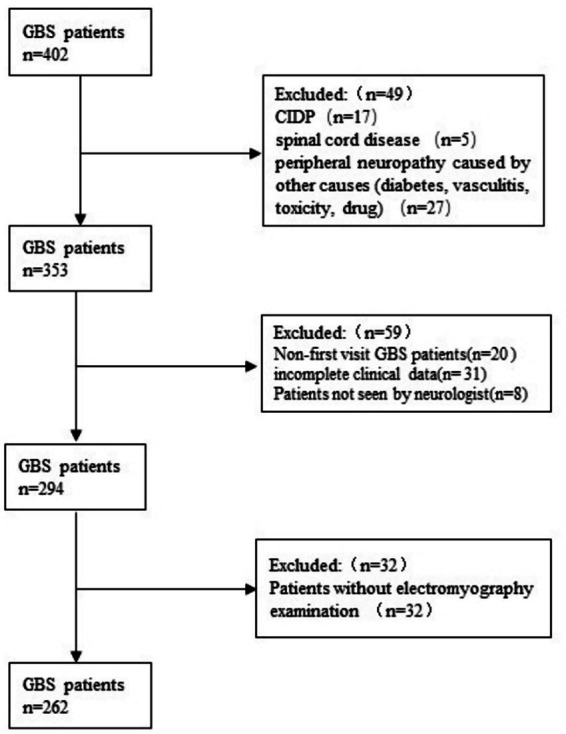 Figure 1
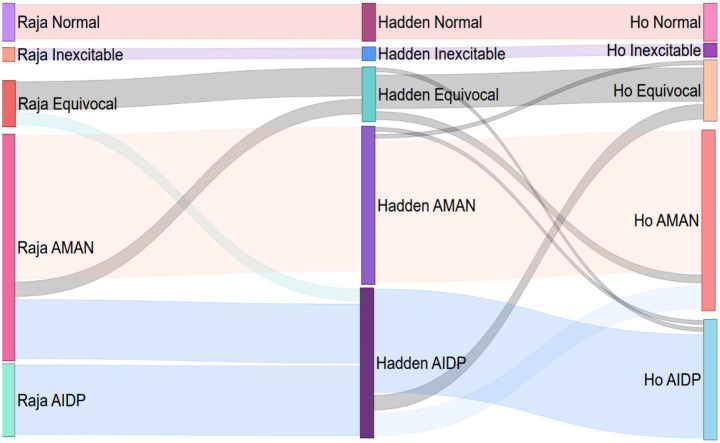 Figure 2
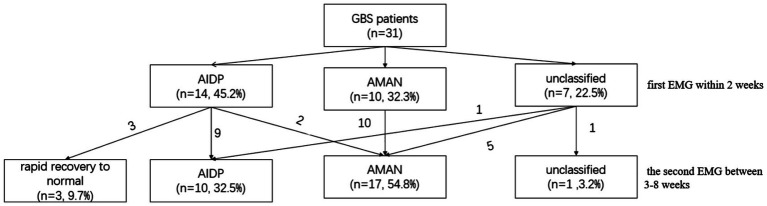 Figure 3
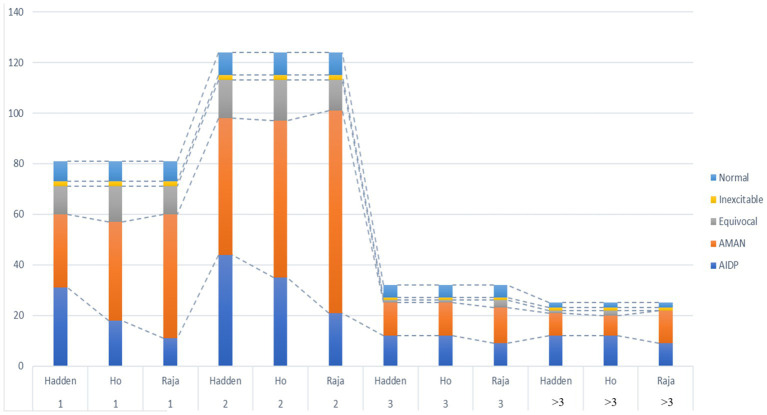 Figure 4
Peer Reviews
No public reviews on file for this paper yet. If you reviewed it on a platform where reviews are public (OpenReview, ICLR, NeurIPS, ICML), you can paste yours below so the community can read it here.
Videos
No videos yet. Explain this paper in a talk, walkthrough, or lecture? Add one.
Taxonomy
TopicsPeripheral Neuropathies and Disorders · Peripheral Nerve Disorders · Facial Nerve Paralysis Treatment and Research