Parametrizing reaction probabilities for proton transfers in protic ionic liquids
Márta Gődény, Adriel Palmisano, Christian Schröder

TL;DR
This paper studies proton transfer in protic ionic liquids using quantum mechanics to model reaction probabilities for use in simulations.
Contribution
The study introduces a classical kinetic model for proton transfer probabilities in protic ionic liquids based on Morse and hyperbolic tangent functions.
Findings
Proton transfer reactions in 1-methylimidazolium carboxylates have small or negligible energy barriers.
Reaction probabilities are primarily governed by thermally activated hopping rather than quantum tunneling.
Morse potentials and hyperbolic tangent functions accurately model the energy profiles and distance-dependent probabilities.
Abstract
Protic ionic liquids are promising electrolytes for electrochemical applications owing to their intrinsic proton conductivity, but quantitative understanding of the underlying proton transfer processes remains limited. Here, we present a systematic quantum-mechanical investigation of proton transfer in a series of 1-methylimidazolium carboxylates, with the specific goal of parametrizing reaction probabilities for use in reactive molecular dynamics simulations. Density functional theory scans were performed to map relaxed potential energy surfaces along two collective variables, the donor–acceptor distance and the proton transfer coordinate. The resulting energy profiles were accurately represented by Morse potentials. From the donor–acceptor distance scans, the distance-dependent reaction probabilities were fitted using a hyperbolic tangent function. Analysis of the proton transfer…
Genes, proteins, chemicals, diseases, species, mutations and cell lines named across the full text — each resolved to its canonical identifier and authoritative record.
Click any figure to enlarge with its caption.
 Figure 1
 Figure 2
 Figure 3
 Figure 4
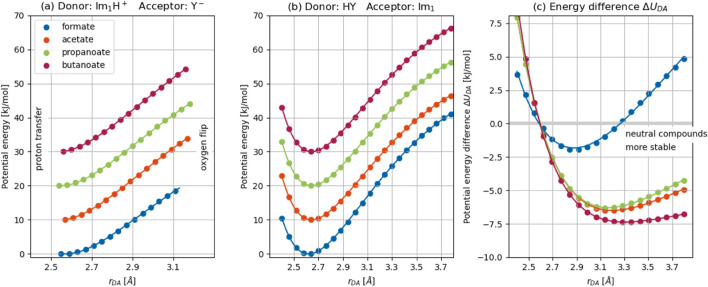 Figure 5
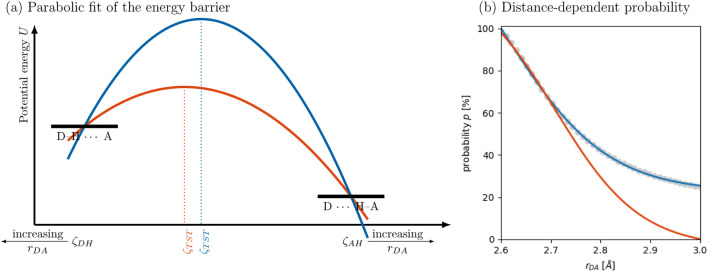 Figure 6
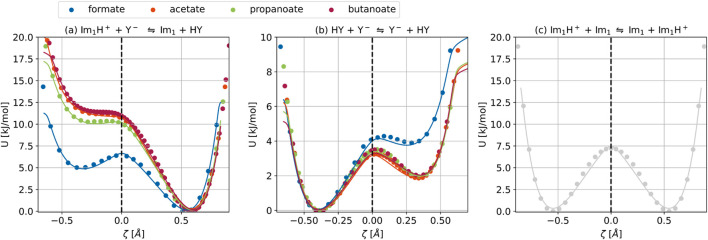 Figure 7
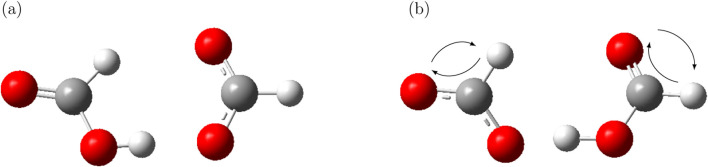 Figure 8
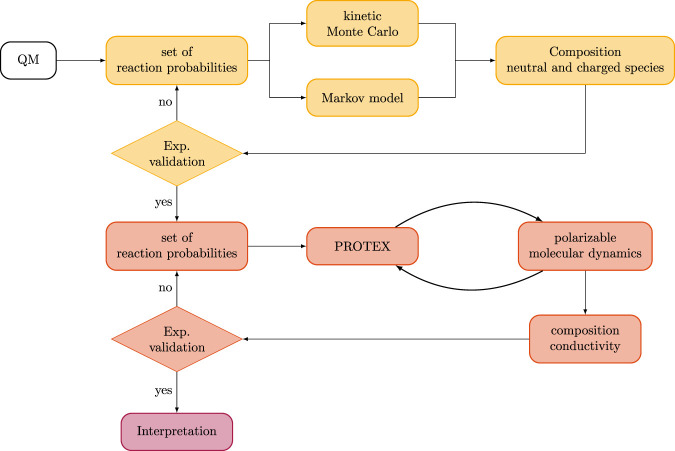 Figure 9
Peer Reviews
No public reviews on file for this paper yet. If you reviewed it on a platform where reviews are public (OpenReview, ICLR, NeurIPS, ICML), you can paste yours below so the community can read it here.
Videos
No videos yet. Explain this paper in a talk, walkthrough, or lecture? Add one.
Taxonomy
TopicsIonic liquids properties and applications · Photochemistry and Electron Transfer Studies · N-Heterocyclic Carbenes in Organic and Inorganic Chemistry