FAME3R: an efficient, practical and reliable open-source tool for predicting phase 1 and phase 2 sites of metabolism
Roxane Axel Jacob, Leo Gaskin, Thomas Seidel, Ya Chen, Angelica Mazzolari, Johannes Kirchmair

TL;DR
FAME3R is an improved open-source tool for predicting where metabolism occurs in molecules, making it more efficient and easier to use in drug and chemical development.
Contribution
FAME3R introduces a reliability assessment method based on Shannon entropy and supports multiple featurization strategies for metabolism site prediction.
Findings
FAME3R improves upon FAME3 by enhancing maintainability, scalability, and interoperability.
The tool offers a novel reliability assessment method and multiple featurization options.
FAME3R is available as an open-source Python package with flexible interfaces.
Abstract
Predicting likely sites of metabolism (SOMs), i.e., the atoms in a molecule where metabolic reactions are initiated, is an important component of the computational development pipeline for pharmaceuticals, agrochemicals, and cosmetics. Among SOM prediction tools, FAME3, introduced in 2019, is one of only a few non-commercial models capable of predicting both Phase 1 and Phase 2 SOMs for a wide range of xenobiotics. However, its original implementation posed challenges in maintainability, scalability, and interoperability, which hindered broader adoption. To overcome these limitations, we developed FAME3R, an enhanced version of FAME3 designed to improve computational efficiency and facilitate integration with contemporary cheminformatics workflows. FAME3R introduces several new features, including a novel reliability assessment method based on Shannon entropy and the option to select…
Genes, proteins, chemicals, diseases, species, mutations and cell lines named across the full text — each resolved to its canonical identifier and authoritative record.
Click any figure to enlarge with its caption.
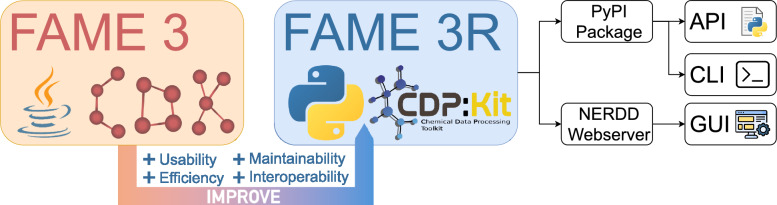 Figure 1
Peer Reviews
No public reviews on file for this paper yet. If you reviewed it on a platform where reviews are public (OpenReview, ICLR, NeurIPS, ICML), you can paste yours below so the community can read it here.
Videos
No videos yet. Explain this paper in a talk, walkthrough, or lecture? Add one.
Taxonomy
TopicsComputational Drug Discovery Methods · Microbial Metabolic Engineering and Bioproduction · Machine Learning in Materials Science