Impact of cellular proteases on the function of antiviral antibodies
Mateo Krzypow, Olivier Schwartz, Timothée Bruel, Andréa Cottignies-Calamarte

TL;DR
This paper reviews how viruses use host proteases to evade the body's antiviral antibodies, reducing their effectiveness.
Contribution
The paper synthesizes current evidence on the role of host proteases in viral antibody evasion mechanisms.
Findings
Host proteases can degrade or shed viral antigens, creating soluble decoys.
Proteolysis can hinder Fc-effector functions by cleaving Fc receptors and complement proteins.
Viruses exploit host proteases to reduce antibody-mediated clearance and neutralization.
Abstract
Viruses evade antibodies through many mechanisms. While mutation remains the predominant pathway, host proteases can be hijacked upon viral infections and decrease antibody-mediated clearance. Proteolysis can degrade or shed viral antigens to create soluble decoys, induce conformational changes that reduce neutralization, and cleave Fc receptors and complement proteins, hindering Fc-effector antibody functions. This review synthesizes evidence on the interplay between viruses and host proteases to evade antiviral activities of antibodies.
Genes, proteins, chemicals, diseases, species, mutations and cell lines named across the full text — each resolved to its canonical identifier and authoritative record.
Click any figure to enlarge with its caption.
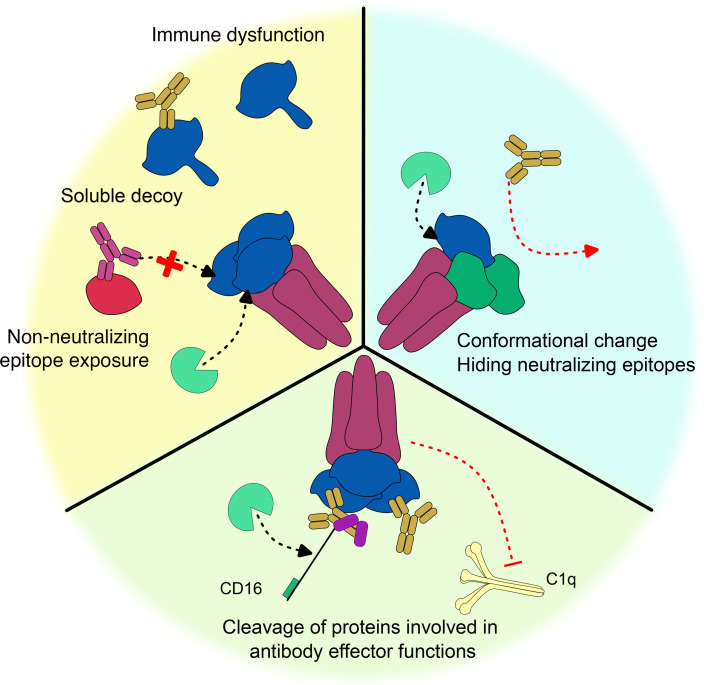 Figure 1
Peer Reviews
No public reviews on file for this paper yet. If you reviewed it on a platform where reviews are public (OpenReview, ICLR, NeurIPS, ICML), you can paste yours below so the community can read it here.
Videos
No videos yet. Explain this paper in a talk, walkthrough, or lecture? Add one.
Taxonomy
TopicsMonoclonal and Polyclonal Antibodies Research · Virus-based gene therapy research · Protease and Inhibitor Mechanisms