Long-term effectiveness and safety of lanadelumab in Canadian patients with hereditary angioedema: a subanalysis of the EMPOWER study
Stephen D. Betschel, Hugo Chapdelaine, Remi Gagnon, M. Dawn Goodyear, Paul K. Keith, Ahmed El-Zoeiby, Natalie Khutoryansky, Daniel N. Castaner

TL;DR
This study shows that lanadelumab is effective and safe for Canadian patients with hereditary angioedema, both new and existing users.
Contribution
The study provides real-world evidence of lanadelumab's long-term effectiveness and safety in Canadian patients with hereditary angioedema.
Findings
Lanadelumab reduced HAE attack rates in newly treated patients from 1.5 to 0.3 attacks per month.
Patients established on lanadelumab maintained a low attack rate of 0.1 attacks per month.
No serious adverse events were reported, and all were unrelated to the treatment.
Abstract
The EMPOWER Study (NCT03845400) was a phase 4, observational, non-interventional, multicenter study evaluating the real-world effectiveness and safety of lanadelumab in patients with hereditary angioedema (HAE). This subanalysis focused on lanadelumab effectiveness and safety in patients from Canada. Enrollment included patients with HAE due to C1 inhibitor deficiency. Patients were categorized as “newly treated” or “established on lanadelumab” if they had received fewer than four or at least four doses before enrollment, respectively. Thirteen patients from Canada were enrolled: seven newly treated and six established on lanadelumab; these patients received lanadelumab for a mean (standard deviation [SD]) duration of 315 (224) and 536 (366) days, respectively, during the study. In newly treated patients, the mean (SD) observed HAE attack rate decreased after lanadelumab initiation…
Genes, proteins, chemicals, diseases, species, mutations and cell lines named across the full text — each resolved to its canonical identifier and authoritative record.
Click any figure to enlarge with its caption.
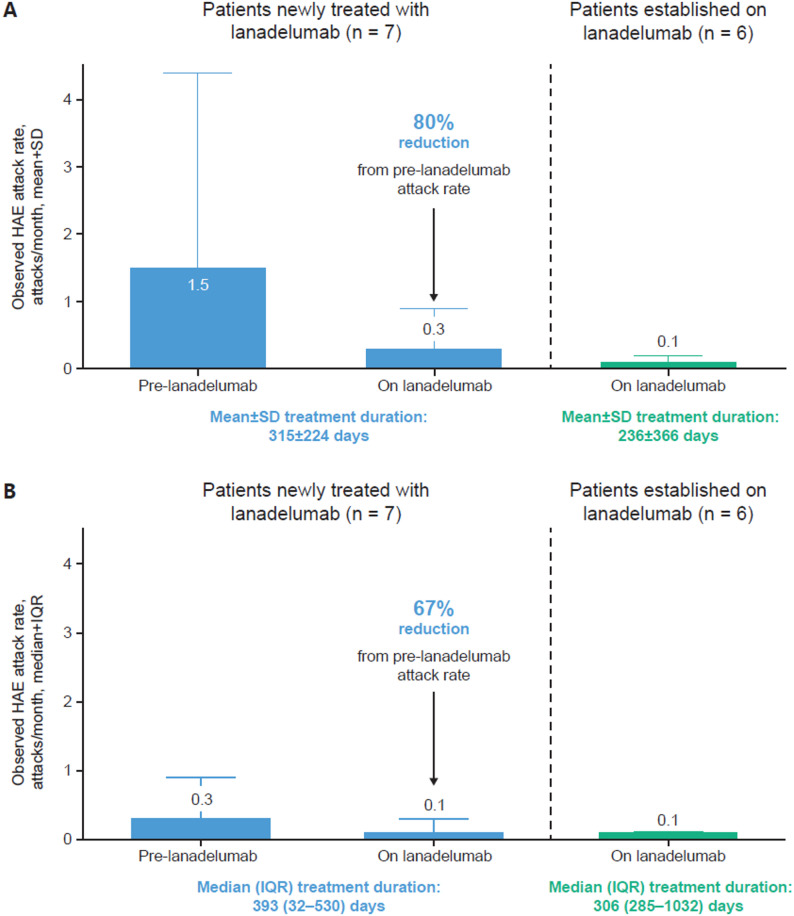 Figure 1
Peer Reviews
No public reviews on file for this paper yet. If you reviewed it on a platform where reviews are public (OpenReview, ICLR, NeurIPS, ICML), you can paste yours below so the community can read it here.
Videos
No videos yet. Explain this paper in a talk, walkthrough, or lecture? Add one.
Taxonomy
TopicsCoagulation, Bradykinin, Polyphosphates, and Angioedema · Hemophilia Treatment and Research · Complement system in diseases