Origins and lifetimes of secular and tidal bars in simulated disc galaxies
Matthew Frosst, Danail Obreschkow, Aaron Ludlow, A Fraser-McKelvie

TL;DR
This study explores how stellar bars in galaxies form through internal processes and external tidal forces using simulations.
Contribution
A new metric, $\mathcal{S}_{\rm bar}$, is introduced to quantify tidal perturbations affecting bar formation in galaxies.
Findings
Most bars form rapidly in dynamically cold discs via secular instabilities.
About 24% of bars form in dark matter-dominated discs due to tidal interactions.
Tidally induced bars are typically transient and form in thicker, more extended discs.
Abstract
We analyse 307 Milky Way-mass disc galaxies in the TNG50 cosmological simulation to study the formation and evolution of stellar bars through secular processes and tidal interactions. About 90 per cent of these galaxies form at least one bar during their cosmic evolution. Most bars form rapidly in dynamically cold discs shortly after the central stellar mass exceeds that of dark matter (inside the stellar half-mass radius). In these cases, bar formation is consistent with secular instabilities driven by the disc’s self-gravity, which organizes stellar orbits into a coherent bar structure. However, about 24 per cent of barred galaxies are dark matter-dominated at the time of bar formation. We trace the origin of these bars to tidal perturbations from passing or accreting satellites and streams, and introduce a new metric, \documentclass[12pt]{minimal} \usepackage{amsmath}…
Click any figure to enlarge with its caption.
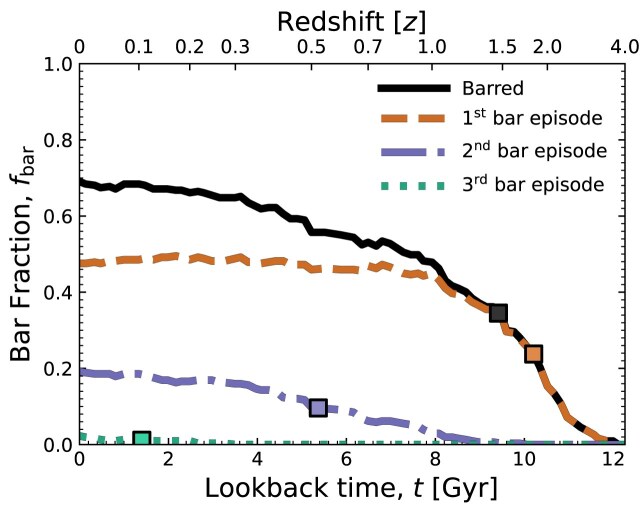 Figure 1
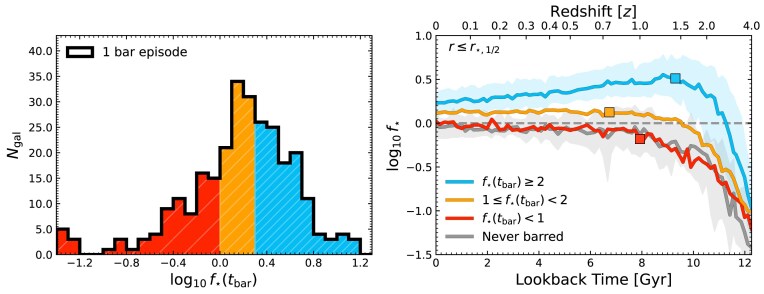 Figure 2
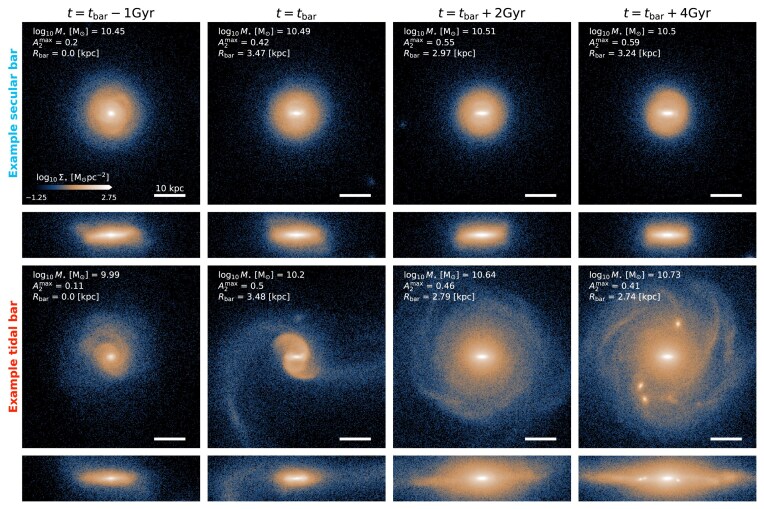 Figure 3
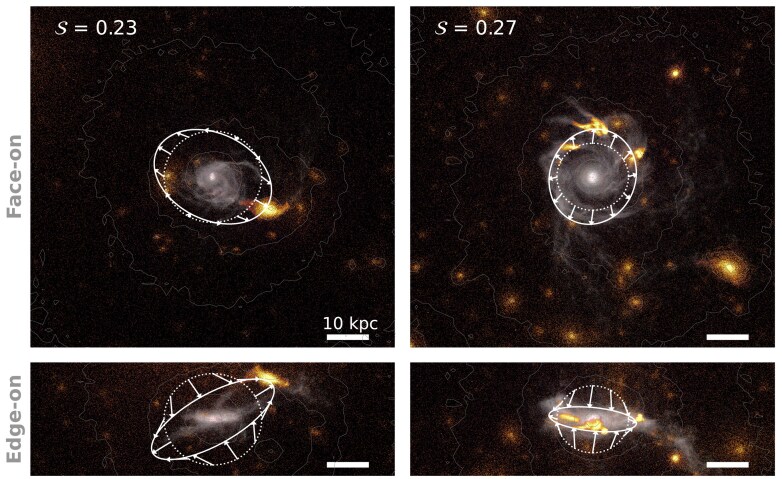 Figure 4
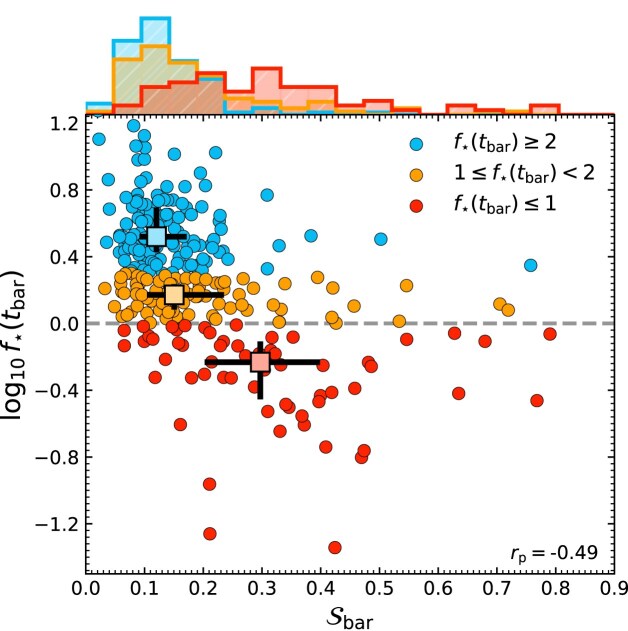 Figure 5
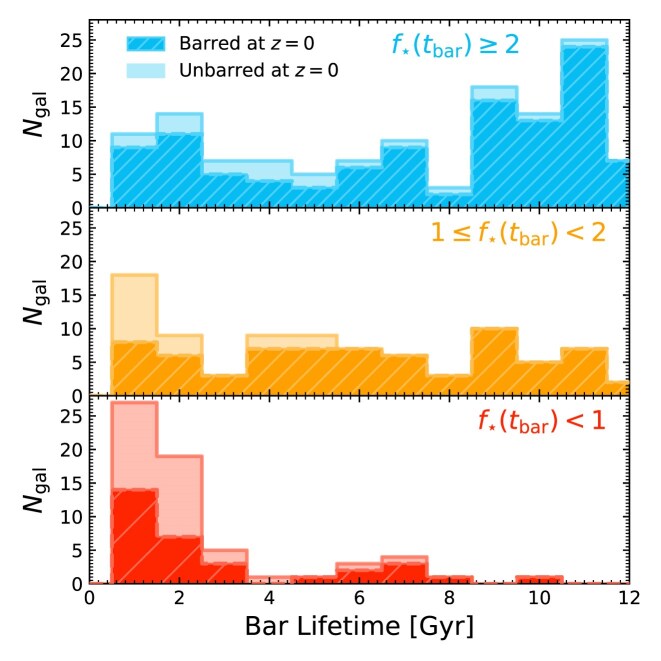 Figure 6
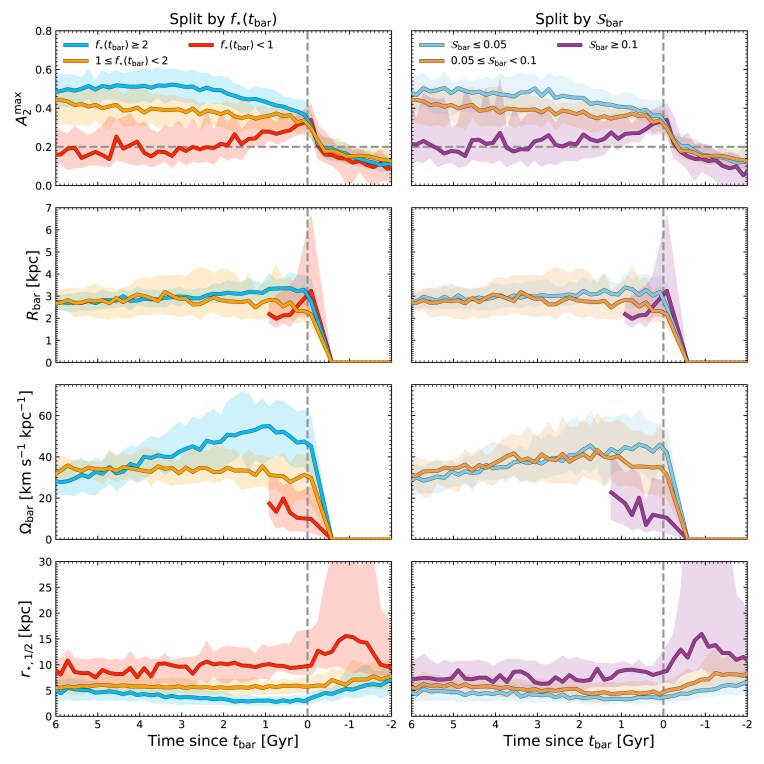 Figure 7
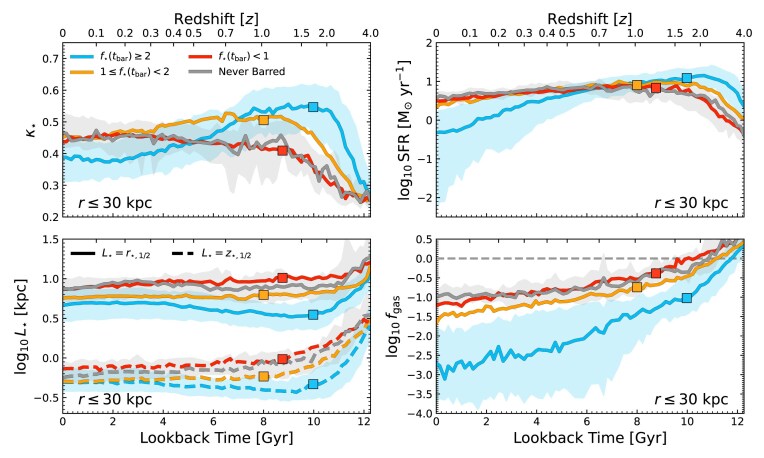 Figure 8
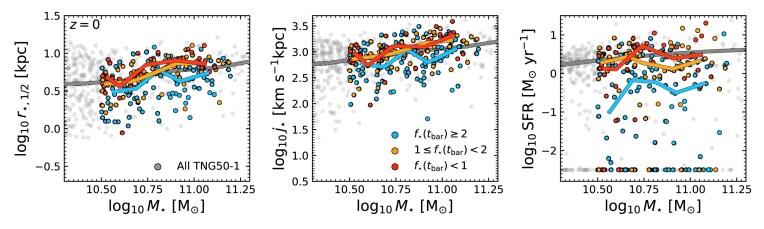 Figure 9
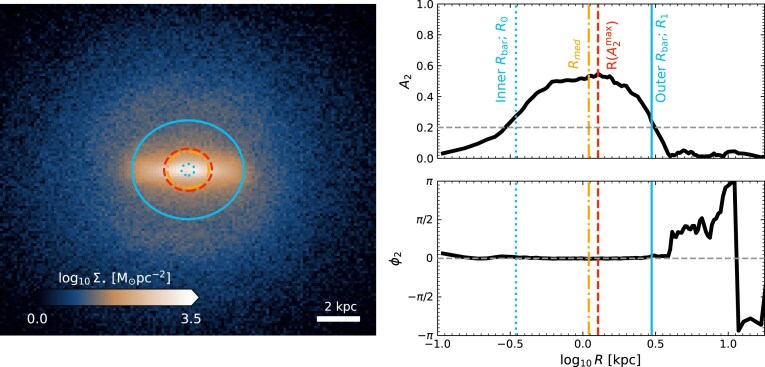 Figure 10
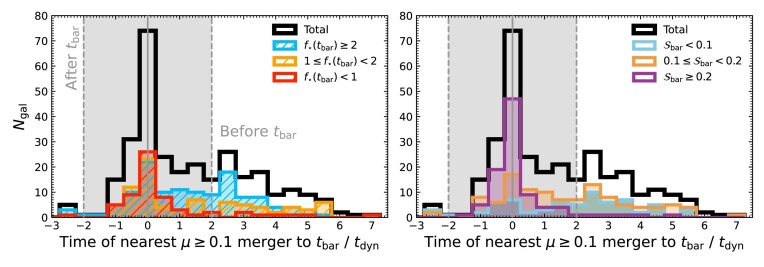 Figure 11
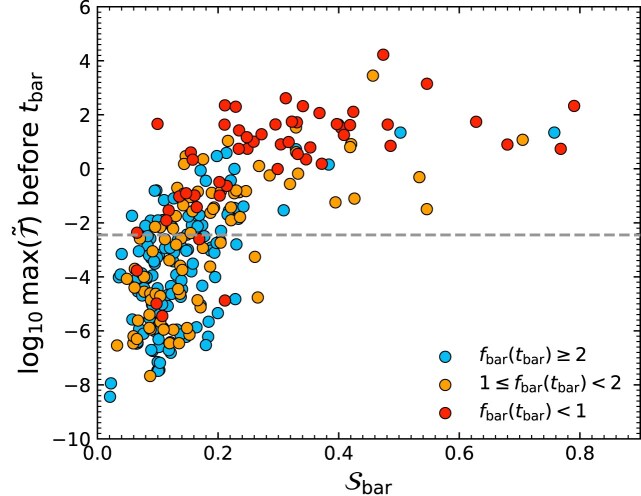 Figure 12
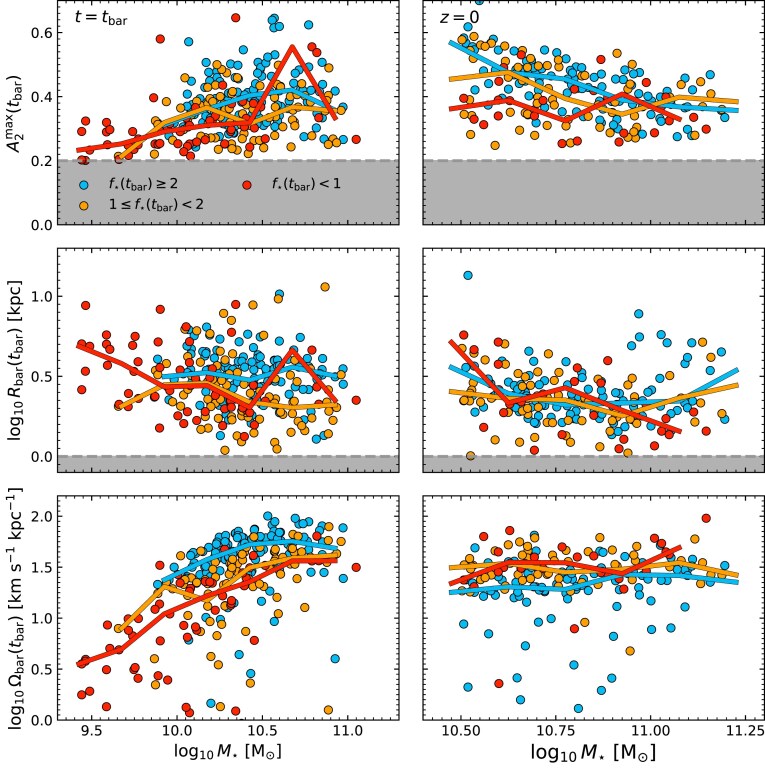 Figure 13
Peer Reviews
No public reviews on file for this paper yet. If you reviewed it on a platform where reviews are public (OpenReview, ICLR, NeurIPS, ICML), you can paste yours below so the community can read it here.
Videos
No videos yet. Explain this paper in a talk, walkthrough, or lecture? Add one.
Taxonomy
TopicsGalaxies: Formation, Evolution, Phenomena · Astronomy and Astrophysical Research · Electrical and Electromagnetic Research