“To me, it was overwhelming”: a mixed methods study of maternal healthcare in a marginalised community in New York City, guided by the person-centered care framework for reproductive health equity
Khadija R. Jones, Nandini Choudhury, Mary Archana Fernandez, George Hagopian, Rachel Schwartz, Adiba Chowdhury, Sushmita Diyali, Keeley McNamara, Hugo Teo, Payal Ram, Andrea Archer, Amanda Misiti, Teresa Janevic, Sheela Maru

TL;DR
This study explores how maternal healthcare is affected by social and community factors in a marginalized New York City community, highlighting disparities and barriers during the pandemic.
Contribution
The study applies the Person-Centered Care Framework to maternal healthcare in an underserved U.S. population, revealing pandemic-related disparities and community-specific barriers.
Findings
Over half of pregnant individuals received inadequate prenatal care, with disparities among younger women, Black women, Arabic-speaking women, and those who smoked.
Barriers to care included telehealth challenges, immigration status, and low health literacy.
Quality of care issues included poor patient-provider communication and inconsistent care delivery.
Abstract
The Person-Centered Care Framework for Reproductive Health Equity (PCC) elucidates drivers of health disparities: community determinants, health-seeking behaviours and quality of care. Limited studies assess person-centered maternal healthcare in underserved populations. Racial and ethnic disparities in maternal health were exacerbated by the COVID-19 pandemic. We applied PCC to evaluate factors influencing maternal healthcare at two public hospitals in NYC before and during the pandemic. We conducted mixed-method, community-engaged research using PCC. A cross-sectional study using EHR data from 5330 pregnant individuals in 2019 assessed factors related to inadequate maternity care utilisation. Qualitative research in 2020 explored perceptions of maternal health equity, barriers, and healthcare quality through 17 in-depth interviews and five focus group discussions with postpartum…
Genes, proteins, chemicals, diseases, species, mutations and cell lines named across the full text — each resolved to its canonical identifier and authoritative record.
Click any figure to enlarge with its caption.
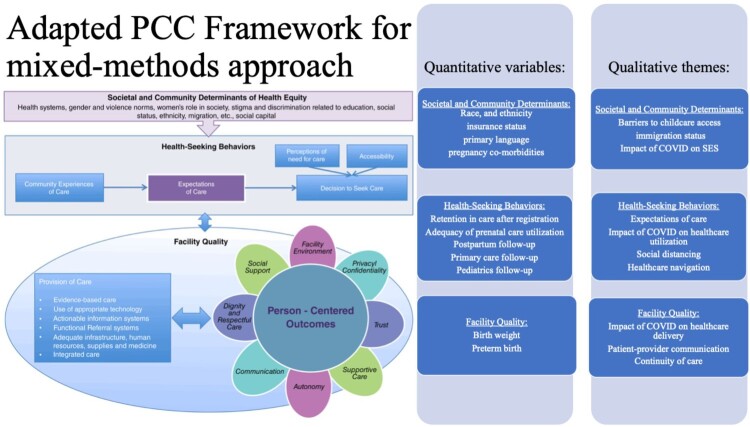 Figure 1
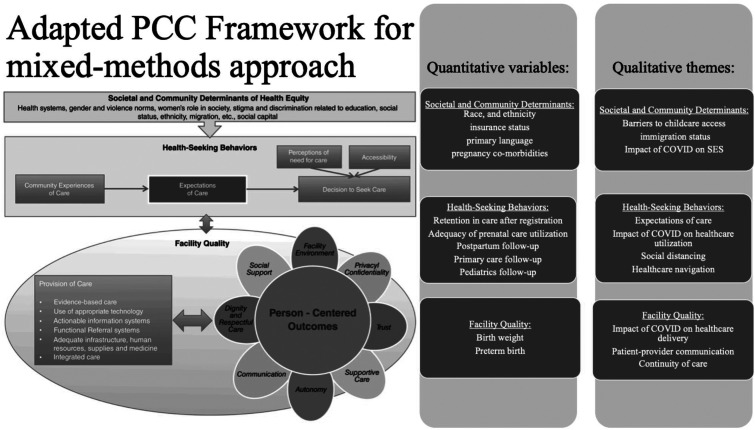 Figure 2
Peer Reviews
No public reviews on file for this paper yet. If you reviewed it on a platform where reviews are public (OpenReview, ICLR, NeurIPS, ICML), you can paste yours below so the community can read it here.
Videos
No videos yet. Explain this paper in a talk, walkthrough, or lecture? Add one.
Taxonomy
TopicsCOVID-19 Impact on Reproduction · Maternal and Perinatal Health Interventions · Maternal Mental Health During Pregnancy and Postpartum