Efficacy of the digital health application ORIKOⓇ for attention-deficit/hyperactivity disorder (ADHD) in adults: Protocol of a randomized controlled trial
Lea Schuurmans, Daniel Schöttle, Andreas Reif, Kai G. Kahl, Steffen Moritz, Anne Karow, Martin Lambert, Felix Betzler, Alexandra Philipsen, Anna Baumeister

TL;DR
This study tests a digital health app for improving quality of life in adults with ADHD through a randomized trial.
Contribution
The study evaluates a scalable digital intervention for ADHD in adults, building on promising pilot results.
Findings
The trial will assess the impact of a digital intervention on quality of life and ADHD symptoms in adults.
Outcomes will include functional impairment, anxiety, and medication adherence.
Results will determine the clinical value of a low-threshold digital health solution for ADHD.
Abstract
Attention-deficit/hyperactivity disorder (ADHD) often continues into adulthood and affects several million adults in Germany. Many do not receive timely, evidence-based treatment because of long waiting times and limited access to care. Digital health applications offer a low-threshold option to provide guideline-based support. A pilot study of the present app-based program showed encouraging improvements in quality of life and reductions in ADHD symptom severity. This randomized controlled trial (RCT) aims to confirm and extend the pilot findings. The primary objective is to examine whether the digital intervention improves quality of life in adults with ADHD. Further outcomes include changes in ADHD symptoms, functional impairment, depressive and anxiety symptoms, substance use, general health, health literacy, medication adherence, and user satisfaction. A total of 380 adults with…
Genes, proteins, chemicals, diseases, species, mutations and cell lines named across the full text — each resolved to its canonical identifier and authoritative record.
Click any figure to enlarge with its caption.
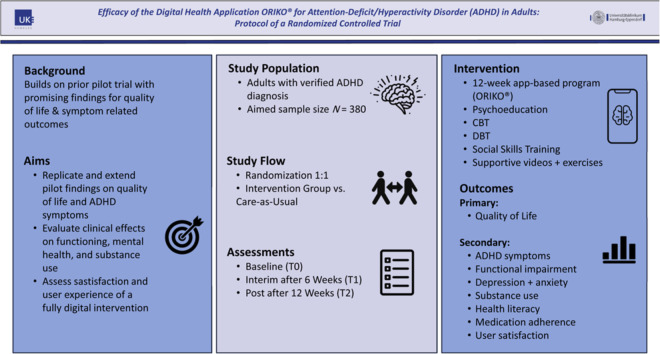 Figure 1
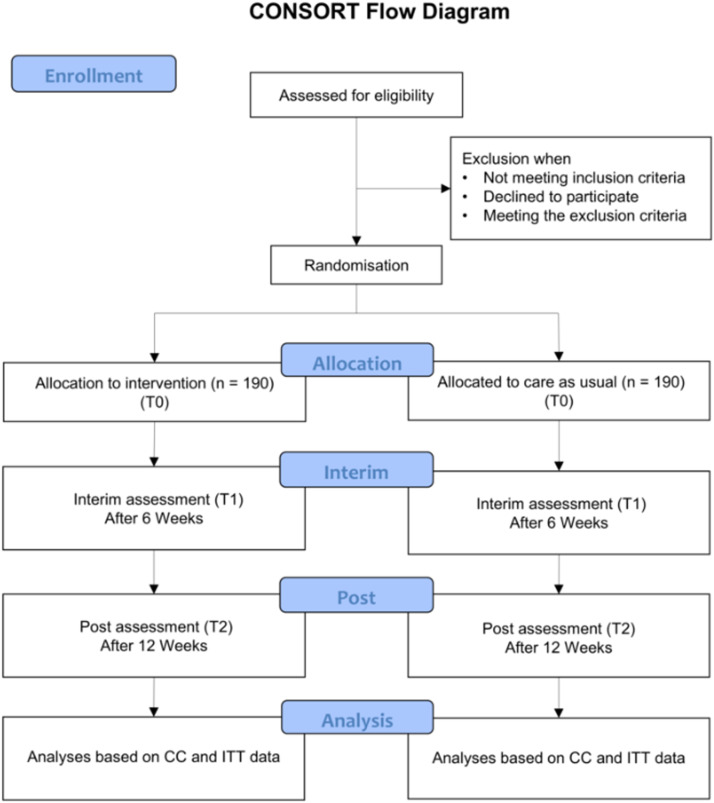 Figure 2
Peer Reviews
No public reviews on file for this paper yet. If you reviewed it on a platform where reviews are public (OpenReview, ICLR, NeurIPS, ICML), you can paste yours below so the community can read it here.
Videos
No videos yet. Explain this paper in a talk, walkthrough, or lecture? Add one.
Taxonomy
TopicsAttention Deficit Hyperactivity Disorder · Neuroethics, Human Enhancement, Biomedical Innovations · Digital Mental Health Interventions