Short- to mid-term outcomes of refractory electrical storm patients listed for urgent heart transplantation
Miloud Cherbi, Philippe Maury, Pierre Groussin, Mathilde Hamel-Bougault, Francis Bessière, Matteo Pozzi, Fabrice Extramiana, Charles Guenancia, Audrey Sagnard, Sandro Ninni, Céline Goemine, Pascal Defaye, Aude Boignard, Baptiste Maille, Vlad Gariboldi, Pierre Baudinaud

TL;DR
This study examines the outcomes of patients with refractory electrical storms who are listed for urgent heart transplants, finding high in-hospital mortality and the importance of optimizing transplant selection.
Contribution
The study provides new insights into the outcomes of urgent heart transplant candidates with refractory electrical storms.
Findings
In-hospital mortality was 28.9% for transplanted and 35.0% for non-transplanted patients, with no significant difference.
About 52.9% of patients underwent heart transplantation during their initial hospitalization.
Approximately 16.5% of non-transplanted patients eventually received a transplant within one year.
Abstract
Heart transplantation (HTx) has been suggested for refractory electrical storm (ES). Data regarding the outcomes of these patients are scarce. To compare the prognosis of refractory ES patients listed for urgent HTx, with and without transplantation. Patients registered on urgent HTx waiting list for refractory ES were retrospectively included in 13 French centers between 2010–2022. The primary endpoint was in-hospital all-cause mortality. Eighty-five patients were included (85.9% men; 56.0 [48.0–61.0] years old; 55.1% with dilated cardiomyopathy), among whom 45 (52.9%) ultimately underwent HTx during index hospitalization. In the overall cohort, 89.3% of patients received amiodarone, 64.3% beta-blockers, 45.9% required deep sedation, 5.9% underwent stellate ganglion block, and 41.2% received mechanical circulatory support. Catheter ablation was less frequently performed in the…
Genes, proteins, chemicals, diseases, species, mutations and cell lines named across the full text — each resolved to its canonical identifier and authoritative record.
Click any figure to enlarge with its caption.
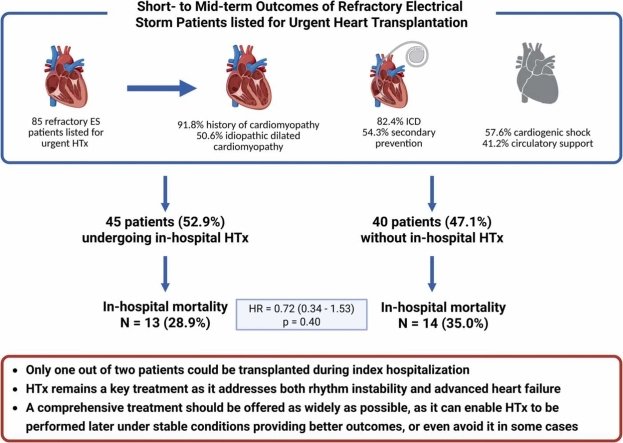 Figure 1
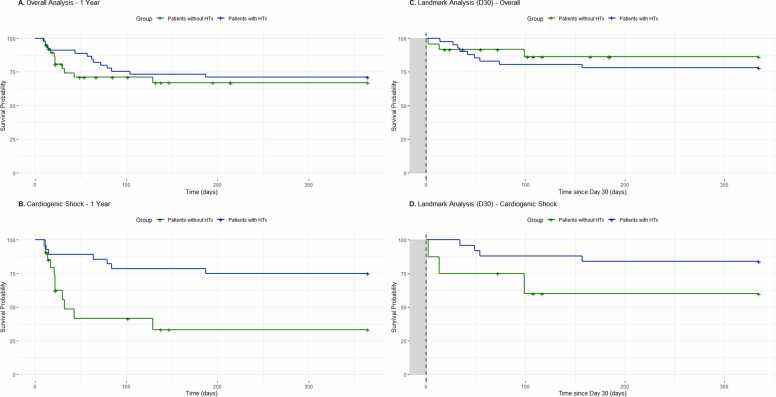 Figure 2
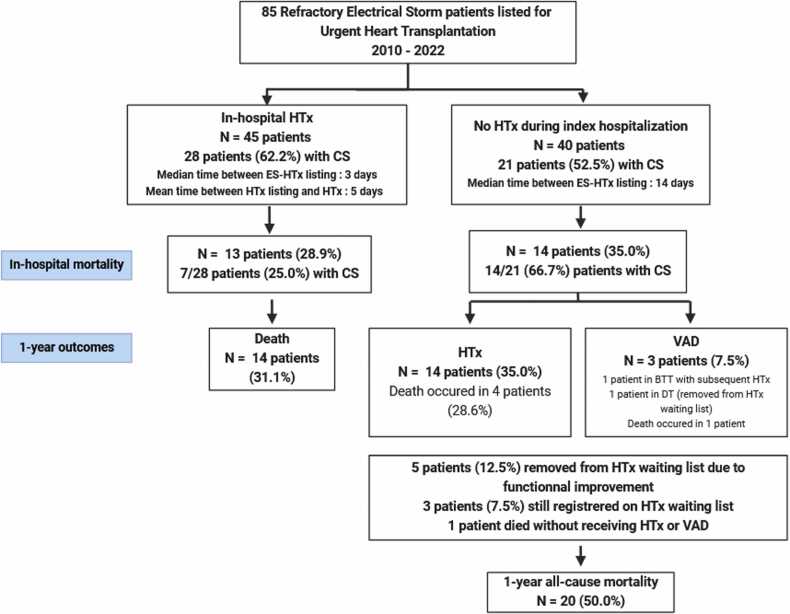 Figure 3
Peer Reviews
No public reviews on file for this paper yet. If you reviewed it on a platform where reviews are public (OpenReview, ICLR, NeurIPS, ICML), you can paste yours below so the community can read it here.
Videos
No videos yet. Explain this paper in a talk, walkthrough, or lecture? Add one.
Taxonomy
TopicsCardiac electrophysiology and arrhythmias · Transplantation: Methods and Outcomes · Burn Injury Management and Outcomes