Connectivity and Age of Restored Atlantic Forest Fragments Drives Composition and Functionality of the Fungal Community in the Leaf Litter Layer
Guilherme Lucio Martins, Dina in 't Zandt, Luis Fernando Merloti, Wanderlei Bieluczyk, Gabriel Silvestre Rocha, Robert Timmers, Ricardo Ribeiro Rodrigues, Siu Mui Tsai, Wim H. van der Putten

TL;DR
Restoring connected forest areas helps recover important fungi in leaf litter, which supports forest health and biodiversity.
Contribution
This study shows that forest connectivity has a stronger impact than forest age on restoring fungal communities in leaf litter.
Findings
Fungal composition in forest litter is more diverse and less uniform compared to pasture litter.
Forest connectivity promotes wood saprotrophs and endophytes while suppressing soil saprotrophs.
Tree diversity and leaf litter chemistry strongly influence fungal guilds like endophytes and saprophytes.
Abstract
The restoration of biodiversity and functional tropical forests is critical to mitigating global biodiversity losses. Aboveground, increasing the connectivity of regenerating forest fragments facilitates the recolonization of tropical forest biodiversity. However, restoring functional ecosystems also requires the recovery of decomposition processes as these are essential in shaping aboveground biodiversity. Therefore, we investigate the role of forest connectivity in restoring the composition and functioning of fungal communities in the leaf litter layer during a chronosequence of forest restoration. In the Brazilian Atlantic Forest, we studied secondary forests regrown between 18 and 55 years after deforestation and different levels of forest connectivity and compared their litter to recently abandoned pastures and undisturbed primary forests. We quantified how forest age and…
Genes, proteins, chemicals, diseases, species, mutations and cell lines named across the full text — each resolved to its canonical identifier and authoritative record.
Click any figure to enlarge with its caption.
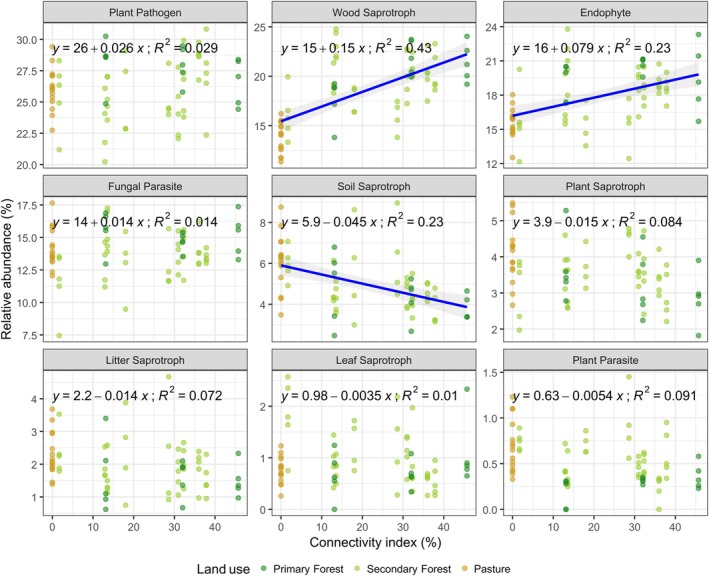 Figure 1
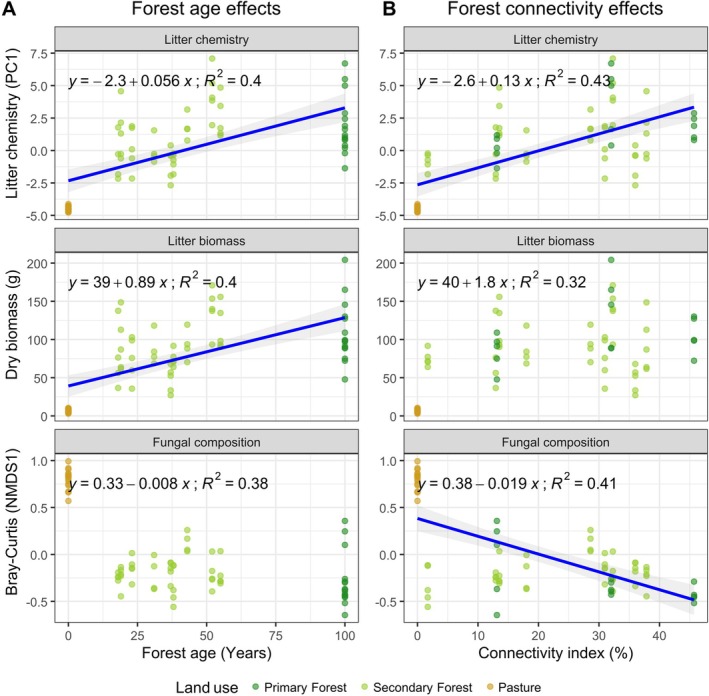 Figure 2
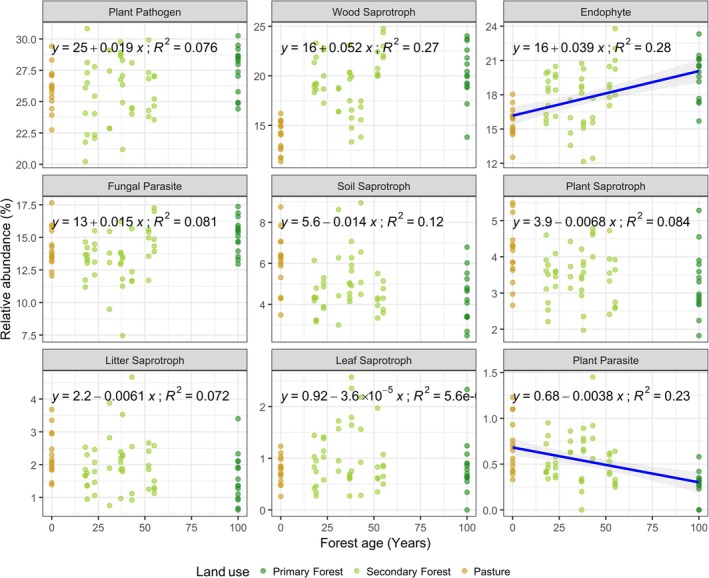 Figure 3
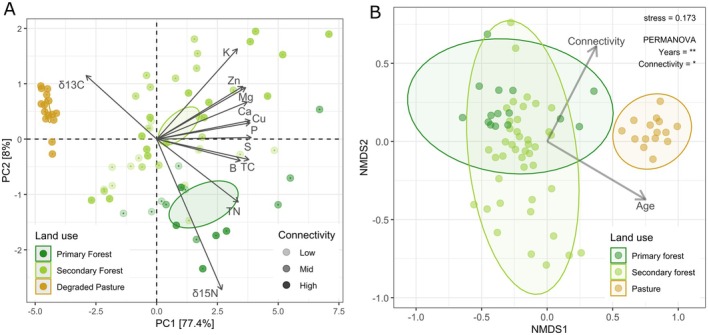 Figure 4
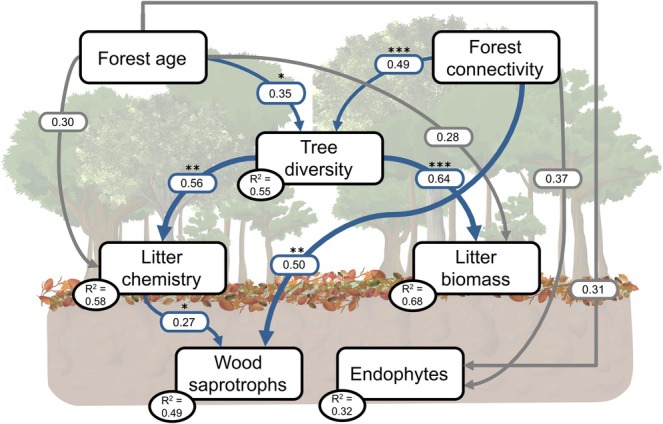 Figure 5
Peer Reviews
No public reviews on file for this paper yet. If you reviewed it on a platform where reviews are public (OpenReview, ICLR, NeurIPS, ICML), you can paste yours below so the community can read it here.
Videos
No videos yet. Explain this paper in a talk, walkthrough, or lecture? Add one.
Taxonomy
TopicsMycorrhizal Fungi and Plant Interactions · Forest Ecology and Biodiversity Studies · Plant Pathogens and Fungal Diseases