Dose–Response Relationship Between Sleep Regularity Index and Stage-Specific Alzheimer’s Disease: Cross-Sectional Evidence from Japanese Adults
Yue Cao, Jaehee Lee, Jaehoon Seol, Kenji Tsunoda, Kyohei Shibuya, Jieun Yoon, Tetsuaki Arai, Tomohiro Okura

TL;DR
This study finds that maintaining regular sleep patterns may help reduce the risk of Alzheimer's disease progression in Japanese adults.
Contribution
The study identifies a non-linear dose-response relationship between sleep regularity and Alzheimer's disease stages.
Findings
Prevalence ratios of cognitive impairment decline beyond a Sleep Regularity Index (SRI) of 60.
Participants with SRI above 60 showed lower prevalence ratios of poorer executive function.
Results were independent of age, sleep duration, and depression risk.
Abstract
Background/Objectives: Daily sleep patterns are associated with cognitive health and Alzheimer’s disease (AD). However, it remains unclear how suboptimal irregular sleep manifests in AD from the preclinical stage to dementia. This study aimed to establish the dose–response association between sleep irregularity and psychometrically defined stage-specific AD as well as executive dysfunction, among adults with subjective cognitive and sleep issues. Methods: Cross-sectional data were obtained from 532 Japanese adults (mean age = 63.9 years) between March 2023 and April 2024. Sleep irregularity was quantified using the Sleep Regularity Index (SRI) with 24/7 accelerometer data. A modified Poisson regression with cubic splines was performed to establish the dose–response association. Results: This study identified novel non-linear associations. The prevalence ratios of cognitive impairment,…
Genes, proteins, chemicals, diseases, species, mutations and cell lines named across the full text — each resolved to its canonical identifier and authoritative record.
Click any figure to enlarge with its caption.
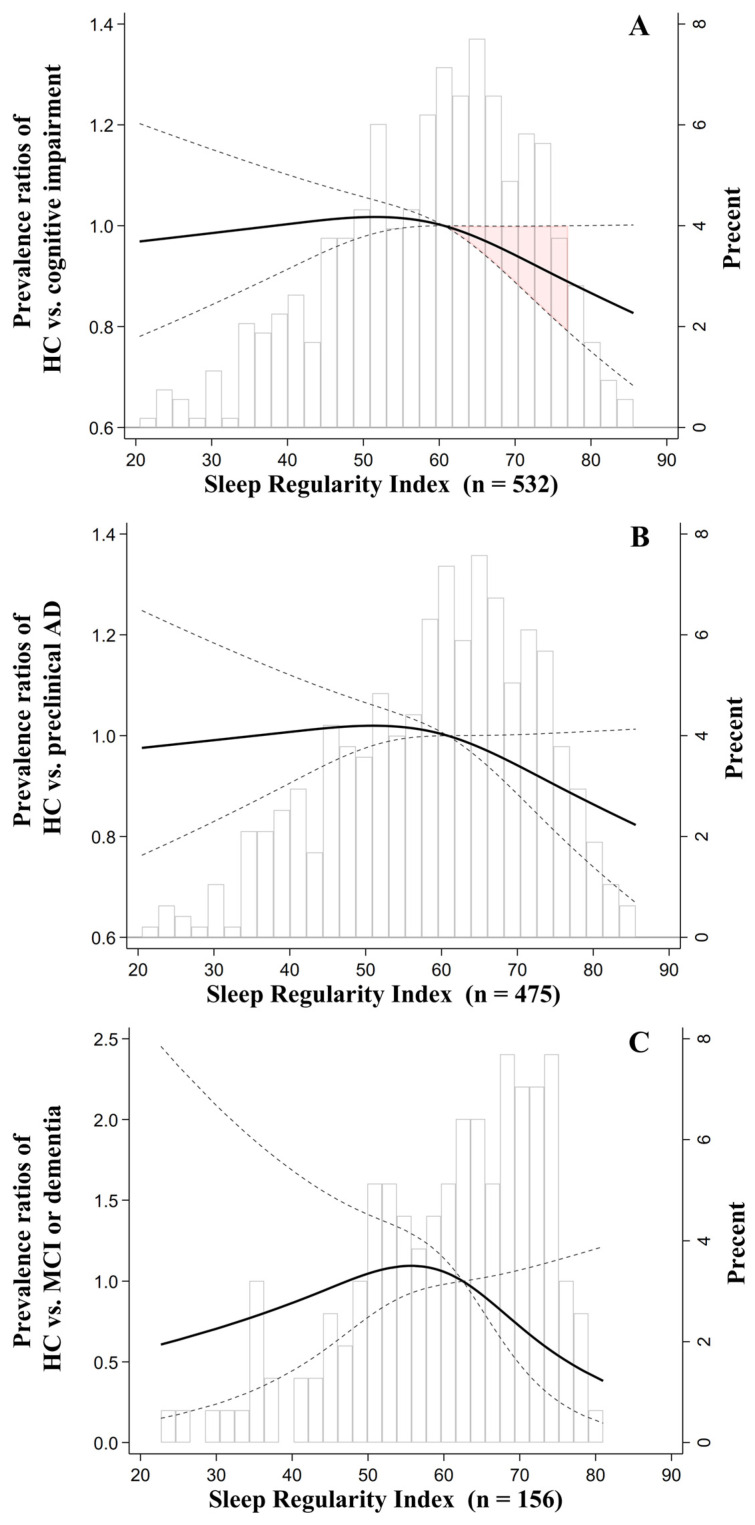 Figure 1
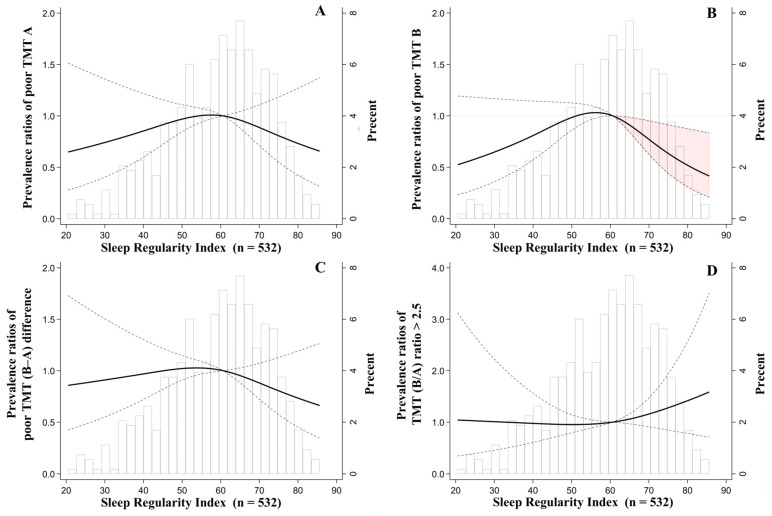 Figure 2
Peer Reviews
No public reviews on file for this paper yet. If you reviewed it on a platform where reviews are public (OpenReview, ICLR, NeurIPS, ICML), you can paste yours below so the community can read it here.
Videos
No videos yet. Explain this paper in a talk, walkthrough, or lecture? Add one.
Taxonomy
TopicsSleep and related disorders · Sleep and Wakefulness Research · Sleep and Work-Related Fatigue