Effectiveness of Robot-Assisted Versus Conventional Occupational Therapy on Changes in Upper Extremity Function After Cervical Spinal Cord Injury (Armeo X-over Trial): Study Protocol of a Randomised Crossover Trial
Chantal Wunderlin, Flavia Bürgisser, Armin Gemperli, Claudio Perret, Mario Widmer

TL;DR
This study compares robot-assisted therapy with traditional occupational therapy to see which better improves upper body function in people with cervical spinal cord injuries.
Contribution
It introduces a randomized crossover trial design to evaluate unilateral robot-assisted therapy versus conventional occupational therapy for cervical spinal cord injury rehabilitation.
Findings
The study will assess changes in upper extremity function using the GRASSP-QtG test.
A linear mixed model will estimate treatment effects based on changes over time.
The trial aims to inform improved and individualized therapy schedules for cervical spinal cord injury patients.
Abstract
Robot-assisted therapy (RT) is increasingly implemented in rehabilitation, yet evidence on its effectiveness in improving upper extremity function after cervical spinal cord injury (cSCI) remains limited. Therefore, this randomised crossover study aims to investigate the effects of unilateral RT compared to conventional unilateral occupational therapy (OT) on upper extremity function in individuals with cSCI. 40 participants with traumatic or non-traumatic cSCI (16–81 days post-injury, neurological level of injury: C1–T1) will be randomised (1:1), stratified by their predicted recovery profile, to receive 6 weeks of RT (ArmeoSpring) and 6 weeks of OT in random order, each 3 × 30 min/week in addition to the clinical routine therapy. Assessments are conducted before (t0), between (t1) and after both intervention blocks (t2 and t3). The primary outcome is the Quantitative Grasping Subtest…
Genes, proteins, chemicals, diseases, species, mutations and cell lines named across the full text — each resolved to its canonical identifier and authoritative record.
Click any figure to enlarge with its caption.
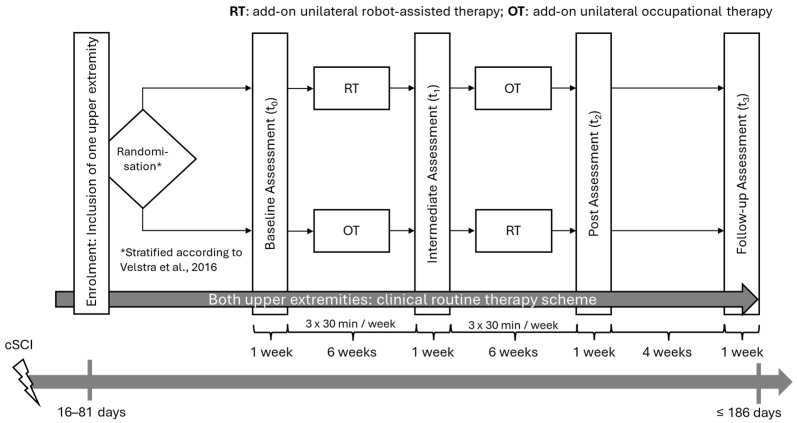 Figure 1
Peer Reviews
No public reviews on file for this paper yet. If you reviewed it on a platform where reviews are public (OpenReview, ICLR, NeurIPS, ICML), you can paste yours below so the community can read it here.
Videos
No videos yet. Explain this paper in a talk, walkthrough, or lecture? Add one.
Taxonomy
TopicsSpinal Cord Injury Research · Stroke Rehabilitation and Recovery · Prosthetics and Rehabilitation Robotics