Differentiating Atypical BPPV from Central Positional Vertigo: A Narrative Review
Giorgos Sideris, George Korres, Ilias Lazarou, Eleni Vasileiou, Amanda Male, Diego Kaski

TL;DR
This paper reviews how to distinguish unusual cases of BPPV from central positional vertigo to improve accurate diagnosis and treatment.
Contribution
The paper provides practical diagnostic guidance for clinicians to differentiate atypical BPPV from central positional vertigo.
Findings
Atypical BPPV can present without nystagmus or with conflicting torsional components in bilateral cases.
Persistent symptoms despite repositioning maneuvers and canal switch or pseudo-spontaneous nystagmus are observed in atypical BPPV.
Diagnosis relies on nystagmus characteristics and exclusion of neurological red flags to confirm peripheral origin.
Abstract
While typical benign paroxysmal positional vertigo (BPPV) presents with reproducible patterns of nystagmus and vertigo during positional testing, atypical variants often deviate from typical patterns, making diagnosis more complex. Recognizing atypical BPPV is crucial to avoid misdiagnosis and inappropriate management. This study aims to describe the clinical spectrum of atypical BPPV, differentiate it from central positional vertigo, and provide practical diagnostic guidance for clinicians. A narrative review was conducted to explore the clinical spectrum of atypical BPPV. Findings indicate that it may present with vertigo without nystagmus, conflicting torsional components in bilateral cases, or persistent symptoms despite repositioning maneuvers. Canal switch and pseudo-spontaneous nystagmus have also been described. Although these variants may mimic central etiologies, the absence…
Genes, proteins, chemicals, diseases, species, mutations and cell lines named across the full text — each resolved to its canonical identifier and authoritative record.
Click any figure to enlarge with its caption.
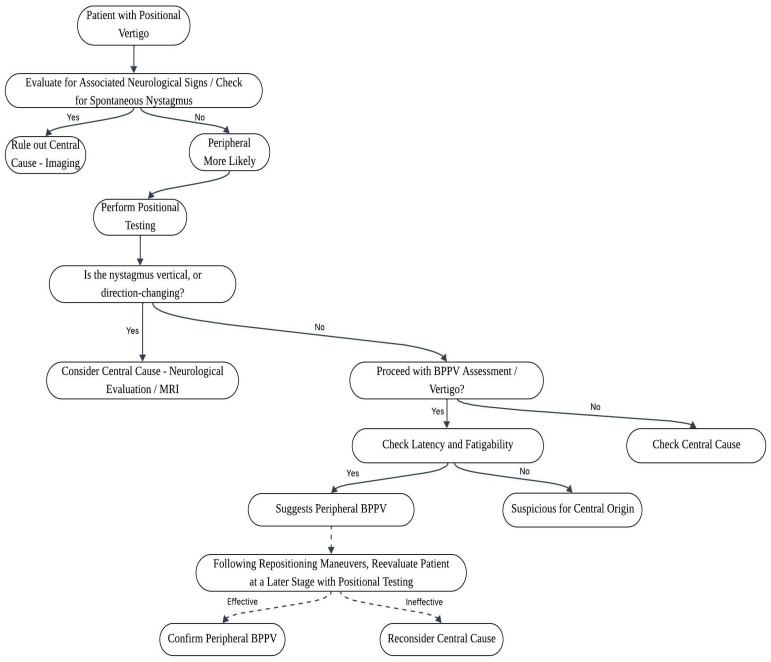 Figure 1
Peer Reviews
No public reviews on file for this paper yet. If you reviewed it on a platform where reviews are public (OpenReview, ICLR, NeurIPS, ICML), you can paste yours below so the community can read it here.
Videos
No videos yet. Explain this paper in a talk, walkthrough, or lecture? Add one.
Taxonomy
TopicsVestibular and auditory disorders · Genetic Neurodegenerative Diseases · Trigeminal Neuralgia and Treatments