Clinical Experience with Emicizumab and Rituximab as First-Line Treatment in a Case Series of Acquired Hemophilia A
Hikari Ota, Kyohei Yasuda, Namie Toyota, Kazuhiro Masuoka

TL;DR
This study shows that using emicizumab and rituximab together as first-line treatment for acquired hemophilia A can prevent severe bleeding and lead to faster recovery.
Contribution
The paper presents new clinical evidence supporting the early use of emicizumab combined with rituximab for treating acquired hemophilia A.
Findings
Two recent cases treated with emicizumab and rituximab achieved complete remission without severe bleeding or infections.
Early use of emicizumab allowed for prompt rehabilitation and earlier hospital discharge.
Combining emicizumab with rituximab may reduce adverse effects compared to standard immunosuppressive therapy.
Abstract
Background: Acquired hemophilia A (AHA) is a bleeding disorder caused by autoantibodies against coagulation factor VIII. Treatment includes controlling bleeding and eliminating the inhibitor. Emicizumab has been increasingly used to prevent bleeding in patients with AHA. Rituximab is used as a first-line immunosuppressive therapy (IST) for AHA, either in combination with corticosteroids in high-risk patients or as monotherapy in low-risk patients who cannot tolerate corticosteroids. However, evidence regarding concomitant emicizumab and rituximab as first-line treatment for AHA is limited. Case presentations: We present five cases of AHA diagnosed at a single institution. The first three high-risk AHA cases in the era before emicizumab resulted in poor outcomes due to bleeding (Cases 1 and 3) or infection (Case 2). The recent cases (Cases 4 and 5) were successfully treated with…
Genes, proteins, chemicals, diseases, species, mutations and cell lines named across the full text — each resolved to its canonical identifier and authoritative record.
Click any figure to enlarge with its caption.
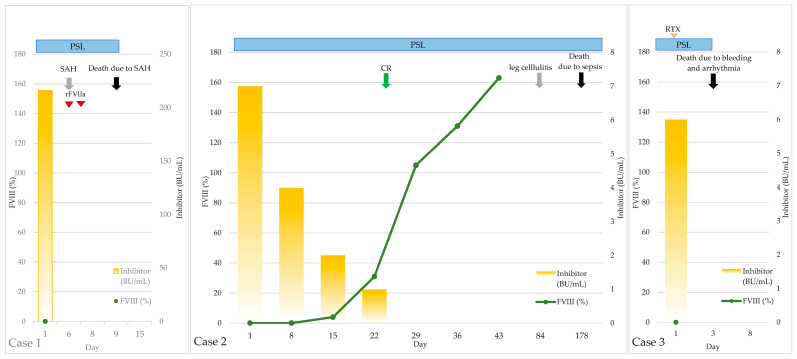 Figure 1
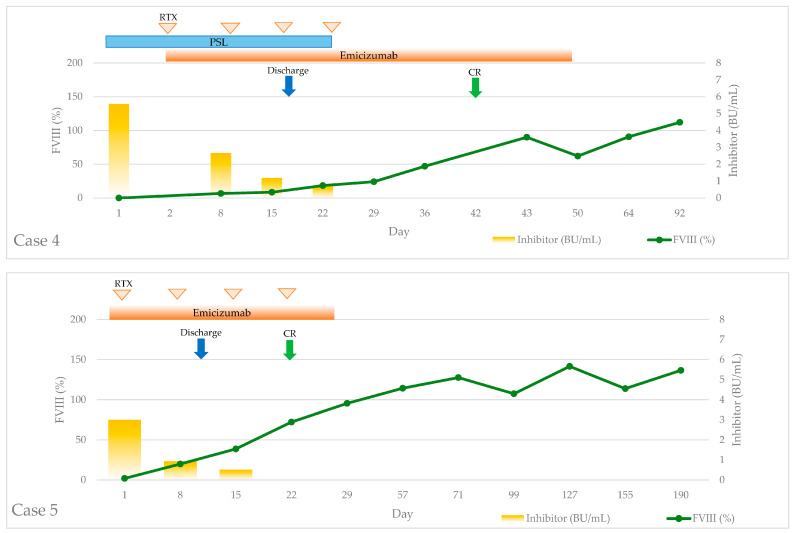 Figure 2
Peer Reviews
No public reviews on file for this paper yet. If you reviewed it on a platform where reviews are public (OpenReview, ICLR, NeurIPS, ICML), you can paste yours below so the community can read it here.
Videos
No videos yet. Explain this paper in a talk, walkthrough, or lecture? Add one.
Taxonomy
TopicsHemophilia Treatment and Research · Platelet Disorders and Treatments · Coagulation, Bradykinin, Polyphosphates, and Angioedema