Beyond Hyperexcitability: A Review of Neural Mechanisms in Charles Bonnet Syndrome
Eric Altieri, Luca Battaglini

TL;DR
This review explores the complex brain mechanisms behind Charles Bonnet Syndrome, focusing on how visual hallucinations arise in people with vision loss.
Contribution
The paper introduces an integrated model of CBS pathophysiology that goes beyond hyperexcitability, emphasizing desynchronization in visual processing pathways.
Findings
CBS hallucinations may result from interactions between deafferentation-induced plasticity and neurotransmitter imbalances.
Neuroimaging and modeling suggest desynchronization between bottom-up and top-down visual pathways is central to CBS.
The findings challenge the traditional hyperexcitability model and propose a more nuanced neural mechanism.
Abstract
Charles Bonnet syndrome (CBS) is characterized by complex visual hallucinations in visually impaired individuals who maintain intact cognitive function. Despite significant progress in understanding this condition, the precise neural mechanisms underlying CBS remain incompletely understood. This review synthesizes current evidence regarding the pathophysiology of CBS, with particular emphasis on emerging neurobiological models that extend beyond simple cortical hyperexcitability. Recent neuroimaging, neurophysiological, and computational modeling studies suggest that CBS hallucinations may arise from complex interactions among deafferentation-induced neural plasticity, neurotransmitter imbalances, and altered functional connectivity within visual processing hierarchies. The evidence increasingly points toward a model involving desynchronization between bottom-up and top-down visual…
Genes, proteins, chemicals, diseases, species, mutations and cell lines named across the full text — each resolved to its canonical identifier and authoritative record.
Click any figure to enlarge with its caption.
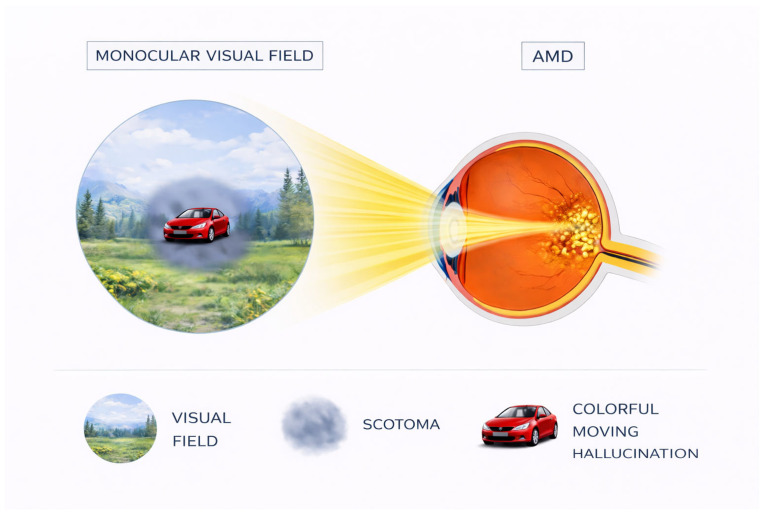 Figure 1
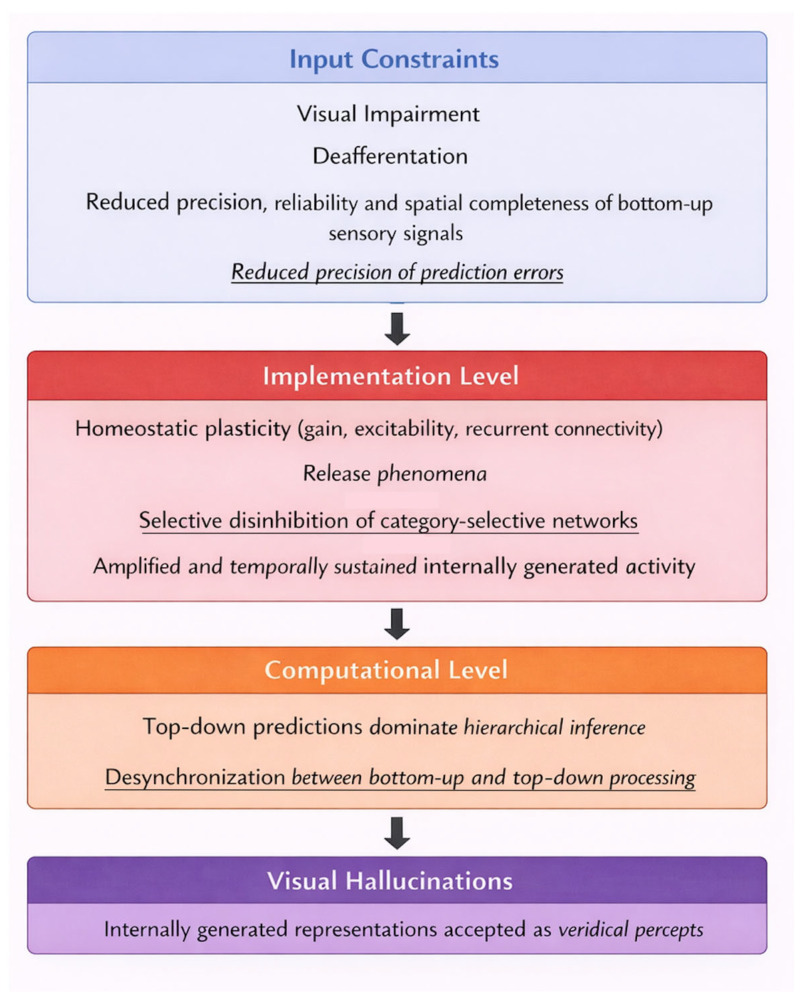 Figure 2
Peer Reviews
No public reviews on file for this paper yet. If you reviewed it on a platform where reviews are public (OpenReview, ICLR, NeurIPS, ICML), you can paste yours below so the community can read it here.
Videos
No videos yet. Explain this paper in a talk, walkthrough, or lecture? Add one.
Taxonomy
TopicsHallucinations in medical conditions · Spatial Neglect and Hemispheric Dysfunction · Drug-Induced Ocular Toxicity