Beyond the Air–Bone Gap: The Role of Bone Conduction Thresholds in Predicting Functional Outcomes and Guiding Surgical Decision-Making in Active Middle Ear and Bone Conduction Implants
Joan Lorente-Piera, Raquel Manrique-Huarte, Sebastián Picciafuoco, Janaina P. Lima, Valeria Serra, Manuel Manrique

TL;DR
This study shows that high-frequency bone conduction thresholds can predict how well patients will understand speech after getting hearing implants, helping doctors make better decisions.
Contribution
The study identifies high-frequency bone conduction thresholds as a strong predictor of postoperative speech recognition outcomes in hearing implant patients.
Findings
High-frequency bone conduction thresholds inversely correlate with postoperative speech recognition scores in both BCI and AMEI users.
High-frequency bone conduction thresholds are the only independent predictor of postoperative outcomes in multivariable models.
ROC analyses show high discriminative performance of high-frequency thresholds for identifying suboptimal outcomes.
Abstract
Introduction: In patients with conductive and mixed hearing loss, implantable hearing devices such as active middle ear implants (AMEIs) and bone conduction implants (BCIs) are established alternatives when conventional hearing aids fail. Although bone conduction (BC) thresholds are routinely used as eligibility criteria, their role as frequency-specific predictors of postoperative functional outcomes remains poorly defined. This study aimed to evaluate the influence of preoperative BC thresholds across the audiometric spectrum on postoperative speech recognition outcomes after implantation with AMEIs and BCIs. Methods: A retrospective observational study was conducted at a tertiary referral center including patients implanted with BCIs or AMEIs. Pre- and postoperative audiological data were analyzed, including air and bone conduction thresholds, frequency-segmented BC measures (low,…
Genes, proteins, chemicals, diseases, species, mutations and cell lines named across the full text — each resolved to its canonical identifier and authoritative record.
Click any figure to enlarge with its caption.
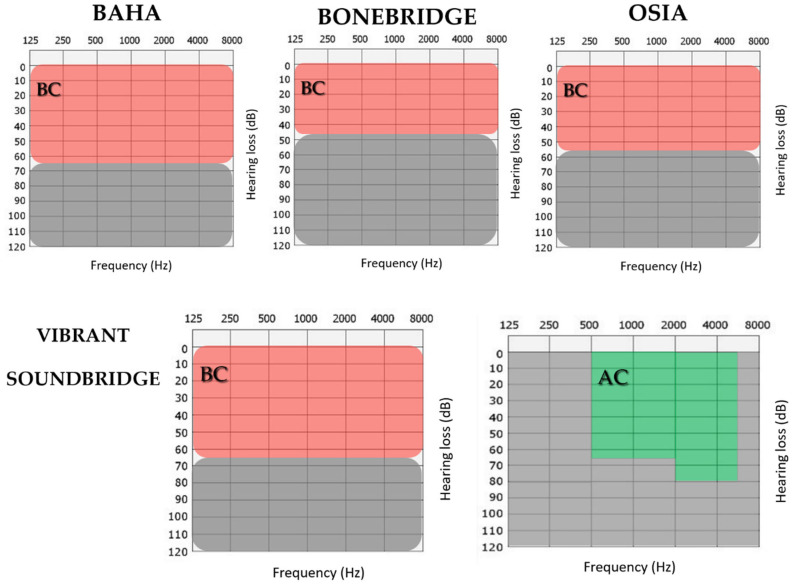 Figure 1
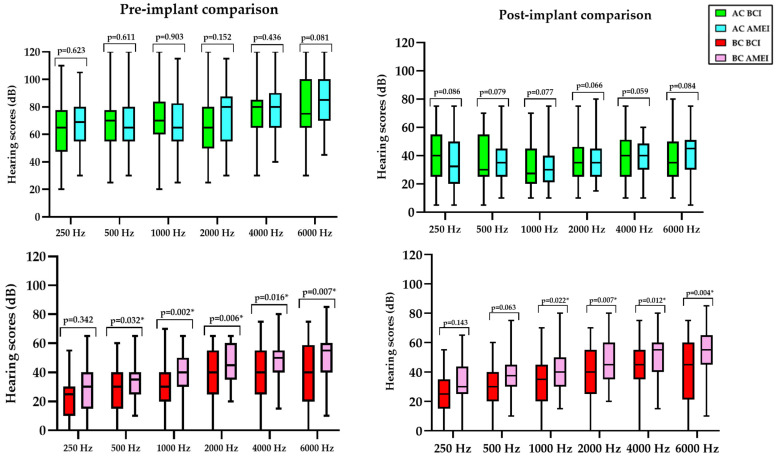 Figure 2
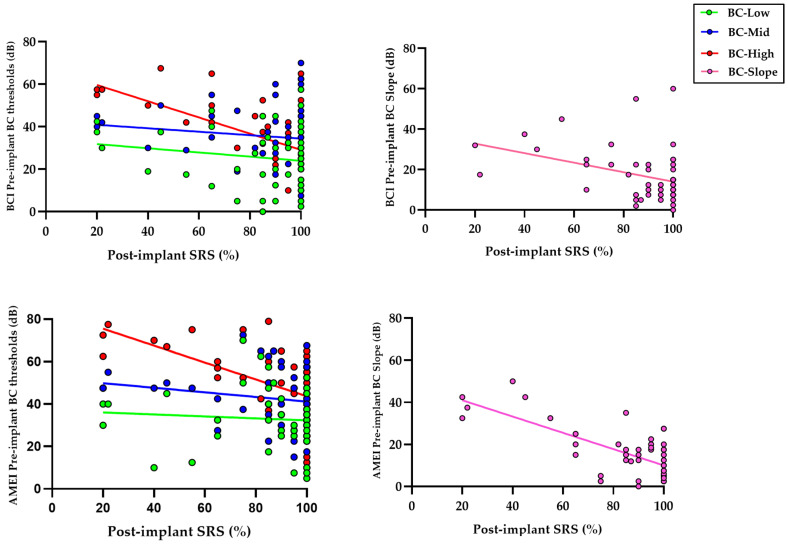 Figure 3
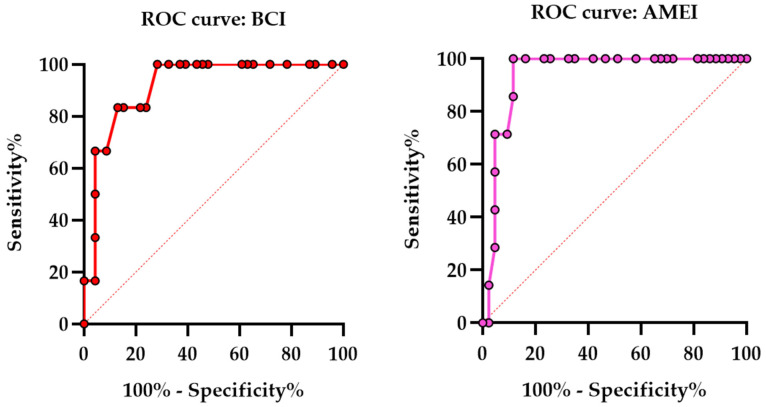 Figure 4
Peer Reviews
No public reviews on file for this paper yet. If you reviewed it on a platform where reviews are public (OpenReview, ICLR, NeurIPS, ICML), you can paste yours below so the community can read it here.
Videos
No videos yet. Explain this paper in a talk, walkthrough, or lecture? Add one.
Taxonomy
TopicsEar Surgery and Otitis Media · Hearing Loss and Rehabilitation · Hearing, Cochlea, Tinnitus, Genetics