Peptide–protein docking: from physics-based models to generative intelligence
Kai Ling, Shu Li, Zicong Zhang, Woong-Hee Shin, Daisuke Kihara

TL;DR
This paper reviews how peptide–protein docking methods have evolved from physics-based models to modern deep learning approaches, highlighting improvements and remaining challenges.
Contribution
The paper introduces a categorization of modern deep learning-based peptide–protein docking methods and outlines future directions for improving their accuracy and applicability.
Findings
Recent deep learning methods have improved the accuracy of peptide–protein docking predictions.
AlphaFold-based protocols and generative models are transforming peptide–protein complex structure prediction.
Challenges remain in handling long, disordered, or chemically modified peptides.
Abstract
Peptide–protein interactions (PepPIs) play a pivotal role in cellular signaling and regulation, representing a significant category of therapeutic agents. However, determining peptide–protein complex structures by experiment is costly and often challenging. Computational peptide–protein complex structure prediction, therefore, plays an important role in mapping binding modes and guiding design. Classical pipelines combine template-based, local, or global docking conformational search algorithms with physics-based or empirical scoring, but they often struggle with highly flexible peptides, induced fit at shallow interfaces, and non-canonical chemistries. In this review, we describe an ongoing shift from such conventional search-and-score workflows to deep learning-based pipelines. We categorize the modern methods into three modules: (i) approaches that predict likely peptide-binding…
Click any figure to enlarge with its caption.
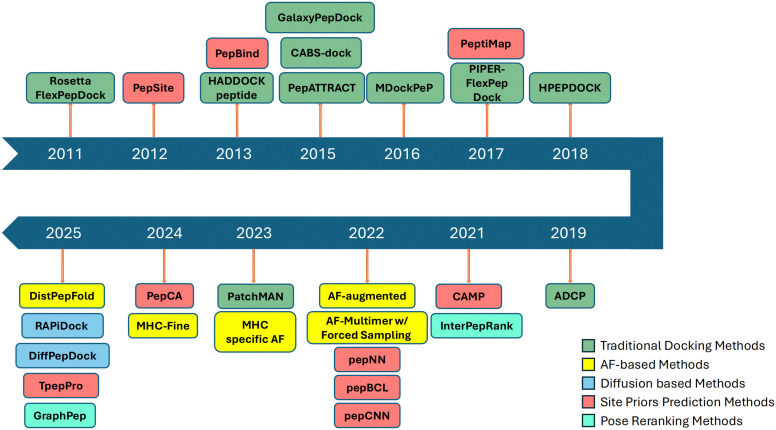 Figure 1
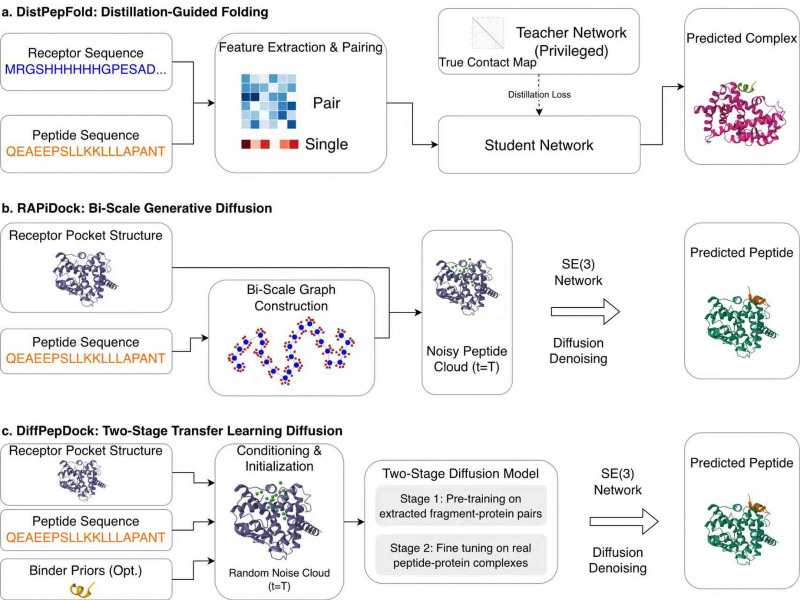 Figure 2
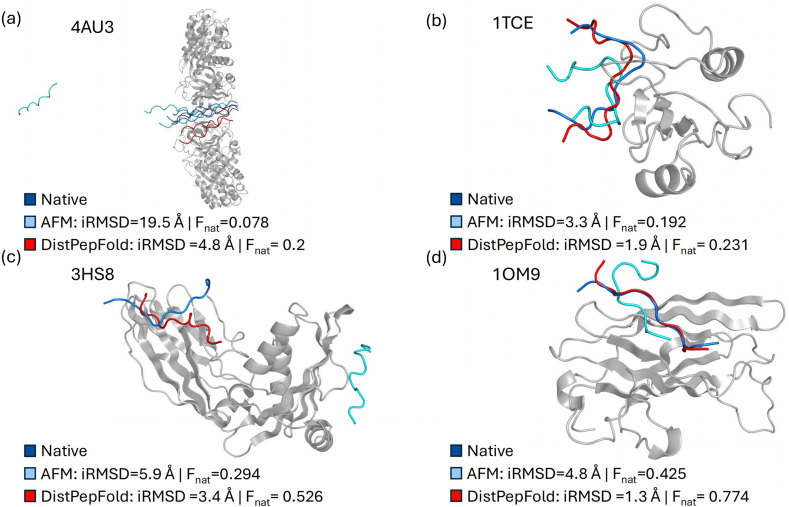 Figure 3
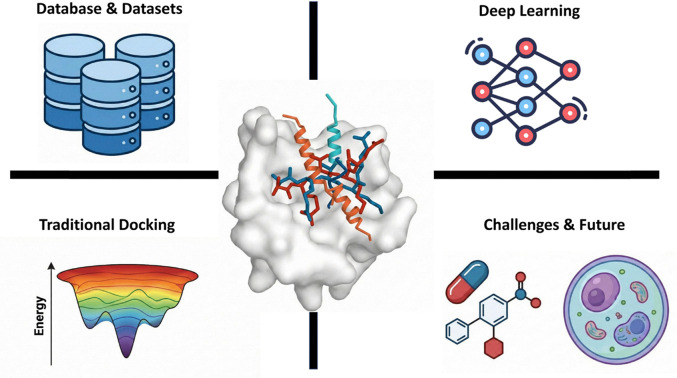 Figure 4
 Figure 5
 Figure 6
 Figure 7
 Figure 8
 Figure 9
Peer Reviews
No public reviews on file for this paper yet. If you reviewed it on a platform where reviews are public (OpenReview, ICLR, NeurIPS, ICML), you can paste yours below so the community can read it here.
Videos
No videos yet. Explain this paper in a talk, walkthrough, or lecture? Add one.
Taxonomy
TopicsBiochemical and Structural Characterization · RNA Interference and Gene Delivery · Chemical Synthesis and Analysis