Impact of everolimus-related interstitial lung disease on subsequent treatment in patients with metastatic breast cancer
Hikari Kiyohara, Chihiro Kondoh, Akira Hirota, Nobuyuki Takahashi, Misao Fukuda, Shota Kusuhara, Takehiko Nakao, Hiromichi Nakajima, Chikako Funasaka, Kenichi Harano, Nobuaki Matsubara, Yoichi Naito, Ako Hosono, Naoki Niikura, Toru Mukohara

TL;DR
This study examines how lung disease caused by everolimus affects future cancer treatments in breast cancer patients.
Contribution
The study provides new insights into the impact of everolimus-related lung disease on subsequent treatment choices and outcomes.
Findings
e-rILD did not significantly affect the choice of subsequent anti-cancer treatments.
The risk of drug-related ILD during subsequent treatments was similar between patients with and without e-rILD.
Abstract
Everolimus is an option for second-line or later use in combination with endocrine therapy for hormone receptor-positive breast cancer. An important everolimus-associated adverse event is drug-related interstitial lung disease (ILD), reported to occur in 16.0% of individuals in the BOLERO-2 trial, and 23.5% of those in the Asian subgroup. We aimed to examine the impact of everolimus-related ILD (e-rILD) on the risk of drug-related ILD during subsequent anti-cancer treatment. We retrospectively studied the medical records of patients with metastatic breast cancer treated with everolimus plus endocrine therapy from January 2013 to March 2022, at the National Cancer Center Hospital East. We evaluated e-rILD grade using the Common Terminology Criteria for Adverse Events version 5.0. A total of 115 cases were treated with everolimus; 33 (28.7%) patients developed e-rILD of any grade,…
Genes, proteins, chemicals, diseases, species, mutations and cell lines named across the full text — each resolved to its canonical identifier and authoritative record.
Click any figure to enlarge with its caption.
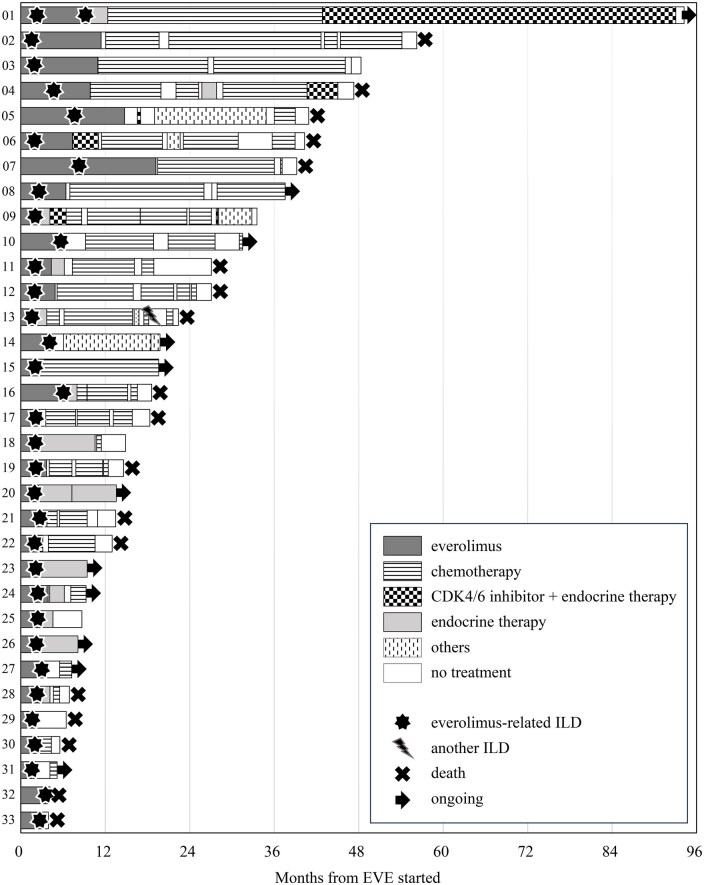 Figure 1
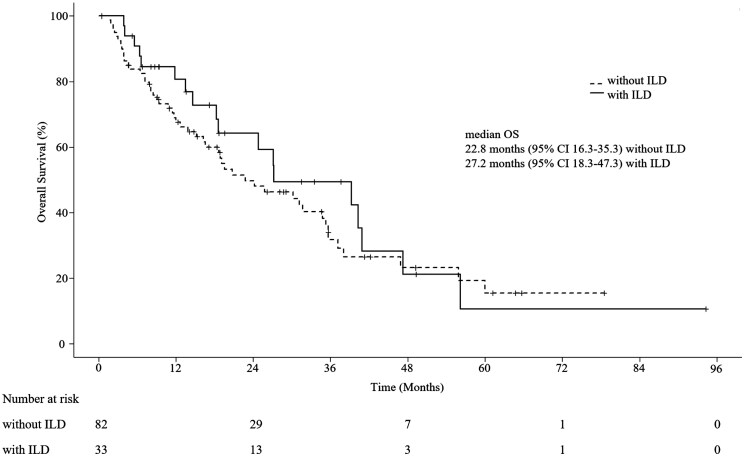 Figure 2
Peer Reviews
No public reviews on file for this paper yet. If you reviewed it on a platform where reviews are public (OpenReview, ICLR, NeurIPS, ICML), you can paste yours below so the community can read it here.
Videos
No videos yet. Explain this paper in a talk, walkthrough, or lecture? Add one.
Taxonomy
TopicsPI3K/AKT/mTOR signaling in cancer · Lung Cancer Treatments and Mutations · Tuberous Sclerosis Complex Research