Contrasting Global and Patient‐Specific Regression Models via a Neural Network Representation
Max Behrens, Daiana Stolz, Eleni Papakonstantinou, Janis M. Nolde, Gabriele Bellerino, Angelika Rohde, Moritz Hess, Harald Binder

TL;DR
This paper introduces a diagnostic tool using neural networks to determine when global clinical prediction models fail and personalized models are needed.
Contribution
A novel diagnostic tool that contrasts global and patient-specific regression models using a neural network-based latent representation.
Findings
Global models are adequate for most COPD patients, but specific subgroups benefit from personalized models.
The tool identifies subgroups where global models fail and provides insights into why these models are inadequate.
Using an autoencoder for dimension reduction helps reveal local outcome-related associations in high-dimensional data.
Abstract
When developing clinical prediction models, it can be challenging to balance between global models that are valid for all patients and personalized models tailored to individuals or potentially unknown subgroups. To aid such decisions, we propose a diagnostic tool for contrasting global regression models and patient‐specific (local) regression models. The core utility of this tool is to identify where and for whom a global model may be inadequate. We focus on regression models and specifically suggest a localized regression approach that identifies regions in the predictor space where patients are not well represented by the global model. As localization becomes challenging when dealing with many predictors, we propose modeling in a dimension‐reduced latent representation obtained from an autoencoder. Using such a neural network architecture for dimension reduction enables learning a…
Genes, proteins, chemicals, diseases, species, mutations and cell lines named across the full text — each resolved to its canonical identifier and authoritative record.
Click any figure to enlarge with its caption.
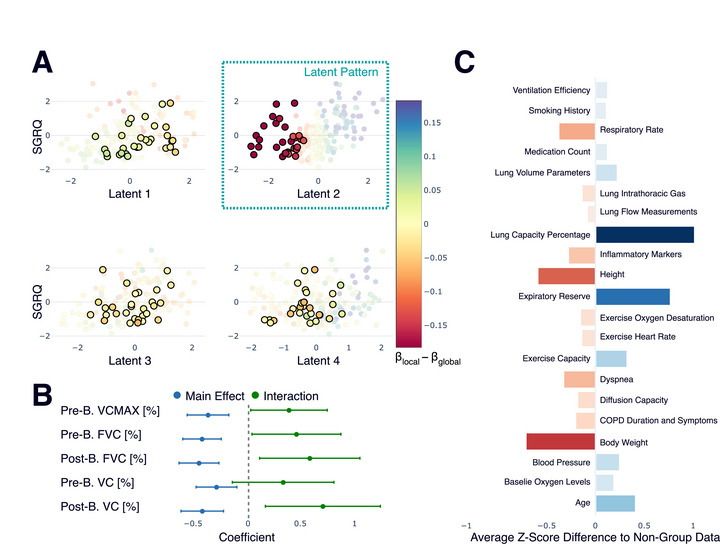 Figure 1
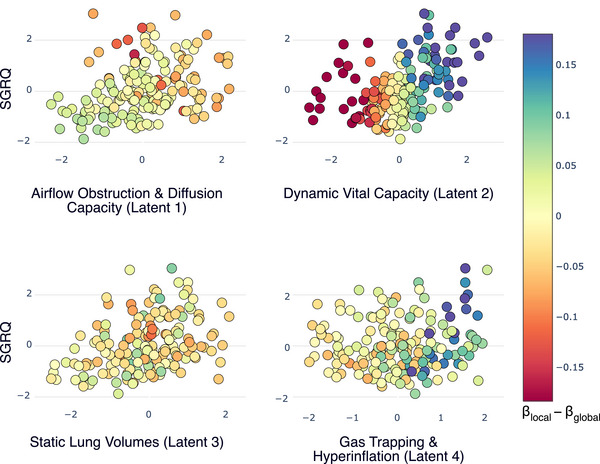 Figure 2
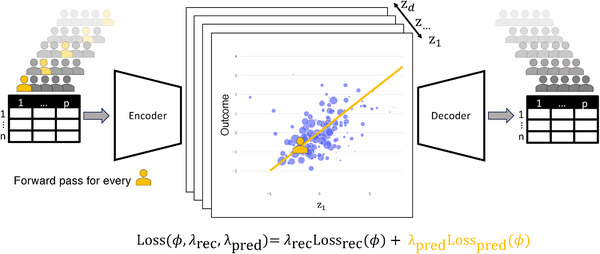 Figure 3
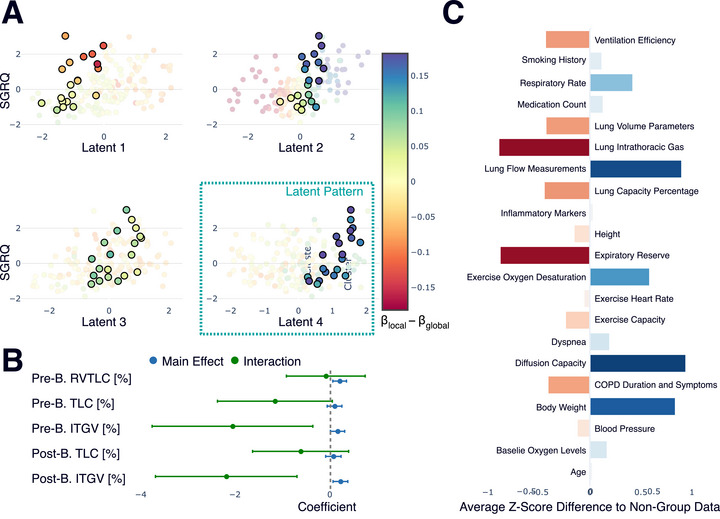 Figure 4
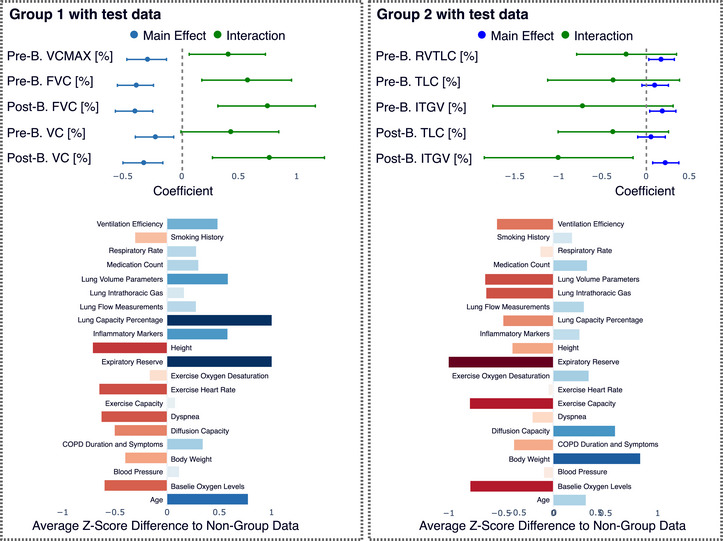 Figure 5
Peer Reviews
No public reviews on file for this paper yet. If you reviewed it on a platform where reviews are public (OpenReview, ICLR, NeurIPS, ICML), you can paste yours below so the community can read it here.
Videos
No videos yet. Explain this paper in a talk, walkthrough, or lecture? Add one.
Taxonomy
TopicsMachine Learning in Healthcare · Explainable Artificial Intelligence (XAI) · Advanced Statistical Modeling Techniques