Is Parenthood Contributing to Emotional Wellbeing? The Neutrality Paradox and a Possible Resolution
Menelaos Apostolou, Mark Sullman, Agata Błachnio, Ondrej Burysek, Ekaterina Bushina, Fran Calvo, William Costello, Tetiana Hill, Maria Galatiani Karageorgiou, Yanina Lisun, Denisse Manrique-Millones, Oscar Manrique-Pino, Yohsuke Ohtsubo, Aneta Przepiórka, Burcu Tekeş

TL;DR
This study finds that parenthood has a small positive effect on meaning in life but not on happiness or life satisfaction, contradicting evolutionary predictions.
Contribution
The study reveals a 'neutrality paradox' where parents report similar hedonic wellbeing to non-parents despite perceiving children as sources of positive emotions.
Findings
Parenthood had a small positive effect on eudaimonic wellbeing, especially for women.
No significant differences were found between parents and non-parents in hedonic wellbeing or life satisfaction.
Parents reported slightly lower relationship satisfaction compared to non-parents.
Abstract
Evolutionary theorizing predicts that parenthood is associated with higher hedonic wellbeing (experiencing more positive and fewer negative emotions), higher eudaimonic wellbeing (experiencing greater meaning in life), and greater life satisfaction. To test this hypothesis, we analyzed a dataset comprising 5,556 participants drawn from 10 different nations. We found a small positive effect of parenthood on eudaimonic wellbeing, which was more pronounced for women. Conversely, we found virtually no differences between parents and nonparents across all measured dimensions of hedonic wellbeing and life satisfaction. Furthermore, for most dimensions, we did not detect significant interactions between parenthood status and sex, age, or relationship status. Additionally, participants with children reported lower relationship satisfaction than those without children; however, the observed…
Genes, proteins, chemicals, diseases, species, mutations and cell lines named across the full text — each resolved to its canonical identifier and authoritative record.
Click any figure to enlarge with its caption.
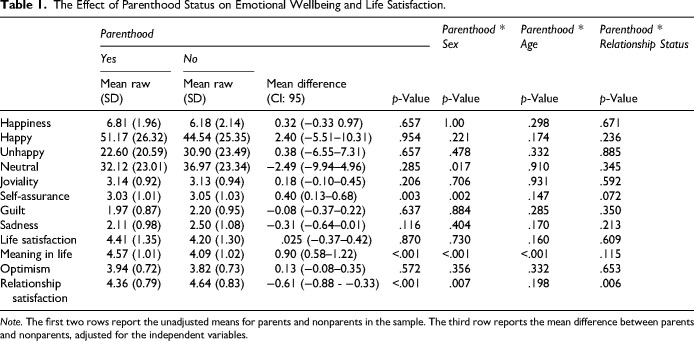 Figure 1
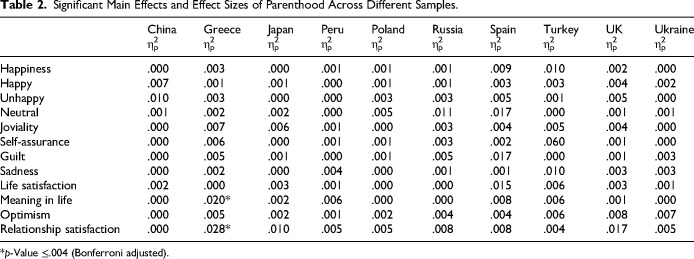 Figure 2
Peer Reviews
No public reviews on file for this paper yet. If you reviewed it on a platform where reviews are public (OpenReview, ICLR, NeurIPS, ICML), you can paste yours below so the community can read it here.
Videos
No videos yet. Explain this paper in a talk, walkthrough, or lecture? Add one.
Taxonomy
TopicsEvolutionary Psychology and Human Behavior · Psychological Well-being and Life Satisfaction · Attachment and Relationship Dynamics