Successful use of isavuconazole as secondary prophylaxis of cryptococcal meningitis in a person living with HIV and AIDS: a case report
Carmela Pinnetti, Alessandro Giacinta, Federico Cecilia, Francesco Baldini, Annalisa Mondi, Saba Gebremeskel Teklè, Susanna Grisetti, Marta Camici, Donatella Vincenti, Stefania Carrara, Carla Fontana, Andrea Antinori

TL;DR
A person with HIV and AIDS successfully used isavuconazole to prevent recurring cryptococcal meningitis after initial treatment.
Contribution
This case report demonstrates the successful off-label use of isavuconazole for secondary prophylaxis of cryptococcal meningitis in an HIV-positive patient.
Findings
The patient showed neurological stabilization and CD4+ T-cell recovery with isavuconazole prophylaxis.
Isavuconazole was well-tolerated with no drug-related toxicity or recurrence of meningitis.
The drug's favorable pharmacokinetics and minimal drug interactions made it suitable for long-term use with ART.
Abstract
Cryptococcal meningitis (CM) is a severe opportunistic infection in people living with HIV (PLWH). We report a 54-year-old man with advanced HIV infection who presented with CM due to Cryptococcus neoformans. Induction therapy with liposomal amphotericin B (4 mg/kg/day) plus fluconazole (800 mg/day) was prolonged to 10 weeks because flucytosine was initially unavailable; intravenous flucytosine (25 mg/kg q6h) was introduced when accessible. Maintenance fluconazole (800 mg/day) was continued, and antiretroviral therapy (ART) with dolutegravir plus emtricitabine/tenofovir disoproxil was initiated after 8 weeks. One year later, despite virological suppression, he developed neurological deterioration compatible with recurrent CM in the absence of culture confirmation. He underwent re-induction with liposomal amphotericin B plus flucytosine, followed by off-label secondary prophylaxis with…
Genes, proteins, chemicals, diseases, species, mutations and cell lines named across the full text — each resolved to its canonical identifier and authoritative record.
Click any figure to enlarge with its caption.
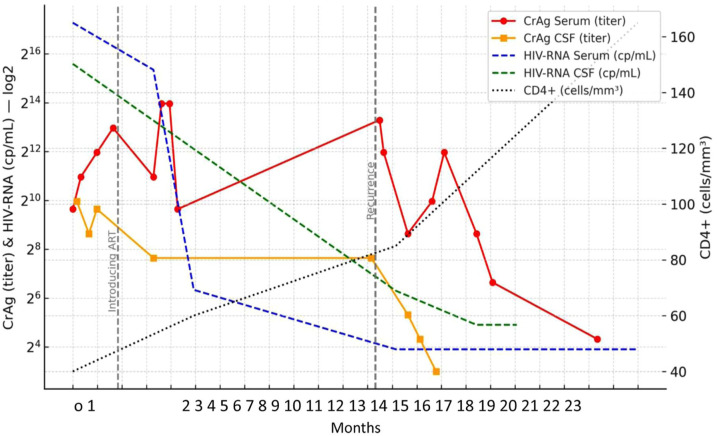 Figure 1
 Figure 2
Peer Reviews
No public reviews on file for this paper yet. If you reviewed it on a platform where reviews are public (OpenReview, ICLR, NeurIPS, ICML), you can paste yours below so the community can read it here.
Videos
No videos yet. Explain this paper in a talk, walkthrough, or lecture? Add one.
Taxonomy
TopicsFungal Infections and Studies · Nail Diseases and Treatments · Infectious Diseases and Tuberculosis