Assessing Visual Contributions to the Perception of Speech in Noise
Lida C. Alampounti, Hannah Cooper, Stuart Rosen, Jennifer K. Bizley

TL;DR
This study shows that visual cues beyond lipreading help people understand speech in noisy environments, improving auditory focus and speech perception.
Contribution
The study introduces a new audiovisual speech-in-noise test to evaluate visual contributions to auditory streaming and speech perception.
Findings
Both full audiovisual and interrupted visual conditions improved speech reception over static audio alone.
Visual coherence with the target talker provided the greatest listening advantage.
Interrupted visual cues still offered a robust benefit despite no lipreading information.
Abstract
Investigations of the role of audiovisual integration in speech-in-noise perception have largely focused on the benefits provided by lipreading cues. Nonetheless, audiovisual temporal coherence can offer a complementary advantage in auditory selective attention tasks. We developed an audiovisual speech-in-noise test to assess the benefit of visually-conveyed phonetic information and visual contributions to auditory streaming. The test was a video version of the Children's Coordinate Response Measure with a noun as the second keyword (vCCRMn). The vCCRMn allowed us to measure speech reception thresholds in the presence of two competing talkers under three visual conditions: a full naturalistic video (AV), a video which was interrupted during the target word presentation (Inter), thus, providing no lipreading cues, and a static image of a talker with audio (A). In each case, the…
Genes, proteins, chemicals, diseases, species, mutations and cell lines named across the full text — each resolved to its canonical identifier and authoritative record.
Click any figure to enlarge with its caption.
 Figure 1
 Figure 2
 Figure 3
 Figure 4
 Figure 5
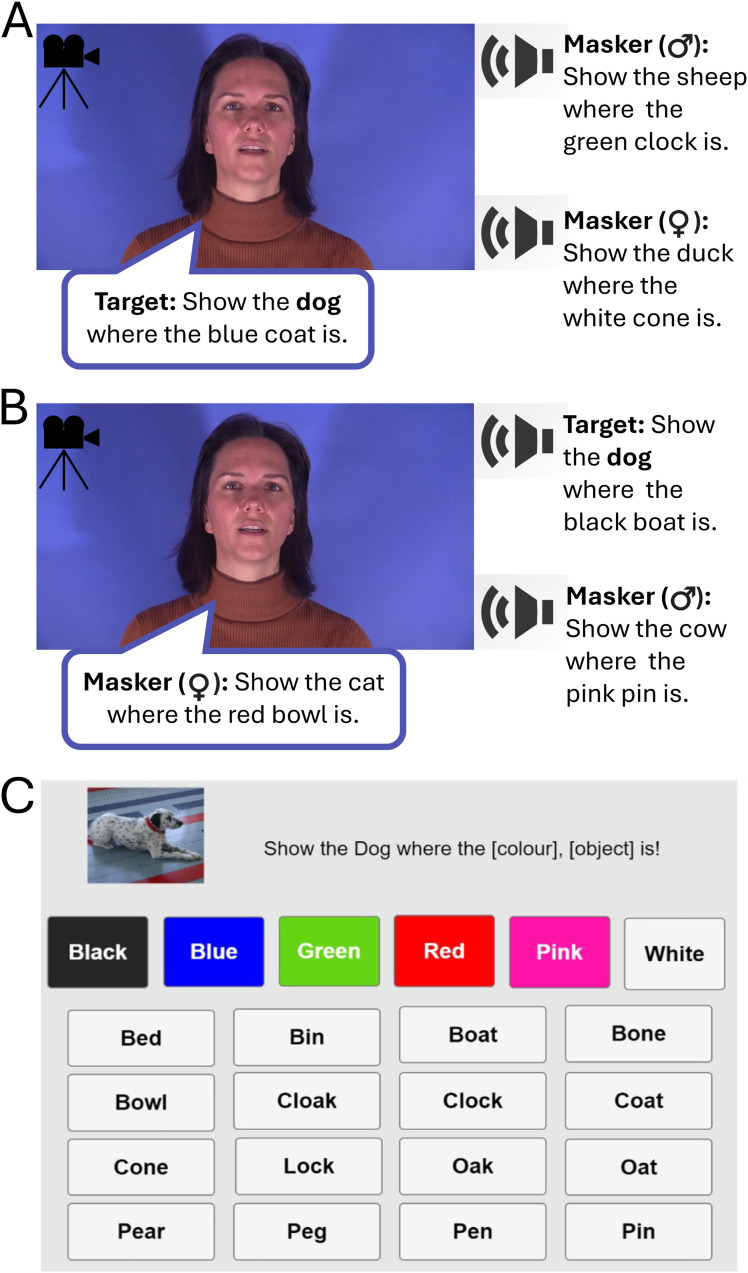 Figure 1
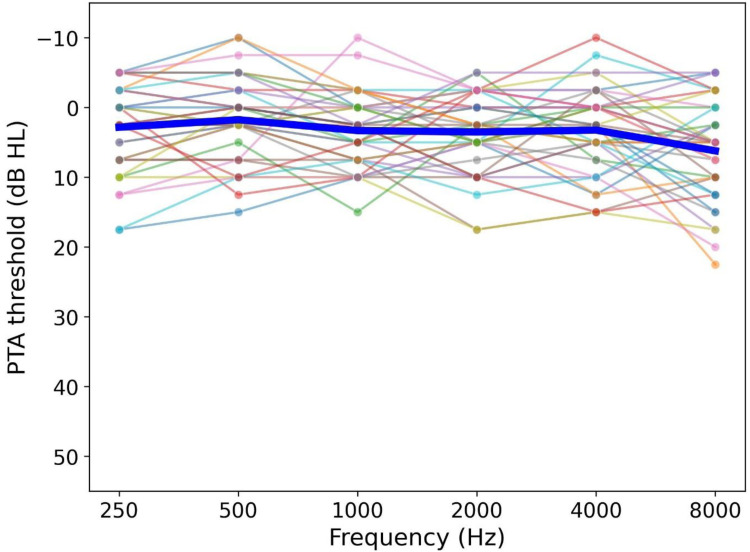 Figure 2
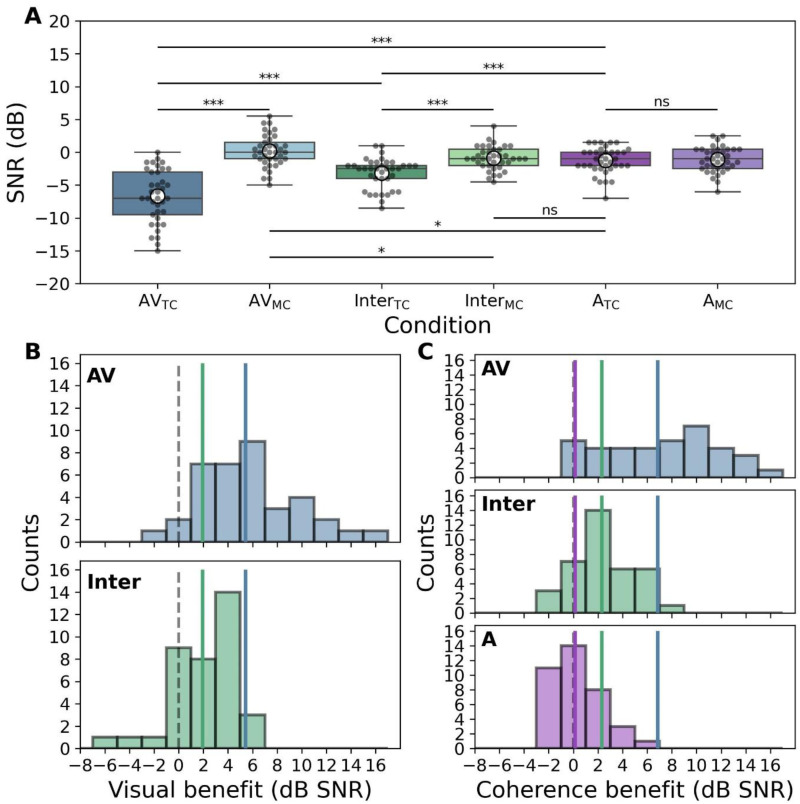 Figure 3
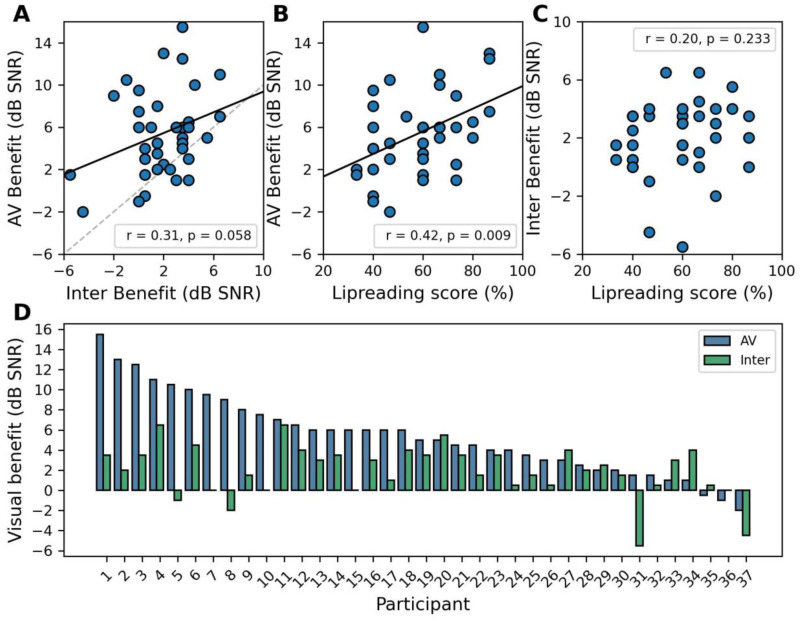 Figure 4
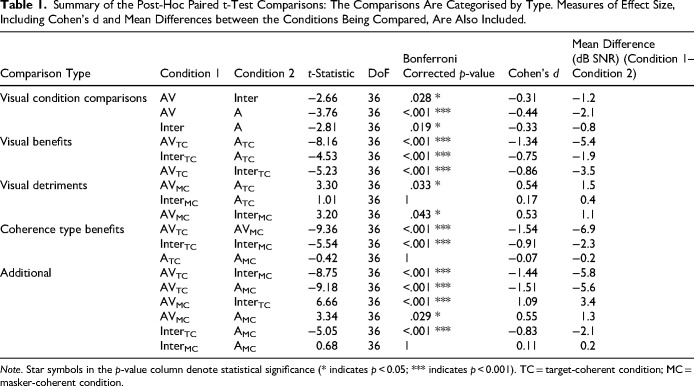 Figure 10
Peer Reviews
No public reviews on file for this paper yet. If you reviewed it on a platform where reviews are public (OpenReview, ICLR, NeurIPS, ICML), you can paste yours below so the community can read it here.
Videos
No videos yet. Explain this paper in a talk, walkthrough, or lecture? Add one.
Taxonomy
TopicsMultisensory perception and integration · Hearing Loss and Rehabilitation · Tactile and Sensory Interactions