Neuroendocrine prostate cancer (NEPC) in focus: state of the art and future prospectives
Emilio Francesco Giunta, Giuseppe Schepisi, Sara Bleve, Riccardo Serra, Nicole Brighi, Irene Torresan, Elisa Tassinari, Sofia Zanuccoli, Cristian Lolli

TL;DR
Neuroendocrine prostate cancer is a rare, aggressive form of prostate cancer that resists common treatments and is becoming more common due to new therapies.
Contribution
This review integrates recent findings on NEPC biology, diagnostics, and therapeutics to provide a forward-looking analysis.
Findings
NEPC is resistant to androgen receptor-directed therapies and has a poor prognosis.
The incidence of NEPC is increasing, likely due to the use of new AR pathway inhibitors.
NEPC often evolves from castration-resistant prostate cancer due to tumor lineage plasticity.
Abstract
Neuroendocrine Prostate Cancer (NEPC) is a rare and clinically aggressive subtype of Prostate Cancer (PCa) with its own biological behavior, unfavorable prognosis, and resistance to androgen receptor (AR) directed therapies. De novo NEPC account for less than 1% of PCa cases, whereas a later evolution from castration-resistant PCa (CRPC) to NEPC is more frequent (approximately 15–20% of cases), because of tumor lineage plasticity. The loss of AR signaling, low prostate-specific antigen (PSA) levels, visceral metastases, and significantly reduced survival are the main characteristics of this tumor subtype. In the last decade, the incidence of NEPC has increased, in conjunction with the increasingly frequent use of new AR pathway inhibitors (ARPIs) such as abiraterone, enzalutamide, apalutamide and darolutamide. The increasing incidence of NEPC and especially its disproportionate…
Genes, proteins, chemicals, diseases, species, mutations and cell lines named across the full text — each resolved to its canonical identifier and authoritative record.
Click any figure to enlarge with its caption.
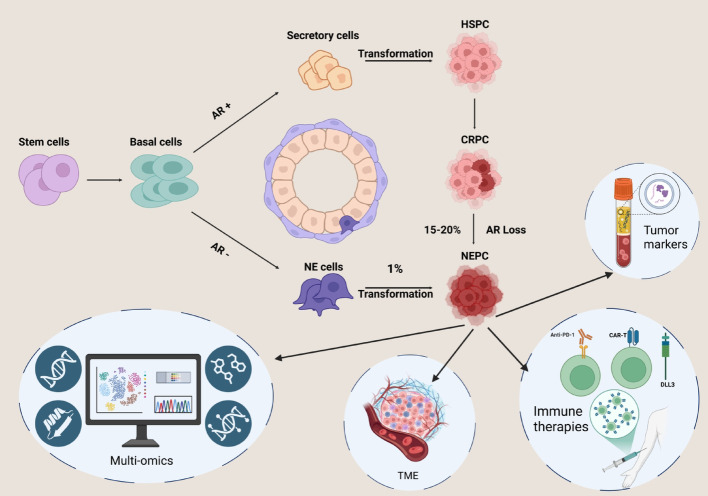 Figure 1
Peer Reviews
No public reviews on file for this paper yet. If you reviewed it on a platform where reviews are public (OpenReview, ICLR, NeurIPS, ICML), you can paste yours below so the community can read it here.
Videos
No videos yet. Explain this paper in a talk, walkthrough, or lecture? Add one.
Taxonomy
TopicsProstate Cancer Treatment and Research · Prostate Cancer Diagnosis and Treatment · Radiopharmaceutical Chemistry and Applications