Time course of functional and structural brain network changes after mild traumatic brain injury
Eunkyung Kim, Han Gil Seo, Roh-Eul Yoo, Byung-Mo Oh

TL;DR
This study shows that mild traumatic brain injury causes early functional brain network disruptions that recover over time, while structural changes remain stable and influence cognitive performance later.
Contribution
The study provides longitudinal evidence of functional recovery and later structure-cognitive coupling after mild traumatic brain injury.
Findings
Early functional disconnection between the default mode network and attention networks was observed in mild traumatic brain injury patients.
Functional connectivity normalized by follow-up, but structural connectivity remained stable with diffusion metrics linking to cognitive outcomes later.
Attentional performance in mild traumatic brain injury patients correlated with fractional anisotropy during the follow-up phase.
Abstract
Traumatic brain injury is a progressive and potentially persistent pathophysiological condition affecting multiple cognitive domains. Large-scale brain networks, particularly those supporting attention, are closely linked to these cognitive impairments. Additionally, functional network connectivity, which captures statistical dependencies among network time courses, has revealed disrupted coupling between attentional networks. However, longitudinal evidence on how functional network connectivity changes over time and whether such changes are related to structural connectivity or cognitive outcomes remains limited. To address these gaps, this study investigated functional and structural connectivity among the default mode network, dorsal attention network, and ventral attention network in 41 patients with mild traumatic brain injury (mean age: 48.7 ± 15.8 years) and 35 matched controls…
Genes, proteins, chemicals, diseases, species, mutations and cell lines named across the full text — each resolved to its canonical identifier and authoritative record.
Click any figure to enlarge with its caption.
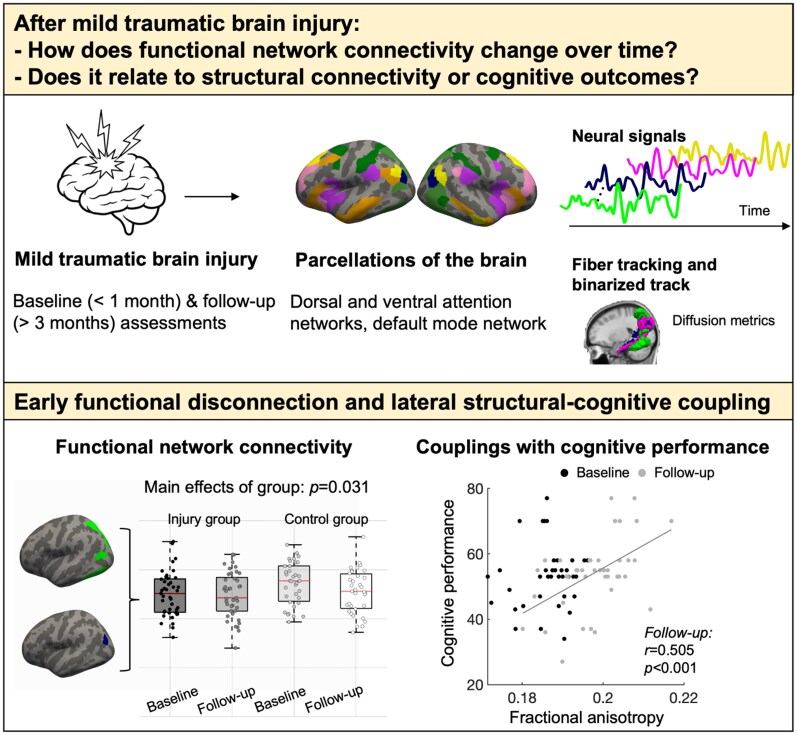 Figure 1
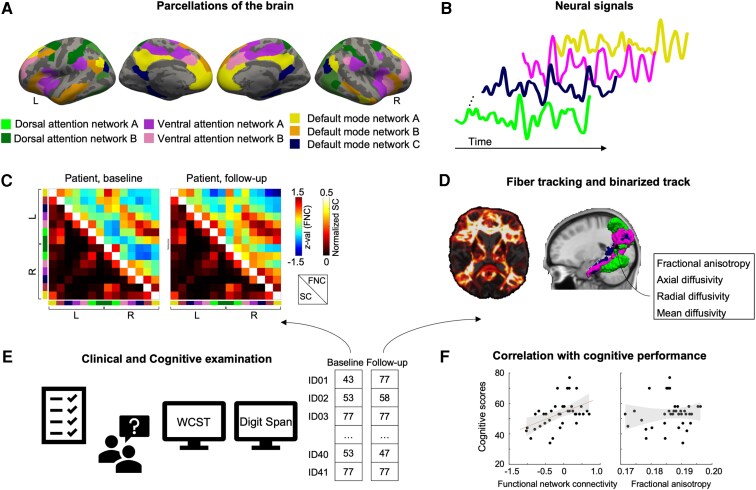 Figure 2
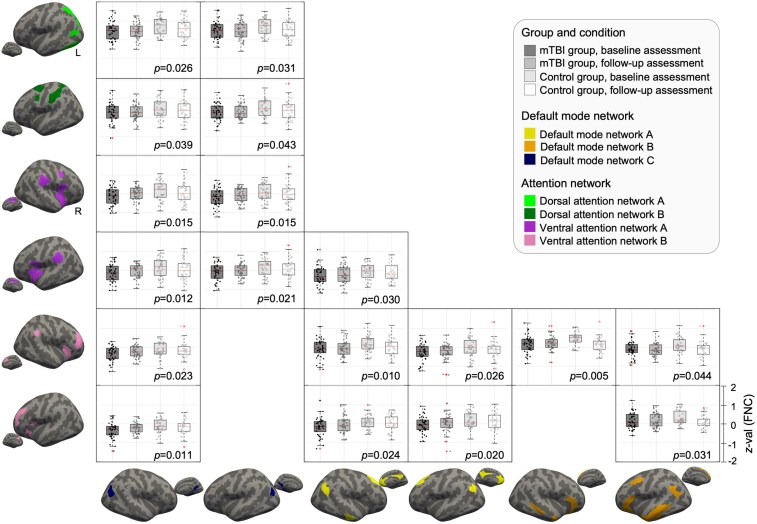 Figure 3
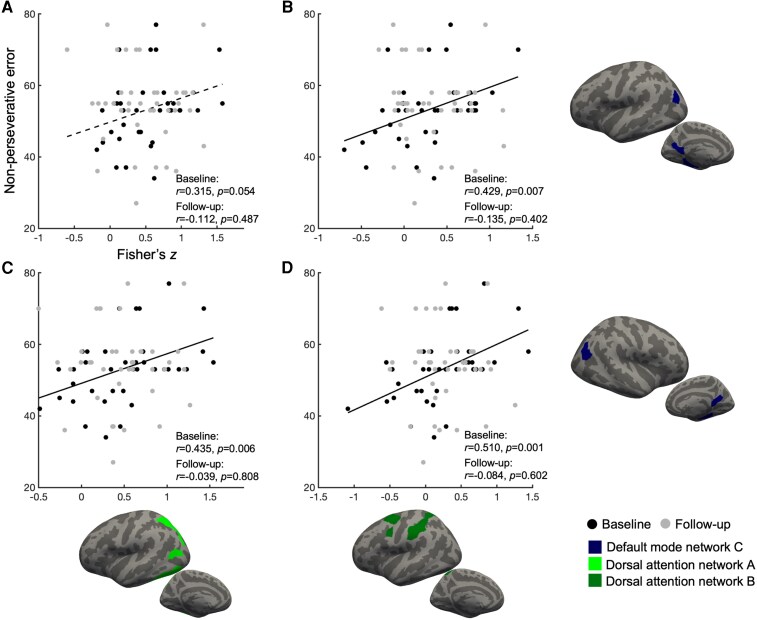 Figure 4
Peer Reviews
No public reviews on file for this paper yet. If you reviewed it on a platform where reviews are public (OpenReview, ICLR, NeurIPS, ICML), you can paste yours below so the community can read it here.
Videos
No videos yet. Explain this paper in a talk, walkthrough, or lecture? Add one.
Taxonomy
TopicsFunctional Brain Connectivity Studies · Traumatic Brain Injury Research · Mental Health Research Topics