Nocturnal Risk Assessment and Its Association With Anxiety Symptoms
Derek P. Spangler, Richa Gautam, Jennifer T. Kubota, Jasmin Cloutier, Nina Lauharatanahirun

TL;DR
This study finds that nighttime enhances threat-related attention and is linked to higher anxiety symptoms, suggesting that our body's response to danger varies with the time of day.
Contribution
The study introduces a novel task to show that nighttime selectively enhances attentional threat responses and their link to anxiety.
Findings
Nighttime, but not daytime, groups showed sustained cardiac deceleration to infection threat images.
Higher cardiac deceleration to infection images at night was associated with elevated anxiety symptoms.
Time-of-day modulates threat responses and anxiety phenotype expression, particularly for ambiguous illness-related threats.
Abstract
Human risk assessment (RA), the attentional and behavioral activities involved in detecting and analyzing threat, is feasibly enhanced at night to protect against hidden danger. However, this enhanced RA at night might come at a cost and thus signal increased risk for anxiety disorders. To test the hypothesis that the nighttime enhances RA and its associations with anxiety, the current study randomly assigned healthy volunteers (N = 87, Mean age = 22.4; 69% Female) to visit the laboratory at day or night. Participants completed a novel task that presented images depicting neutral content, injury threat (e.g., weapon) or infection threat (e.g., person sneezing). Each image was followed by a lottery decision. The task estimated RA's attentional component as threat‐induced bradycardia—cardiac deceleration to threat images. RA's behavioral component was estimated as threat‐induced risk…
Genes, proteins, chemicals, diseases, species, mutations and cell lines named across the full text — each resolved to its canonical identifier and authoritative record.
Click any figure to enlarge with its caption.
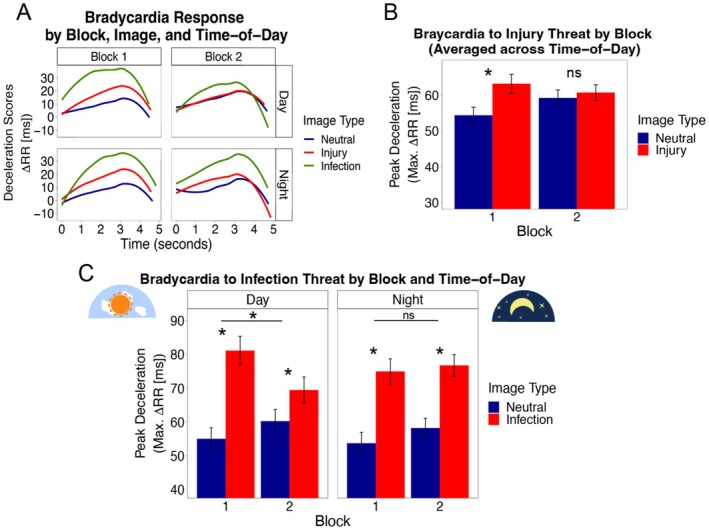 Figure 1
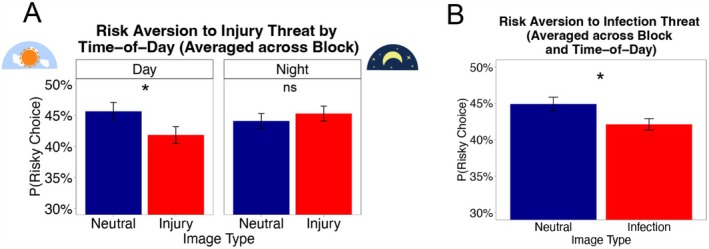 Figure 2
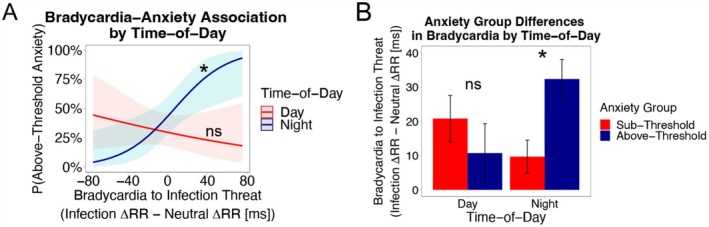 Figure 3
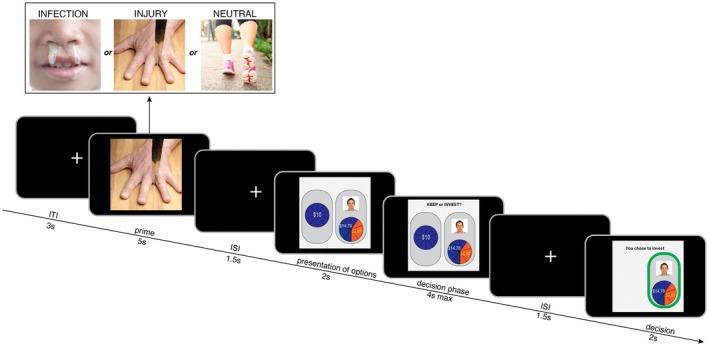 Figure 4
Peer Reviews
No public reviews on file for this paper yet. If you reviewed it on a platform where reviews are public (OpenReview, ICLR, NeurIPS, ICML), you can paste yours below so the community can read it here.
Videos
No videos yet. Explain this paper in a talk, walkthrough, or lecture? Add one.
Taxonomy
TopicsAnxiety, Depression, Psychometrics, Treatment, Cognitive Processes · Memory and Neural Mechanisms · Psychosomatic Disorders and Their Treatments