Machine learning and the role of the vaginal and fecal microbiome in miscarriage: a matched case-control study
Unnur Gudnadottir, Stefanie Prast-Nielsen, Nicole Wagner, Luisa W. Hugerth, Vilma Kuttainen Alderheim, Anusha T. Antony, Juan Du, Jorge Reis Guerreiro, Fredrik Boulund, Eva Wiberg-Itzel, Lars Engstrand, Ina Schuppe-Koistinen, Nele Brusselaers, Emma Fransson

TL;DR
This study explores how the vaginal and fecal microbiome, along with HPV infection, may predict miscarriage risk using machine learning and data from a Swedish cohort.
Contribution
The study introduces machine learning models for predicting miscarriage using microbiome and questionnaire data, highlighting specific microbiome types and HPV as risk factors.
Findings
Non-vaccine type HPV and specific vaginal microbiome types (CST II and CST-IVB) are associated with increased miscarriage risk.
Machine learning models achieved 81-85% accuracy in predicting miscarriage using microbiome and questionnaire data.
Combined data from vaginal and fecal microbiomes did not significantly improve prediction accuracy over individual data sources.
Abstract
Miscarriage occurs in approximately 15% of all pregnancies, and recent studies have suggested a potential role of the microbiome. A nested case-control study from the Swedish Maternal Microbiome cohort was conducted, including 34 participants who sent at least one vaginal or fecal microbiome sample and questionnaire data before miscarrying (n = 34), and matched controls (n = 105 for regression models, n = 27 for machine learning models). Non-vaccine type HPV (aOR 3.95, 95%CI 1.04–15.06) and vaginal microbiome with community state type (CST) II (aOR 6.52, 95%CI 1.58–26.98) or CST-IVB (aOR 4.18, 95%CI 1.08–16.18) in early pregnancy were associated with an increased risk of miscarriage. Furthermore, we explored six machine learning algorithms using 70% of the cohort for training and 30% for testing, for the prediction of miscarriage using vaginal (AUROC 85%), fecal (AUROC 81%) and…
Genes, proteins, chemicals, diseases, species, mutations and cell lines named across the full text — each resolved to its canonical identifier and authoritative record.
Click any figure to enlarge with its caption.
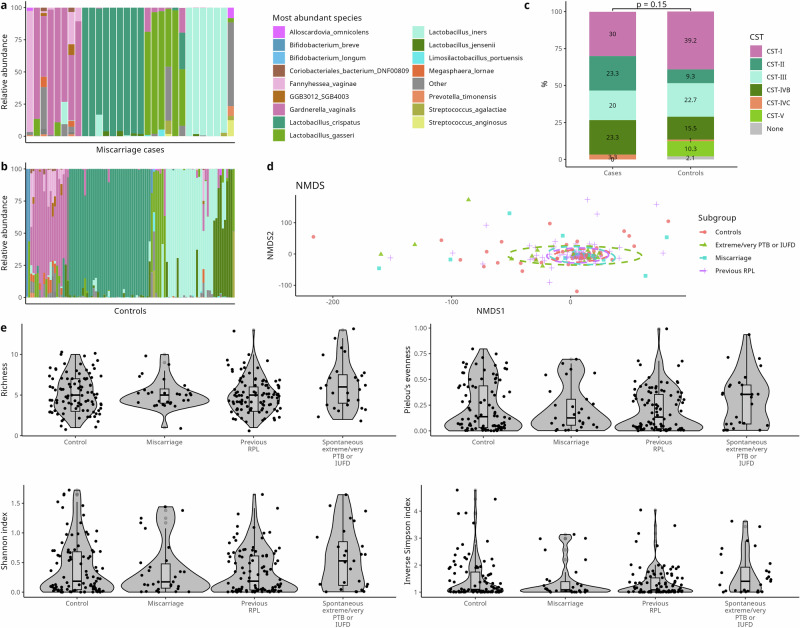 Figure 1
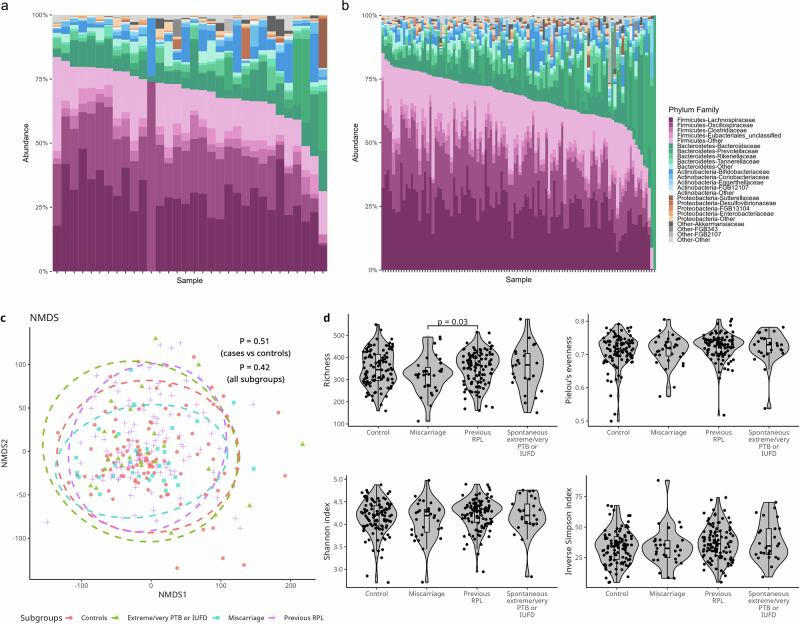 Figure 2
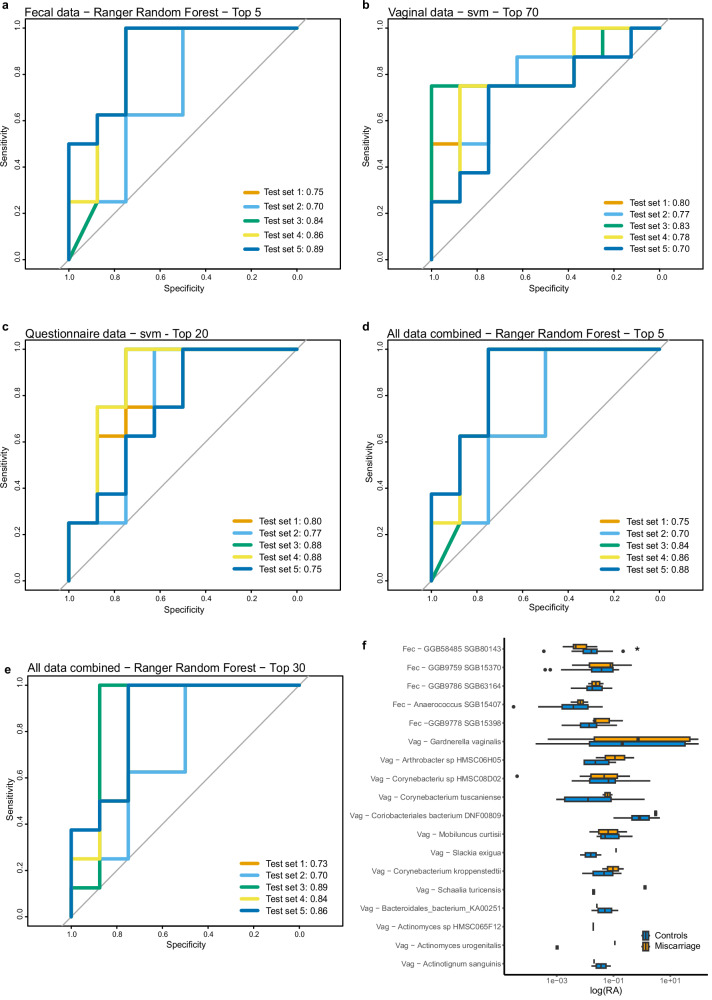 Figure 3
Peer Reviews
No public reviews on file for this paper yet. If you reviewed it on a platform where reviews are public (OpenReview, ICLR, NeurIPS, ICML), you can paste yours below so the community can read it here.
Videos
No videos yet. Explain this paper in a talk, walkthrough, or lecture? Add one.
Taxonomy
TopicsReproductive tract infections research · Reproductive System and Pregnancy · Preterm Birth and Chorioamnionitis