Heterogeneity Primer Spacers Improve the Performance of Massively Parallel Amplicon Sequencing of the V3-V4 Region of the 16 S rDNA as well as the 18 S Region for Blastocystis Subtyping
Ondrej Cinek, Klára Hubáčková, Karolína Litošová, Lucie Hlináková

TL;DR
This paper introduces a new method using heterogeneity spacers in PCR primers to improve sequencing performance for 16S and 18S rDNA marker genes.
Contribution
A systematic, algorithm-driven approach to designing heterogeneity spacers that increase sequencing diversity and eliminate the need for PhiX balancing.
Findings
Heterogeneity spacers improved sequencing signal diversity in 16S and 18S rDNA profiling.
The method was successfully applied to thousands of samples without requiring PhiX library balancing.
Staggered primer designs with spacers ensured equal representation of primer combinations.
Abstract
The Illumina MiSeq and NextSeq instruments are workhorses for many low- to medium-throughput amplicon sequencing applications in microbiology; however, their performance is highly sensitive to decreased diversity of libraries. Here, we present a systematic, algorithm-driven approach to designing heterogeneity spacers for amplification primers and demonstrate their use in two marker gene profiling applications. Heterogeneity spacers were designed to balance the sequencing signal, ensuring that no sequencing cycle contained more than 60% of a single dominant base. Additional bases were inserted into the first-round amplification primer adjacent to the target-specific portion. A simple script was written to remove the heterogeneity spacers from the reads, and verify equal representation of primer combinations. We designed sixteen staggered primer variants for profiling the V3-V4 regions of…
Genes, proteins, chemicals, diseases, species, mutations and cell lines named across the full text — each resolved to its canonical identifier and authoritative record.
Click any figure to enlarge with its caption.
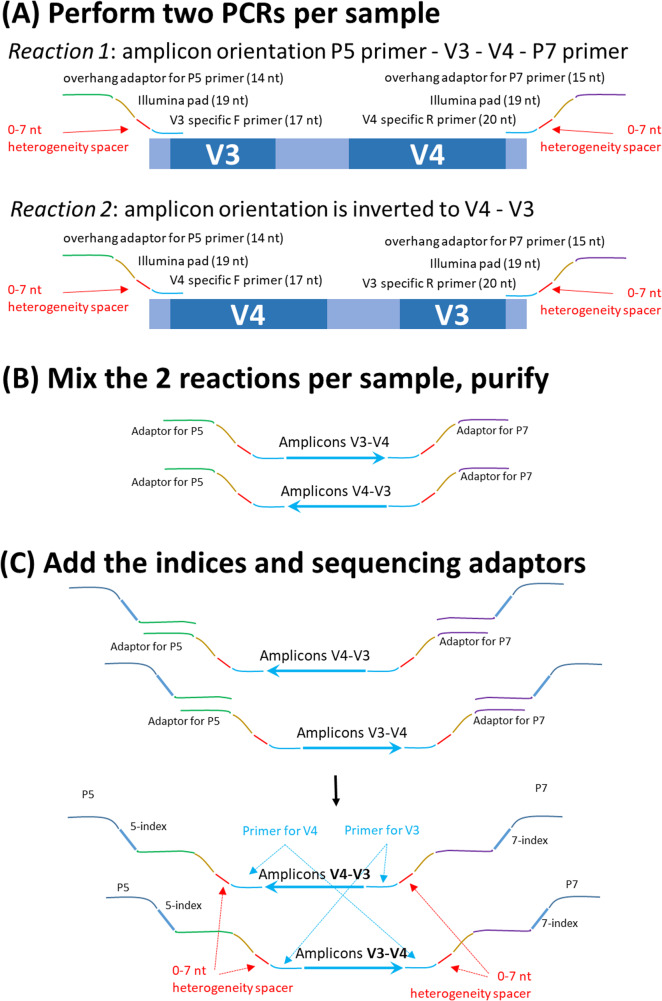 Figure 1
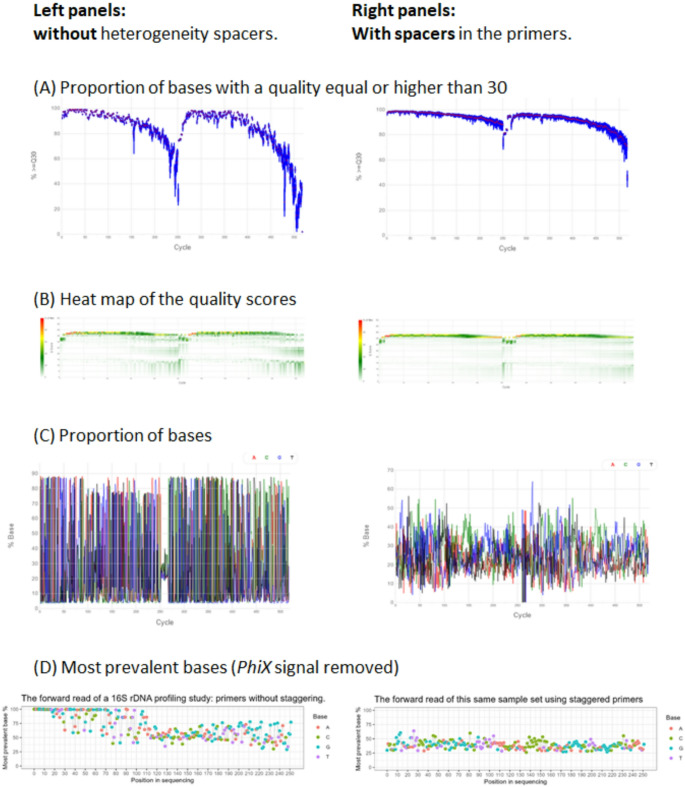 Figure 2
Peer Reviews
No public reviews on file for this paper yet. If you reviewed it on a platform where reviews are public (OpenReview, ICLR, NeurIPS, ICML), you can paste yours below so the community can read it here.
Videos
No videos yet. Explain this paper in a talk, walkthrough, or lecture? Add one.
Taxonomy
TopicsParasitic Infections and Diagnostics · Parasitic infections in humans and animals · Protist diversity and phylogeny