Automated calculation of background parenchymal enhancement as a biomarker of treatment responses and recurrence-free survival in breast cancer
Yihui Zhu, Roham Hadidchi, Hien Quang Nguyen, Surya Hariharan, Jeremy Weiss, Wei Hou, Chris Chung, Ha Manh Luu, Siddarth Ragupathi, Takouhie Maldjian, Tim Q. Duong

TL;DR
This study shows that automated MRI analysis of breast tissue can predict cancer treatment response and survival outcomes.
Contribution
The paper introduces an automated method to quantify background parenchymal enhancement (BPE) as a predictive imaging biomarker in breast cancer.
Findings
Automated BPE quantification strongly correlates with radiologist-defined BPE categories.
Baseline BPE is independently associated with improved overall survival in breast cancer patients.
Reduction in BPE after chemotherapy predicts pathological complete response in high and low baseline BPE groups.
Abstract
To determine whether automated quantification of background parenchymal enhancement (BPE) from dynamic contrast-enhanced MRI (DCE-MRI) can serve as an imaging biomarker for clinical outcomes including overall survival (OS), recurrence-free survival (RFS), and pathological complete response (pCR) in breast cancer. The multi-institutional data consisted of 922 biopsy-confirmed invasive breast cancer patients from the Duke-Breast-Cancer-MRI dataset and 152 patients with whole-breast pre- (T0) and/or post (T3) DCE-MRI from the I-SPY2 dataset for validation. Automated fibroglandular tissue (FGT) segmentation and BPE quantification were performed on DCE-MRI. The optimal intensity enhancement threshold by volume-based method was established against four radiologist-defined BPE categories. The area under the curve (AUC) was obtained for classification of BPE categories. Cox proportional…
Genes, proteins, chemicals, diseases, species, mutations and cell lines named across the full text — each resolved to its canonical identifier and authoritative record.
Click any figure to enlarge with its caption.
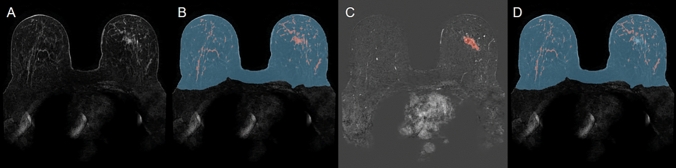 Figure 1
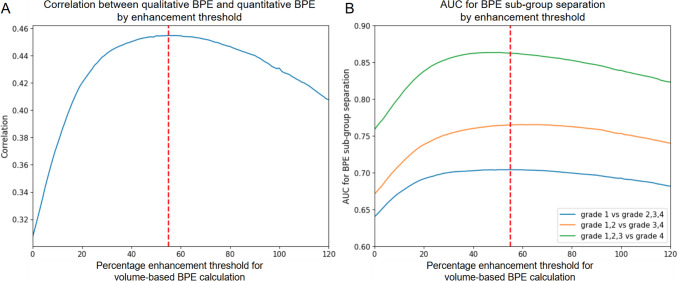 Figure 2
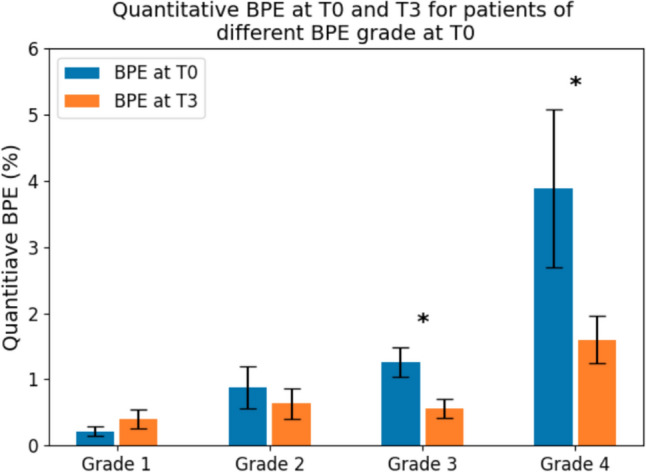 Figure 3
Peer Reviews
No public reviews on file for this paper yet. If you reviewed it on a platform where reviews are public (OpenReview, ICLR, NeurIPS, ICML), you can paste yours below so the community can read it here.
Videos
No videos yet. Explain this paper in a talk, walkthrough, or lecture? Add one.
Taxonomy
TopicsMRI in cancer diagnosis · Breast Cancer Treatment Studies · Radiomics and Machine Learning in Medical Imaging