A newborn with type 1 Bartter syndrome: challenges in the treatment and development during 30 months follow-up—a case report
Justyna Czubilińska-Łada, Anna Szymańska, Anna Sienko, Andrzej Badeński, Jakub Behrendt, Maria Szczepanska

TL;DR
A preterm infant with type I Bartter syndrome faced severe electrolyte issues and required long-term specialized care to manage his condition.
Contribution
This case report provides longitudinal insight into the challenges of managing neonatal-onset Bartter syndrome over 30 months.
Findings
Early diagnosis and targeted therapy with celecoxib stabilized electrolyte imbalances in a preterm infant with Bartter syndrome.
Long-term management required multidisciplinary care and adjustments in pharmacologic and nutritional therapy.
Persistent nephrocalcinosis was observed without deterioration in renal function over 30 months.
Abstract
Type I Bartter syndrome is a rare autosomal recessive tubulopathy resulting from mutations in the SLC12A1 gene, leading to defective sodium–chloride reabsorption in the thick ascending limb of the loop of Henle. Affected neonates typically present with profound fluid and electrolyte disturbances, polyuria, and metabolic derangements. Early diagnosis and individualized management are crucial to prevent life-threatening complications and support appropriate growth and development. We report the case of a male preterm infant born at 33 weeks’ gestation following a pregnancy complicated by severe polyhydramnios requiring multiple amnioreductions. At 2 weeks of age, he was admitted with severe dehydration, acute kidney injury (creatinine 205 µmol/L; eGFR 8 mL/min/1.73m2), marked polyuria (300 mL/kg/day), and significant electrolyte abnormalities, including hyponatremia, hypokalemia,…
Genes, proteins, chemicals, diseases, species, mutations and cell lines named across the full text — each resolved to its canonical identifier and authoritative record.
Click any figure to enlarge with its caption.
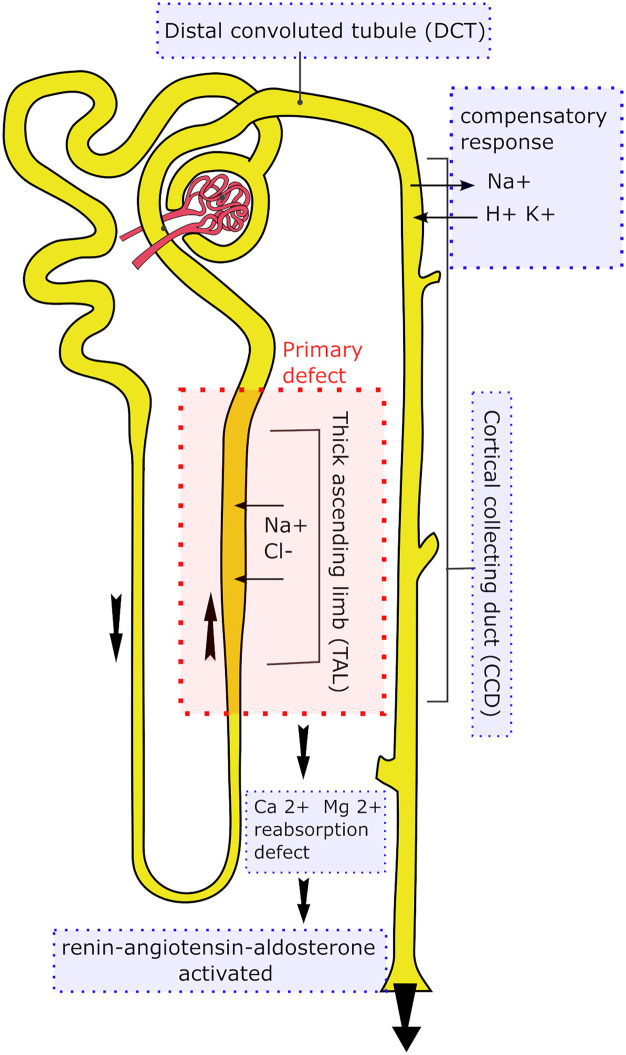 Figure 1
 Figure 2
Peer Reviews
No public reviews on file for this paper yet. If you reviewed it on a platform where reviews are public (OpenReview, ICLR, NeurIPS, ICML), you can paste yours below so the community can read it here.
Videos
No videos yet. Explain this paper in a talk, walkthrough, or lecture? Add one.
Taxonomy
TopicsIon Transport and Channel Regulation · Renal and related cancers · Ion channel regulation and function