Integrating Dimensional Personality and Autistic Traits to Predict Suicidal Ideation, Suicide Attempts, and Nonsuicidal Self‐Injury in Autistic Adults
Aliona Tsypes, Timothy A. Allen, Ligia Antezana, Kelly B. Beck, Caitlin M. Conner, Lori N. Scott, Carla A. Mazefsky

TL;DR
In autistic adults, low enjoyment of activities and social difficulties are linked to higher risks of suicidal thoughts and self-harm, suggesting the need for targeted screening and support.
Contribution
This study integrates autism-specific traits and personality dimensions to identify novel predictors of suicidal and self-harming behaviors in autistic adults.
Findings
Lower enjoyment of daily activities and greater social difficulties were consistently linked to higher risk of suicidal ideation, attempts, and NSSI.
Rapid mood swings were robustly associated with self-harm and more severe suicidal thinking.
Higher IQ showed a modest protective effect against suicide attempts.
Abstract
Given the elevated rates of suicidal ideation, suicide attempts, and nonsuicidal self‐injury (NSSI) in autistic adults, we examined whether autism‐informed traits and transdiagnostic personality tendencies jointly relate to these outcomes. One hundred and two adults with clinician‐diagnosed autism completed structured clinical interview assessments of lifetime histories of suicidal ideation, attempts, and NSSI. Predictors were six Comprehensive Autistic Trait Inventory (CATI) subscales and selected Personality Inventory for DSM‐5 Short Form (PID‐5‐SF) domains and facets. We fit CATI‐only, PID‐5 domain, and facet models, then combined significant predictors and refit with age, sex, and IQ as covariates. Shared variance between PID‐5‐SF facet Anhedonia and CATI Social Interactions showed suppression in joint models, and latent variable modeling confirmed that their shared…
Genes, proteins, chemicals, diseases, species, mutations and cell lines named across the full text — each resolved to its canonical identifier and authoritative record.
Click any figure to enlarge with its caption.
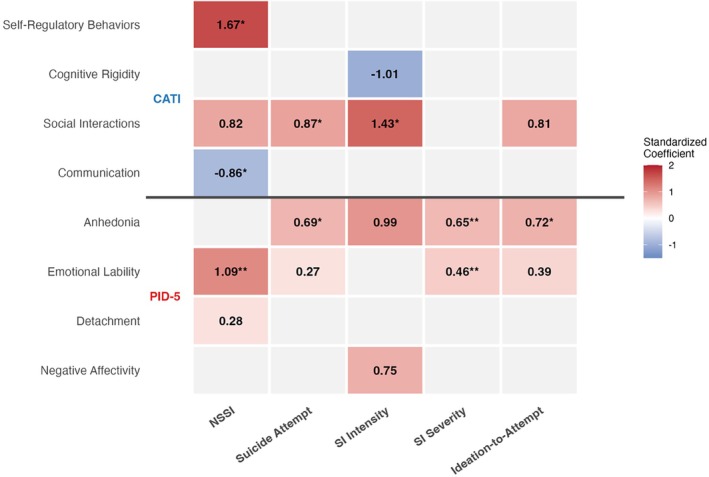 Figure 1
Peer Reviews
No public reviews on file for this paper yet. If you reviewed it on a platform where reviews are public (OpenReview, ICLR, NeurIPS, ICML), you can paste yours below so the community can read it here.
Videos
No videos yet. Explain this paper in a talk, walkthrough, or lecture? Add one.
Taxonomy
TopicsAutism Spectrum Disorder Research · Suicide and Self-Harm Studies · Personality Disorders and Psychopathology
Autistic adults experience significantly elevated rates of suicidal ideation, suicide attempts, and nonsuicidal self-injury (NSSI), with up to one-third having attempted (Bentum et al., 2024; Brown et al., 2024; Cassidy et al., 2018; Maddox et al., 2017; Newell et al., 2023; Schwartzman et al., 2025; Steenfeldt-Kristensen et al., 2020). Although self-injurious thoughts and behaviors (SITB) are intercorrelated, they are distinct processes with different functions. Specifically, NSSI is separate from suicidal thinking and behavior due to its lack of suicidal intent (Hooley et al., 2020; Klonsky et al., 2014; Nock & Favazza, 2009). Further, contemporary ideation-to-action theories (Klonsky & May, 2015; O’Connor & Kirtley, 2018; Van Orden et al., 2010) separate the formation of suicidal ideation from a transition to suicide attempts. While the scale of this issue is now well-documented, the field has only begun to move beyond establishing prevalence toward identifying the individual difference factors that differentiate autistic people who engage in NSSI, those who contemplate suicide, and those who attempt it.
Personality traits, typically conceptualized as relatively stable patterns of thinking, feeling, and behaving, provide a promising lens for understanding these distinct thoughts and behaviors. These traits describe how intensely and how often people experience certain emotional states and how readily they translate urges into action. Such a lens is particularly relevant for autism, where chronic stressors (e.g., sensory overload, social isolation, or exclusion) are pervasive and can overtax coping resources (Beck et al., 2024; Lai, 2023; Mournet et al., 2024; Zhuang et al., 2023). When such pressures intersect with a tendency toward strong emotional reactivity or impulsive responding, crisis risk may escalate; conversely, personality traits linked to planning or emotional stability may buffer against SITB. Despite this logic, empirical work on personality trait-based vulnerability to SITB in autistic adults remains sparse, commonly limited to measures of depression or general social support (Brown et al., 2024; Mournet et al., 2024).
An autism-informed perspective is a useful starting point for this investigation. The Comprehensive Autistic Trait Inventory (CATI; English et al., 2021, 2025) offers a modern, community-informed assessment of six domains that are central to autistic experience: Social Interactions, Communication, Social Camouflage, Self-Regulatory (Repetitive) Behaviors, Cognitive Flexibility, and Sensory Sensitivity. The CATI was designed to capture diagnostically relevant autistic traits, and its neutral, community-vetted wording makes it a less stigmatizing option than many legacy instruments. CATI improves on legacy instruments by the inclusion of domains (i.e., camouflaging) that capture autistic adult experiences beyond just diagnostic features. In doing so, the CATI also measures features that have clear relevance to SITB (Brown et al., 2024; Cassidy et al., 2018). Social Camouflage indexes masking and effortful compensatory strategies that autistic people use to appear non-autistic. Self-Regulatory (Repetitive) Behaviors describe repetitive or patterned actions that can help alleviate stress or anxiety. Cognitive Flexibility taps preference for sameness and difficulty with change, which can intensify distress during disruptions. Sensory Sensitivity indexes reactivity to environmental stimuli that can precipitate overload. The Social Interactions and Communication scales capture the desire for social contact, perceived competence in interactions, and use and understanding of nonverbal communication. By measuring these specific domains, the CATI allows for a direct examination of how core autistic experiences contribute to SITB. However, despite the strengths of CATI in overcoming numerous limitations of prior self-report measures of autistic traits (English et al., 2021, 2025), no studies of which we are aware have examined the links between CATI-assessed traits and SITB in autistic adults, which was our first goal.
Broader trait taxonomies may also have utility in understanding SITB within autism, as they describe general personality tendencies that cut across diagnostic groups and show partial (Widjaja et al., 2025) or full (Wakabayashi et al., 2006) independence from autistic traits. Considering these personality traits may provide additional insights into vulnerabilities for SITB that have not been previously examined in autistic samples. Factor analytic research has consistently shown that both adaptive and maladaptive features of personality can be described by a single structural framework that includes five broad domains: Neuroticism, Extraversion, Agreeableness, Conscientiousness, and Openness (John et al., 2008; Markon et al., 2005). The DSM-5 dimensional model^1^ of personality similarly groups related tendencies into five domains: Negative Affectivity, Detachment, Antagonism, Disinhibition, and Psychoticism. These domains roughly parallel the Big Five (though the mapping from Openness to Psychoticism is not one-to-one; see Suzuki et al., 2017), while emphasizing the tendencies that can create persistent strain in daily life. Negative Affectivity reflects the propensity for intense negative emotion and volatility, Detachment reflects reduced interest in social engagement and diminished pleasure, Antagonism reflects interpersonal exploitation and self-focus, Disinhibition reflects impulsivity and limited behavioral regulation, and Psychoticism reflects unconventional thought and perception. The Personality Inventory for DSM-5 (PID-5; Krueger et al., 2012) operationalizes these domains and, crucially for the present study, provides facet-level indicators that enable a fine-grained view of the specific tendencies that may drive risk. In the current study, we focus on the personality domains of Negative Affectivity, Detachment, and Disinhibition, and their facets, as these traits have the strongest theoretical and empirical ties to suicidal ideation, attempts, and NSSI.
Internalizing and externalizing tendencies appear to support different stages of the suicidal process, although evidence largely comes from non-autistic samples. Within the motivational–volitional framework, internalizing processes contribute to the onset and maintenance of suicidal ideation, whereas externalizing processes help drive the transition from thoughts to suicidal behavior (O’Connor & Kirtley, 2018). Consistent with this, impulsivity (a facet of Disinhibition) has differentiated people with histories of suicidal ideation from those with attempts in several studies (e.g., Dhingra et al., 2015; Nock et al., 2018). Related work shows that higher Negative Affectivity can amplify the link between interpersonal stress and suicidal ideation, while Disinhibition is more closely tied to attempts (Allen et al., 2022). With regard to NSSI, meta-analytic and longitudinal studies indicate associations with both high Negative Affectivity (especially emotional lability; Peters et al., 2016) and impulsivity (e.g., Brezo et al., 2006; Hamza et al., 2015; You et al., 2016). Further, empirical work robustly links SITB with anhedonia, a facet of Detachment, and broader reward-related processes (e.g., Antezana et al., 2024; Bettis et al., 2022; Ducasse et al., 2018; Tsypes et al., 2018, 2019, 2021) and interpersonal processes (Hutchinson et al., 2025; Janssens et al., 2024). Taken together, consideration of transdiagnostic personality features has contributed to an improved understanding of SITB in non-autistic samples, differentially implicating Negative Affectivity, Detachment, and Disinhibition – and in some cases, individual facets within these domains – in suicidal ideation, suicide attempts, and NSSI. The second goal of the present study was to examine how transdiagnostic personality traits, viewed through the lens of the Big Five framework, contribute to SITB in autistic adults.
Autism shows a distinctive trait profile that further motivates combining both autism-informed and broader trait taxonomy-informed measures. Meta-analytic work indicates lower average levels across Big Five domains compared to non-autistic peers (Lodi-Smith et al., 2019). Conceptual accounts also suggest that autism is characterized by reduced draw to novelty and social reward (Rogers et al., 2023), which may relate to SITB in autistic people (Hedley et al., 2021; Reid et al., 2024). Thus, considering autistic and general personality traits in conjunction may offer a more nuanced picture of shared and unique risk factors for SITB. CATI targets experiences central to autistic life that are not fully represented in broad trait models, whereas the PID-5 provides a broader, well-validated dimensional taxonomy of personality that may help to identify features that are underassessed in autistic people but that are nonetheless critical to the development of SITB. Empirical work also suggests partial overlap. For example, social autism traits map onto Extraversion/Detachment (Widjaja et al., 2025), but cognitive and behavioral features are less well represented (Michelini et al., 2024; Stanton et al., 2021; Widjaja et al., 2025). Together, these points underscore the utility of combining CATI and PID-5 to get a full picture of risk for SITB in autistic adults, which was the third goal of the present study.
In sum, the present study sought to integrate CATI and PID-5 to examine trait contributions to SITB among autistic adults capable of consenting and self-report. Specifically, we focused on lifetime histories of NSSI and suicide attempts, as well as suicidal ideation severity (the highest stage ever reached on the ideation-to-plan trajectory) and suicidal ideation intensity (strength and persistence during the worst lifetime episode). We further tested whether trait profiles distinguished people with lifetime suicidal ideation from those with a history of at least one suicide attempt (ideation-to-attempt transition). We focused on three questions: (1) Are CATI domains associated with SITB? (2) Are PID-5 domains and facets associated with SITB? (3) Of the CATI domains and PID-5 facets identified as significant in steps (1) and (2), which remain the strongest predictors when considered together? Guided by ideation-to-action theories (Klonsky & May, 2015; O’Connor & Kirtley, 2018; Van Orden et al., 2010), we hypothesized that Negative Affectivity and Detachment (particularly the Anhedonia facet) would relate most strongly to ideation, Disinhibition would distinguish people with ideation versus attempt history, and NSSI would show contributions from all three domains (particularly Negative Affectivity domain and its facet Emotional Lability). Analyses of CATI domains were exploratory.
Methods
Participants
Participants were recruited from community partners, local sources, and research registries. Recruitment approaches are detailed further in Mazefsky et al. (2025). Participants in this study included 102 autistic adults (67 female) between the ages of 18 and 65 (mean = 31.06, SD = 9.27) with self-reported ability to read English. In this sample, 41 participants had lifetime suicidal ideation only, 38 had at least one suicide attempt, and 63 reported lifetime NSSI engagement. Autism diagnosis was determined through the Autism Diagnostic Observation Schedule- Second Edition (ADOS-2; Lord et al., 2012) administered by a trained clinician and a brief clinical interview based on the DSM-5 checklist (Williams & Lewis, 2021). Participants were excluded if a clinician, tester, or investigator determined that they would be unable to complete the study tasks required of the parent study (see Mazefsky et al., 2025). Additional exclusion criteria included the presence of current mania, psychosis, or severe alcohol/substance use that could interfere with participation. Written informed consent was obtained from all participants prior to study participation, and the Institutional Review Board approved all procedures. Mean IQ was 115.70 (SD = 13.97); 41 participants held a bachelor’s degree or higher; 47 had some college, associate, or vocational/technical training; 12 had a high-school diploma or equivalent; 2 did not report their education.
Measures
Columbia-Suicide Severity Rating Scale (C-SSRS; Posner et al., 2011).
The C-SSRS is a semi-structured clinical interview designed to assess lifetime SITB. Core questions were dichotomous (ideation, attempts, preparatory acts), followed by probes on ideation and attempt characteristics. Administration was adapted for autistic adults: a five-step “thermometer” to anchor ideation from passive wish to plan with intent, calendar grids to date attempts, and written versions of longer questions and response options. Interviewers practiced under supervision until their ratings matched study standards and met weekly to settle scoring questions. We analyzed the highest lifetime ideation severity (highest score: intent with specific plan) and worst-episode ideation intensity among ideators (sum of frequency, duration, reasons, deterrents, controllability).
Self-Injurious Thoughts and Behaviors Interview (SITBI; Nock et al., 2007).
Selected items captured NSSI history and characteristics. We incorporated visuals and an autism-focused NSSI framework (Antezana et al., 2025).
Wechsler Abbreviated Scale of Intelligence, Second Edition (WASI-II; Wechsler, 2011). The WASI-II provides a general estimate of cognitive ability and is normed for ages 6–90 years. For this study, an examiner administered the two-subscale version, which consisted of one verbal and one perceptual reasoning subtest yielding an overall IQ score. The 2-subscale IQ demonstrates strong validity and reliability with a full-scale IQ score (Wechsler, 2011).
Personality Inventory for DSM-5 Short Form (PID-5-SF; Maples et al., 2015).
The PID-5-SF is a 100-item self-report measure of personality traits. Items are rated from 0 (“very false or often false”) to 3 (“very true or often true”), and higher scores indicate greater expression of each trait. Negative Affectivity (α = 0.85) facets are Emotional Lability (α = 0.87), Anxiousness (α = 0.87), and Separation Insecurity (α = 0.80). Detachment (α = 0.84) facets are Withdrawal (α = 0.80), Anhedonia (α = 0.87), and Intimacy Avoidance (α = 0.87). Disinhibition (α = 0.82) facets are Impulsivity (α = 0.87), Distractibility (α = 0.80), and Irresponsibility (α = 0.57).
Comprehensive Autistic Trait Inventory (CATI; English et al., 2021; 2025).
The CATI is a 42-item self-report measure of autistic traits. Respondents rate each item from 1 (“strongly disagree”) to 5 (“strongly agree”). Items form six subscales: Social Interactions (α = 0.86), Communication (α = 0.69), Social Camouflage (α = 0.74), Self-Regulatory (Repetitive) Behaviors (α = 0.74), Cognitive Rigidity/Flexibility (α = 0.74), and Sensory Sensitivity (α = 0.69), with higher scores reflecting greater endorsement of autistic traits.
Results
Analytical approach
For each outcome (NSSI, suicide attempts, suicidal ideation intensity, suicidal ideation severity, and ideation-to-attempt transition), we fit three models in sequence: (1) a six-subscale CATI model; (2) a three-domain PID-5 model (Negative Affectivity, Disinhibition, Detachment); and (3) three-facet PID-5 models within each PID-5 domain. For a domain, if none of its three facets were significant, we advanced the domain score (if significant) to the joint model. Given the nested structure of facets within a given domain, if any facet was significant, we advanced only the significant facet(s) and omitted the domain score. The final joint model included all significant CATI subscales plus these PID-5 predictors and was re-estimated with covariates (age, sex, IQ). All continuous predictors (CATI subscales, PID-5 facets, IQ, and age) were standardized (z-scored) prior to analysis. Higher CATI and PID-5 scores indicate greater difficulty in the corresponding domain or facet. Table 1 presents descriptive statistics for sample characteristics, SITB outcomes, and predictor variables, including means, standard deviations, and observed ranges for continuous measures, and frequencies and percentages for binary outcomes.^2^
Lifetime NSSI
(Table 2)
CATI six-subscale model.
Self-Regulatory (Repetitive) Behaviors and Social Interactions were positively associated with NSSI; Communication was negatively associated with NSSI.
PID-5 three-domain model.
Detachment was positively associated with NSSI.
Three-facet PID-5 models.
Negative Affectivity facet Emotional Lability was positively associated with NSSI.
Final models.
In the joint model, CATI Self-Regulatory (Repetitive) Behaviors and PID-5 Emotional Lability were positively associated with NSSI, whereas CATI Communication was inversely associated with NSSI. Effects were unchanged with covariates. The CATI Social Interactions association observed in the CATI-only screen and the PID-5 Detachment effect in the domain-level model were both attenuated in the joint model, potentially due to suppression (i.e., shared variance between the scales).
Lifetime Suicide Attempts (Table
CATI six-subscale model.
Social Interactions was positively associated with lifetime attempts.
PID-5 three-domain model.
Negative Affectivity was positively associated with lifetime attempts.
Three-facet PID-5 models.
Detachment facet Anhedonia and Negative Affectivity facet Emotional Lability were each positively associated with attempts in facet screens.
Final models.
In the joint model, PID-5 Anhedonia was positively associated with lifetime attempts. With covariates, both PID-5 Anhedonia and CATI Social Interactions were positively associated with lifetime attempts. In contrast, IQ was inversely associated with lifetime attempts.
Lifetime Suicidal Ideation Intensity (Table
CATI six-subscale model.
Cognitive Flexibility was negatively associated with ideation intensity, whereas Social Interactions was positively associated with ideation intensity.
PID-5 three-domain model.
Negative Affectivity was positively associated with ideation intensity.
Three-facet PID-5 models.
Detachment facet Anhedonia was positively associated with ideation intensity.
Final models.
In the joint model without covariates, no predictor reached significance. With covariates, CATI Social Interactions was positively associated with ideation intensity, though the effect was weaker than in the CATI-only model. Once again, this suggests potential suppression between predictors in the joint model (i.e., shared variance between the scales).
Lifetime Suicidal Ideation Severity (Table
CATI six-subscale model.
No subscale reached statistical significance.
PID-5 three-domain model.
Detachment and Negative Affectivity were positively associated with ideation severity.
PID-5 three-facet models.
Detachment facet Anhedonia and Negative Affectivity facet Emotional Lability were positively associated with ideation severity.
Final models.
In the joint model, both PID-5 Anhedonia and PID-5 Emotional Lability were positively associated with ideation severity. Both effects remained significant with covariates.
Ideation-to-Attempt Transition (n = 79; Table
CATI six-subscale model.
Social Interactions was significantly higher in people with a lifetime suicide attempt relative to lifetime suicidal ideation.
PID-5 three-domain model.
No domain reached statistical significance.
PID-5 three-facet models.
Detachment facet Anhedonia and Negative Affectivity facet Emotional Lability were each significantly higher in people with lifetime suicide attempt relative to lifetime suicidal ideation.
Final models. In the joint model, PID-5 Anhedonia was higher among those with attempts than ideation only, though the effect was weaker than in the facet-only model. Emotional Lability and CATI Social Interactions did not reach statistical significance in joint models. Higher IQ showed a marginal inverse association after covariate adjustment.
Figure 1 displays the standardized regression coefficients from the final adjusted models for all trait predictors across the five SITB outcomes, illustrating the pattern of associations and highlighting both shared and outcome-specific predictors.
Exploratory Analyses (Latent Factors)
Exploratory latent-variable models fit in Mplus (Muthén & Muthén, 2019) tested whether shared variance between CATI Social Interactions (SOC) and PID-5 Detachment/Anhedonia contributed to the suppression we observed in joint regressions. We first fit measurement models using Bayesian confirmatory factor analysis. In the first model, we specified a latent Detachment factor from the PID-5 Detachment facets (Withdrawal, Intimacy Avoidance, Anhedonia) and the CATI Social Interactions. The model was an excellent fit to the data (CFI = 1.00, RMSEA < 0.001), with all scales loading significantly on the latent Detachment factor. In the second model, we specified a latent Anhedonia factor from individual PID-5 Anhedonia items and the CATI Social Interactions scale. The second model also demonstrated excellent fit to the data (CFI = 1.00, RMSEA < 0.001), with all indicators having significant factor loadings. Next, we substituted the latent Detachment and Anhedonia factors into the models where we had observed suppression in place of CATI Social Interactions and PID-5 Detachment or Anhedonia, respectively (all covariates were retained). Latent Detachment significantly predicted lifetime NSSI (β = 0.46, p = 0.036, 95% CI = 0.06, 0.74). Likewise, latent Anhedonia significantly predicted ideation intensity (β = 0.29, p < 0.001, 95% CI = 0.07, 0.50) and was higher among those with attempts than ideation only (β = 0.44, p < 0.001, 95% CI = 0.17, 0.66). This suggests that CATI Social Interactions shares variance with both the higher-order Detachment domain and the lower-order Anhedonia facet; whereas the former predicts NSSI, the latter predicts ideation intensity and attempt history (relative to ideation only). Moreover, shared variance between these scales accounts for their attenuated effects in the joint models reported above.
Discussion
This study integrated an autism-informed trait inventory with a broader trait taxonomy-informed measure to identify personality correlates of SITB in autistic adults. Three patterns were consistent across models. First, Detachment facet Anhedonia was associated with higher ideation severity and higher odds of lifetime suicide attempts and the ideation-to-attempt transition. Second, the Negative Affectivity facet Emotional Lability was a strong correlate of NSSI and ideation severity. Third, several CATI domains added complementary information, with higher Social Interactions scores predicting greater risk across most outcomes, Self-Regulatory (Repetitive) Behaviors scores predicting NSSI, and Communication scores inversely relating to NSSI. After covariate adjustment, higher IQ also showed a small protective association with lifetime suicide attempts. Notably, exploratory latent-factor models demonstrated that shared variance between PID-5 Detachment/Anhedonia and CATI Social Interactions was predictive of several outcomes. Thus, while both autism-specific traits and broader personality dimensions provide incremental validity for SITB in autism, there is also important overlap between the two, highlighting a partially shared underlying trait architecture.
Anhedonia was the most consistent correlate of risk in the joint models. Overall, the Anhedonia facet reflects low interest and enjoyment in routine activities (e.g., “Nothing seems to interest me very much,” “I almost never enjoy life”). Converging work in non-autistic samples links anhedonia and broader reward-related deficits to persistent suicidal ideation and attempts, with effects seen across questionnaires and experimental paradigms that probe reward responsivity, learning, and valuation (e.g., Antezana et al., 2024; Bettis et al., 2022; Ducasse et al., 2018; Tsypes et al., 2018, 2019, 2021). Reward blunting present in anhedonia may reduce the perceived value of alternatives to suicide, weaken deterrents (reasons for living), and sustain suicidal thinking. Future work is needed to better understand the contributors to self-reported anhedonia in autistic adults.
Emotional lability showed a robust association with NSSI. This facet indexes ease of becoming emotionally escalated, along with rapid and unpredictable shifts in affect (e.g., “I get emotional easily, often for very little reason,” “My emotions are unpredictable”), which is distinct from sustained negative mood or anxiety. This NSSI link is in line with the functional models that view self-injury as negatively reinforced relief from acute aversive arousal, supported by empirical work that shows affect-regulation as a primary function of NSSI (Hamza & Willoughby, 2015; Kuehn et al., 2022). Meta-analytic and longitudinal studies in non-autistic samples connect NSSI to high negative affect and to difficulties modulating fast affective shifts, with additional contributions from impulsivity in some cohorts (Hamza et al., 2015; Hamza & Willoughby, 2015; Kuehn et al., 2022; You et al., 2016). Autism research describes pervasive dysregulation in contexts of sensory load, social effort, and masking, which may plausibly shorten the time from trigger to peak arousal (Beck et al., 2024; Lai, 2023). Taken together, the present findings indicate that rapidly rising affect is a proximal target when NSSI is present in autistic adults. Accordingly, clinicians should not infer benignity from autism status or from whether a behavior looks “autism-related.” Instead, self-injury in autistic adults should prompt direct assessment of intent, function, and suicide risk.
Similar to Anhedonia, CATI Social Interactions was associated with a higher risk across SITB. Higher scores on this scale reflect greater difficulty enjoying and seeking contact, greater avoidance, more stress in social situations, and lower confidence in making or keeping friends (e.g., “I generally enjoy social events” [reverse-scored], “I find social interactions stressful”). This pattern is consistent with contemporary theories that highlight the centrality of interpersonal processes in risk for SITB (Klonsky & May, 2015; O’Connor & Kirtley, 2018; Van Orden et al., 2010) and with qualitative accounts of sustained social effort, misunderstanding, and invalidation in autistic adults that can deplete coping resources (Beck et al., 2024; Cassidy et al., 2018). For NSSI, CATI Self-Regulatory (Repetitive) Behaviors, which index stress-triggered rocking, pacing, fiddling, nail biting, and hair pulling, was positively related to NSSI, consistent with a shared negative-reinforcement function. Frequent reliance on repetitive motor acts to down-regulate arousal may co-occur with NSSI and, for some people, may involve a transition from these repetitive acts to NSSI that serves the same regulatory goal. Future work should delineate functional similarities and differences between stimming and NSSI in autistic adults (Antezana et al., 2025). In contrast, after accounting for variance shared with CATI Social Interactions and Emotional Lability, the residual Communication signal emerged as protective against NSSI engagement, and future work will be needed to replicate and better understand this effect.
Using CATI alongside PID-5 achieved complementary coverage. CATI quantified domains central to autistic experience that are not fully represented by broad trait models, including masking, sensory sensitivity, cognitive flexibility, and repetitive regulation (English et al., 2021, 2025). Conversely, PID-5 provided facet-level resolution of affective and regulatory tendencies that are well studied transdiagnostically, but often not in autism specifically (Krueger et al., 2012). Prior work suggests only partial alignment between autistic traits and broad personality dimensions, with social autistic traits mapping most closely to Extraversion/Detachment and other features less well captured by the Big Five and related spectra (Lodi-Smith et al., 2019; Michelini et al., 2024; Stanton et al., 2021; Widjaja et al., 2025). The present findings are consistent with that pattern, such that autism-specific traits added unique information beyond PID-5, while facet-level PID-5 facets Anhedonia and Emotional Lability emerged as important correlates of risk for SITB in combined models. There was also evidence for partial overlap between the measures. Our exploratory latent-factor models revealed a close mapping between PID-5 Detachment/Anhedonia and CATI Social Interactions. When these scales were entered together in joint models, their predictive utility was frequently attenuated, sometimes to the point of becoming null. This pattern is consistent with statistical suppression and suggests that the variance shared by these constructs carries the predictive signal that is obscured when they are entered separately in joint models. Indeed, a latent Detachment factor that included loadings from all Detachment facets and CATI Social Interactions significantly predicted lifetime NSSI, whereas a latent Anhedonia factor spanning all Anhedonia items and CATI Social Interactions predicted ideation intensity and attempt history (relative to ideation only). Overall, our findings highlight the utility of incorporating features unique to autism into broadband dimensional models, while also identifying points of convergence between these measurement systems, particularly with regard to reward responsiveness and sociability.
Disinhibition in the PID-5 is reflective of problems with planful behavior, a tendency to act without forethought, and distractibility. Contrary to our hypotheses, neither this domain nor its facets were related to any aspects of SITB. Context is important when interpreting these findings. First, the literature on impulsivity and SITB is often mixed, with effects varying by measure and construct definition. Relatedly, there is also significant heterogeneity in executive functioning within autistic adults (e.g., Geurts et al., 2014). Second, autistic trait configuration may shift the ideation-to-attempt trajectory. For example, preference for sameness and difficulties with cognitive flexibility can oppose rash actions, making a transition from considering to attempting suicide more dependent on low reward valuation/responsiveness and interpersonal difficulties than on a tendency to act impulsively per se. Given these possibilities and pending replications, cautious interpretation rather than a conclusion that disinhibition is irrelevant for SITB in autistic adults is recommended.
The lack of robust sex or gender differences in our models aligns with the emerging consensus that, within autism, sex and gender are not reliable stratifiers of SITB risk in the way they often are in non-autistic populations. Across large cohorts, suicide mortality is elevated for autistic people across sexes, and absolute suicide-death rates appear broadly comparable for autistic males and females (Hirvikoski et al., 2016; Kõlves et al., 2021; Kirby et al., 2024). For nonfatal outcomes, sex patterns are more outcome-dependent and heterogeneous across studies, with some cohorts showing higher attempt or self-harm rates in autistic females and others showing weak or null differences (Kõlves et al., 2021; Brown et al., 2024). Meta-analytic evidence further suggests that sample composition can moderate specific outcomes such as suicide plans and suicidal ideation, rather than sex operating as a consistent moderator across all SITB outcomes (Newell et al., 2023). Youth-focused syntheses similarly conclude that age and sex do not explain autistic youths’ vulnerability to suicidality (O’Halloran et al., 2022). Together, the literature supports the interpretation that sex and gender effects in autism are outcome- and ascertainment-dependent and may be smaller than commonly assumed, or obscured by, heterogeneity linked to measurement, clinical enrichment, co-occurring psychopathology, and interpersonal-contextual risk and protective factors (Mournet et al., 2023; Brown et al., 2024).
Several limitations that inform future research directions should be acknowledged. The data were cross-sectional and lifetime in scope, which limits causal inference and may introduce recall bias. Although we discuss the ideation-to-action transition in one set of analyses, that comparison relies on lifetime histories of ideation and attempts and therefore does not establish temporal ordering or within-person transition dynamics. Suicidal ideation also fluctuates over time (e.g., Coppersmith et al., 2023; Hallensleben et al., 2019; Kaurin et al., 2023; Kleiman et al., 2017), which warrants future ecological momentary assessment work to probe how personality traits influence dynamic patterns of suicidal thinking in daily life. In addition, although personality traits are relatively stable, they do not exist in a vacuum and likely interact with life experiences and environmental factors, which the present study did not capture. Further, anhedonia and emotional lability are mechanistically complex constructs that reflect the influence of multiple underlying processes, which should be examined in future research. Finally, the sample was predominantly female and had relatively high IQ, and the generalizability of our results to other samples should be investigated.
Despite these limitations, the study had several notable strengths with direct implications for research and practice. First, it included a large, clinician-verified autistic sample confirmed by ADOS-2. Second, the high-risk nature of this sample allowed a direct comparison between people with ideation only and those with attempts, which is a rare contrast in autism suicide research. Third, the stepwise analytic design strategy is novel and shows the merit of combining autistic and general personality traits. This integrated frame moves the field from prevalence toward a trait-informed perspective on understanding risk for SITB in autistic adults. Clinically, the work supports adding brief screening for anhedonia and emotional lability to routine assessments, using autism-adapted behavioral activation to address low reinforcement and withdrawal (Bal et al., 2025), and pairing rapid arousal-reduction skills with brief, individualized crisis plans (e.g., autism-adapted safety plans or emotional support plans) to manage acute affective surges (Bal et al., 2024; Rodgers et al., 2024). When dysregulation and self-injury are persistent, referral to structured emotion regulation interventions such as Dialectical Behavior Therapy (DBT) skills training (Linehan, 2015; Ritschel et al., 2022) or the Emotion Awareness and Skills Enhancement (EASE) Program (White et al., 2025) may be indicated.
The reference list from the paper itself. Each links out to its DOI / PubMed record.
- 1Allen TA, Hallquist MN, Wright AGC, & Dombrovski AY (2022). Negative Affectivity and Disinhibition as Moderators of an Interpersonal Pathway to Suicidal Behavior in Borderline Personality Disorder. Clinical Psychological Science, 216770262110566. 10.1177/21677026211056686 · doi ↗
- 2Antezana L, Conner C, Feldman J, Manna LL, Ionadi A, Su DJ, Eldeeb S, Gastgeb H, Sivathasan S, Northrup J, Beck KB, Scott L, & Mazefsky CA (2025). Defining Nonsuicidal Self-Injury in Autistic People: A Framework for Assessment Using Key Elements to Aid in Characterization (No. 3ju 8h_v 1). OSF Preprints. 10.31219/osf.io/3ju 8h_v 1 · doi ↗
- 3Antezana L, Garcia KM, Carlton CN, Villalongo Andino M, Gatto AJ, & Richey JA (2024). Transdiagnostic Correlates of Nonsuicidal Self-Injury: The Roles of Anhedonia, Repetitive Negative Thinking, and Trait Mindfulness. Journal of Psychopathology and Behavioral Assessment, 46(2), 1–14. 10.1007/s 10862-024-10130-7 · doi ↗
- 4Bal VH, Mournet AM, Glascock T, Shinall J, Gunin G, Jadav N, Zhang H, Brennan E, Istvan E, & Kleiman EM (2024). The emotional support plan: Feasibility trials of a brief, telehealth-based mobile intervention to support coping for autistic adults. Autism, 28(4), 932–944. 10.1177/1362361323119503037497873 PMC 11566103 · doi ↗ · pubmed ↗
- 5Bal VH, Wilkinson E, Pepa L, Wynn P, Gravino A, Hastings RP, & Jahoda A (2025). Feasibility of Beat It-Aut: Behavioral activation therapy adapted for the treatment of depression in autistic adults. Cognitive and Behavioral Practice. 10.1016/j.cbpra.2025.09.003 · doi ↗
- 6Beck KB, Mac Kenzie KT, Kumar T, Breitenfeldt KE, Chang JC, Conner CM, Mandell DL, White SW, & Mazefsky CA (2024). “The World’s Really Not Set Up for the Neurodivergent Person”: Understanding Emotion Dysregulation from the Perspective of Autistic Adults. Autism in Adulthood. 10.1089/aut.2023.0214 · doi ↗
- 7Bentum J, Sijbrandij M, Huibers M, & Begeer S (2024). Occurrence and predictors of lifetime suicidality and suicidal ideation in autistic adults. Autism, 28(9), 2282–2294. 10.1177/1362361323122590138340029 PMC 11408986 · doi ↗ · pubmed ↗
- 8Bettis AH, Benningfield MM, Dao A, Dickey L, Pegg S, Venanzi L, & Kujawa A (2022). Self-injurious thoughts and behaviors and alterations in positive valence systems: A systematic review of the literature. Journal of Psychiatric Research, 156, 579–593. 10.1016/j.jpsychires.2022.10.03336370537 PMC 9742322 · doi ↗ · pubmed ↗