Psychological outcomes in paediatric major trauma patients who require invasive management: a systematic review
Owen Hibberd, Caroline Thomas, Sarah Gentle, Sandi Angus, Spyridon Karageorgos, Stephen H Thomas

Abstract
Genes, proteins, chemicals, diseases, species, mutations and cell lines named across the full text — each resolved to its canonical identifier and authoritative record.
Click any figure to enlarge with its caption.
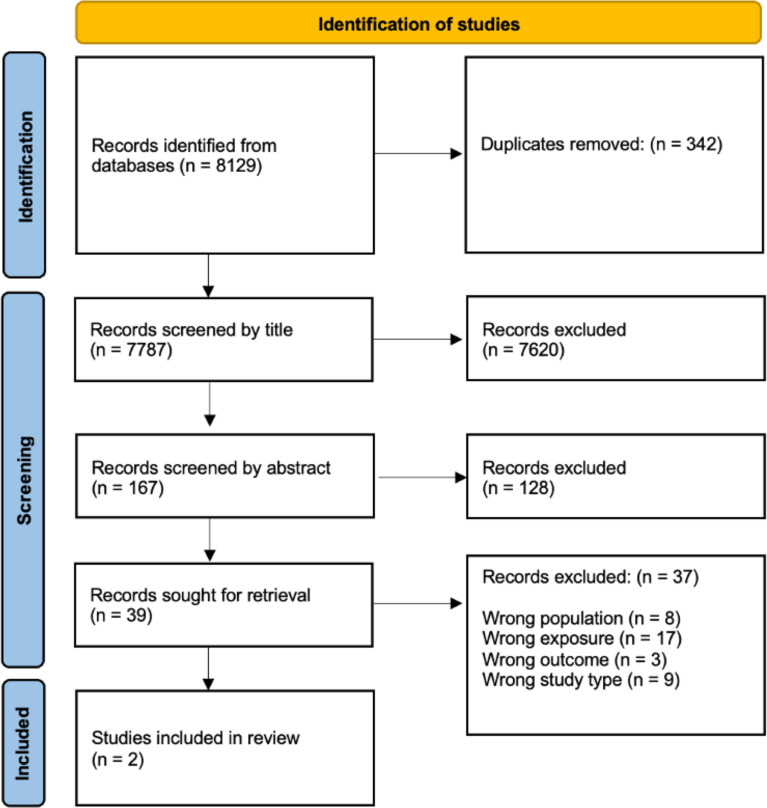 Figure 1
| Title | Child anxiety, depression and post-traumatic stress disorder following orthopedic trauma | Acute stress disorder in the paediatric surgical children and adolescents injured during the Wenchuan earthquake in China |
|---|---|---|
| Author | Al Zomia | Liu |
| Hospital setting | Yes | Yes |
| Study type | Retrospective cross-sectional | Survey |
| Country of treatment | Saudi Arabia | China |
| Cohort size | 100 children | 105 children |
| Gender | 67/100 (67%) male | 50/105 (47.6%) male |
| Mean age (±SD) | 7.3±3.4 years | 11.8±3.8 years |
| Type of injury |
Motor vehicle collision 10/100 (10%) Fall from height 37/100 (37%) During play 44/100 (44%) Other 9/100 (9%) |
Buried during earthquake=48/105 (45.7%) Not buried during earthquake=57/105 (54.3%) |
| Injury severity score | Not reported | Not reported |
| Prior mental health diagnosis | Family history of psychiatric disease reported in 5/100 (5%) of children. Past medical history not reported. | Excluded prior psychotic illness |
| Head injury | 12/100 (12%) | Not reported |
| Fatality at the scene | Not reported | 18/105 (17.1%) dead or missing relatives |
| Family member also injured | Not reported | 5/105 (4.8%) seriously injured relatives |
| Death of a family member | Not reported | 18/105 (17.1%) dead or missing relatives |
| Screening tools used for adverse psychological outcomes | Revised Children’s Anxiety and Depression Scale-25 and Combined Child Trauma Screen for PTSD | Acute Stress Disorder scale |
| Incidence of adverse psychological outcomes | 5/100 (5%) clinically significant PTSD | 57/105 (54.3%) ASD |
| Operation |
70/100 (70%) had an operation. p=0.049 for clinically significant PTSD |
83/105 (79%) had an operation p<0.001 for ASD |
| IR | Not reported | Not reported |
| Length of stay |
1–2 days: 38/100 (38%) 3–4 days: 21/100 (21%) 5–7 days: 30/100 (30%) >7days: 11/100 (11%) | Not reported |
| PICU admission |
10/100 (10%) PICU admission p=0.426 for clinically significant PTSD | Not reported |
| Definition of functional outcomes | Not reported | Not reported |
| Incidence of poor functional outcomes | Not reported | Not reported |
Peer Reviews
No public reviews on file for this paper yet. If you reviewed it on a platform where reviews are public (OpenReview, ICLR, NeurIPS, ICML), you can paste yours below so the community can read it here.
Videos
No videos yet. Explain this paper in a talk, walkthrough, or lecture? Add one.
Taxonomy
TopicsTrauma and Emergency Care Studies · Trauma, Hemostasis, Coagulopathy, Resuscitation · Pediatric Pain Management Techniques
Introduction
Paediatric major trauma is a leading cause of morbidity and mortality in children, often necessitating invasive management and intensive care.1 2 In addition to physical injuries requiring intervention, holistic care for those who have sustained a serious injury should also consider their mental health needs.1 2
This study aims to explore whether paediatric major trauma patients needing surgery or interventional radiology have higher odds of adverse psychological outcomes than those managed conservatively (ie, without procedures).
Methods
This systematic review included paediatric major trauma patients (<16 years) who had invasive management (operation or interventional radiology) compared with conservative management, with data available on the incidence of subsequent psychological disorders. Medline (via Ovid), Embase (via Ovid), PsycInfo (via Ebscohost) and CINAHL (via Ebscohost) were searched from inception to August 2025. Two reviewers assessed each article at each stage of screening, data extraction and risk-of-bias assessment. The full protocol and peer-reviewed search strategy for the study are published online.3
There was no specific patient and public involvement in this study. However, an established James Lind Alliance priority-setting partnership, which involved patient co-design, emphasises the psychological aspects of major trauma care for patients and their families.4
Results
The search strategy identified 8129 studies; following screening, 39 full texts were reviewed, and two studies met the inclusion criteria (figure 1).
Preferred reporting items for systematic reviews and meta-analyses flow diagram.
The characteristics of the two studies identified are shown in table 1.
The study by Al Zomia et al was conducted at a single children’s hospital in Saudi Arabia.5 This study included 100 children, with a mean age of 7.3±3.4 years (SD), who had major orthopaedic trauma, with 70/100 (70%) requiring an operation.5 The study by Liu et al was undertaken at a single centre in China.6 This study included 105 children, with a mean age of 11.8±3.8 years (SD), who had been injured in an earthquake, with 83/105 (79%) requiring an operation. Both studies observed major trauma and operative management to be statistically significantly associated with adverse psychological outcomes compared with those managed conservatively. The included studies were heterogeneous, with a high risk of bias and low confidence in the effect estimate (online supplemental Appendix 1).
Discussion
This systematic review identified two studies, both of which demonstrated that paediatric major trauma patients who had operative management had a greater risk of adverse psychological outcomes than those managed conservatively. However, the evidence base was small, and significant heterogeneity was found between the two studies, making generalisability and comparisons challenging.
Adverse psychological outcomes are frequently observed in paediatric major trauma patients.2 Similarly, children and adolescents who undergo invasive management are recognised to be at increased risk of adverse psychological outcomes.1 It is not known to what extent major trauma patients requiring invasive management are at risk of adverse psychological outcomes compared with those managed conservatively. This review has several limitations, including heterogeneity, a small number of studies and a high risk of bias. The primary exposures differ, and the absence of reported Injury Severity Scores or a clear definition of major trauma makes it challenging to determine whether the psychological outcomes are due to the intervention itself or the incident. These studies also draw on specific populations, which may not be generalisable, and confounders such as paediatric intensive care unit stay, death of a family member or the impact of a natural disaster (may have major lasting external psychological outcomes not directly related to the injuries from the incident) are either not recorded or not accounted for. Despite these limitations, the study has the advantage of utilising a thorough, broad and peer-reviewed search strategy.3
The results of this review highlight a significant gap in the literature related to the hypothesis that paediatric major trauma patients who also require operative management are at greater risk of adverse psychological outcomes. Future studies would benefit from exploring this question while accounting for key confounding factors. Identifying paediatric major trauma patients at increased risk of adverse psychological outcomes can enhance screening for psychological trauma, help pinpoint those most at risk of adverse outcomes and offer early, targeted, holistic support for this group of patients.
Supplementary material
10.1136/bmjpo-2025-004450online supplemental file 1
The reference list from the paper itself. Each links out to its DOI / PubMed record.
- 1Turgoose DP Kerr S De Coppi P et al Prevalence of traumatic psychological stress reactions in children and parents following paediatric surgery: a systematic review and meta-analysis BMJ Paediatr Open 20215 e 00114710.1136/bmjpo-2021-001147 PMC 828760334337164 · doi ↗ · pubmed ↗
- 2Schauss E Hawes K Roberts S et al Examining the incidence of acute stress in pediatric trauma patients Trauma Surg Acute Care Open 20227 e 00094610.1136/tsaco-2022-00094636072965 PMC 9389088 · doi ↗ · pubmed ↗
- 3Hibberd O Thomas CE Gentle S et al Psychological outcomes in paediatric major trauma patients who require invasive management: protocol for a systematic review and meta-analysis BMJ Open 202515 e 10197110.1136/bmjopen-2025-101971 PMC 1236656040829846 · doi ↗ · pubmed ↗
- 4Bretherton CP Hirst R Gacaferi H et al Research priorities for the management of major trauma: an international priority setting partnership with the James Lind Alliance BMJ Open 202414 e 08345010.1136/bmjopen-2023-083450 PMC 1110745138754886 · doi ↗ · pubmed ↗
- 5Al Zomia AS Alqarni MM Alaskari AA et al Child Anxiety, Depression, and Post-traumatic Stress Disorder Following Orthopedic Trauma Cureus 202315 e 4214010.7759/cureus.4214037602069 PMC 10438159 · doi ↗ · pubmed ↗
- 6Liu K Liang X Guo L et al Acute stress disorder in the paediatric surgical children and adolescents injured during the Wenchuan earthquake in China Stress Health 201026262810.1002/smi.1288 · doi ↗