Effective Hamiltonian-Based DNP Sequence Optimization
Lorenzo Niccoli, Gian-Marco Camenisch, Matías Chávez, Matthias Ernst

TL;DR
This paper introduces optimized DNP sequences using effective Hamiltonians, improving NMR signal enhancement through better control of spin dynamics.
Contribution
The novelty lies in using continuous Floquet theory to optimize on-resonance and off-resonance DNP sequences.
Findings
The on-resonance sequence achieved a 100 MHz electron offset bandwidth with 25 MHz microwave power.
The off-resonance sequence covered 20 MHz at a 50 MHz center with 20 MHz microwave power.
Continuous Floquet theory proved effective for optimizing pulsed DNP sequences.
Abstract
Dynamic nuclear polarization (DNP) enhances the intensity of NMR signals by transferring polarization from electron spins to nuclei via microwave irradiation. Pulsed DNP methods offer more control on the spin dynamics than conventional continuous-wave approaches. Here, we report on-resonance and off-resonance DNP sequences optimized using effective Hamiltonians derived from continuous Floquet theory. Experiments at 80 K and 0.35 T using a sample of 5 mM Trityl OX063 in a glycerol-d8/D2O/H2O matrix (60:30:10, v/v/v) demonstrate that the optimized on-resonance sequence achieves 100 MHz electron offset bandwidth, while the off-resonance sequence centered at an electron offset of 50 MHz can cover 20 MHz, with 25 and 20 MHz of microwave power, respectively. These results demonstrate that continuous Floquet theory is a useful framework for the optimization of pulsed DNP sequences.
Genes, proteins, chemicals, diseases, species, mutations and cell lines named across the full text — each resolved to its canonical identifier and authoritative record.
Click any figure to enlarge with its caption.
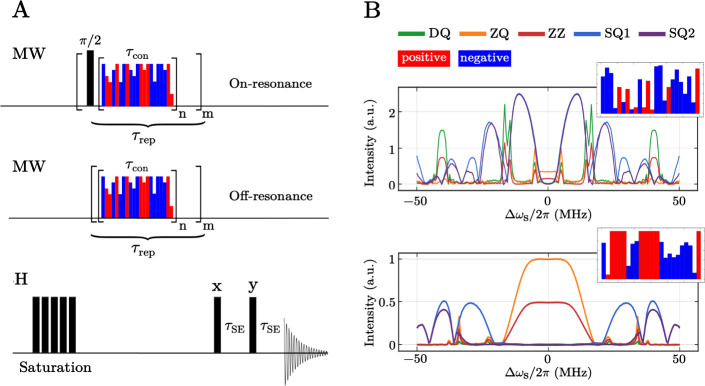 Figure 1
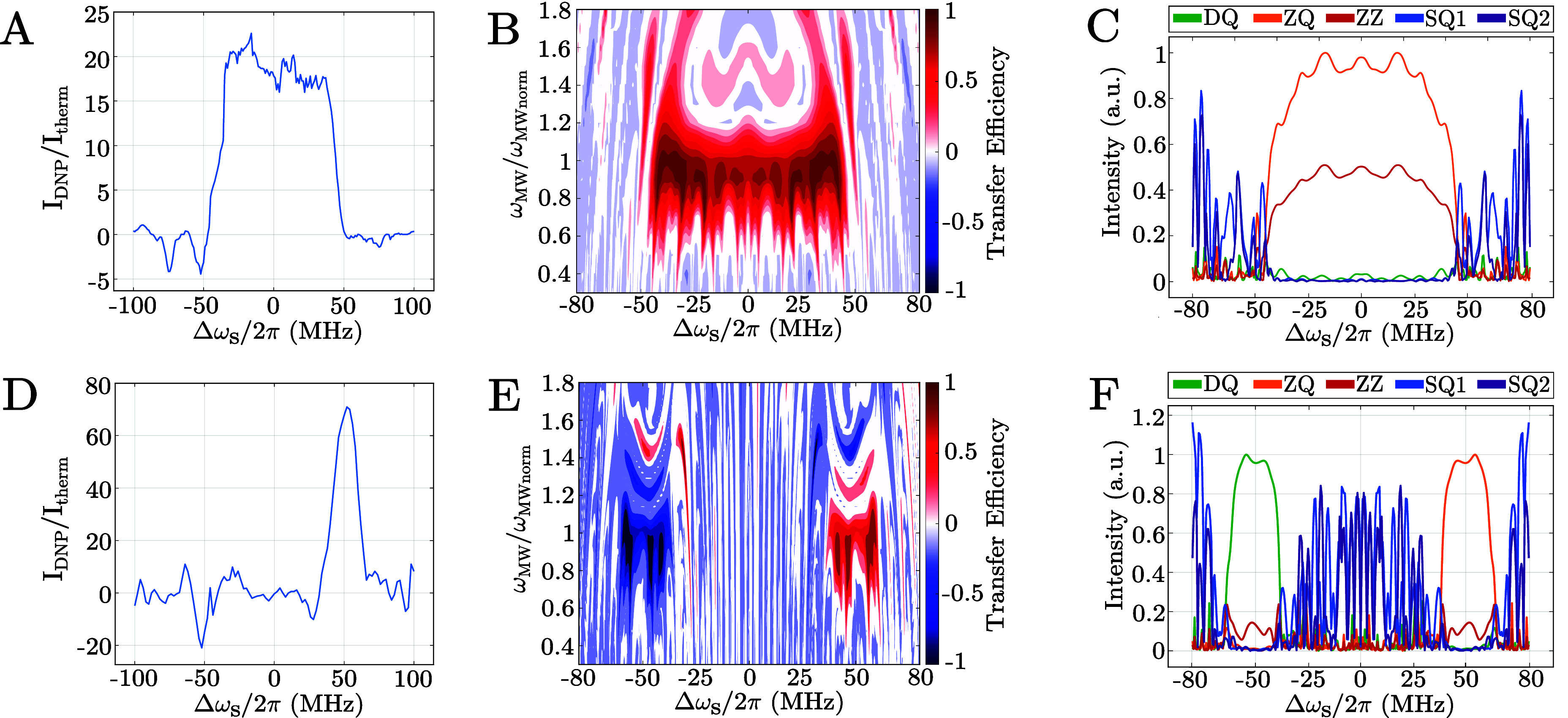 Figure 2
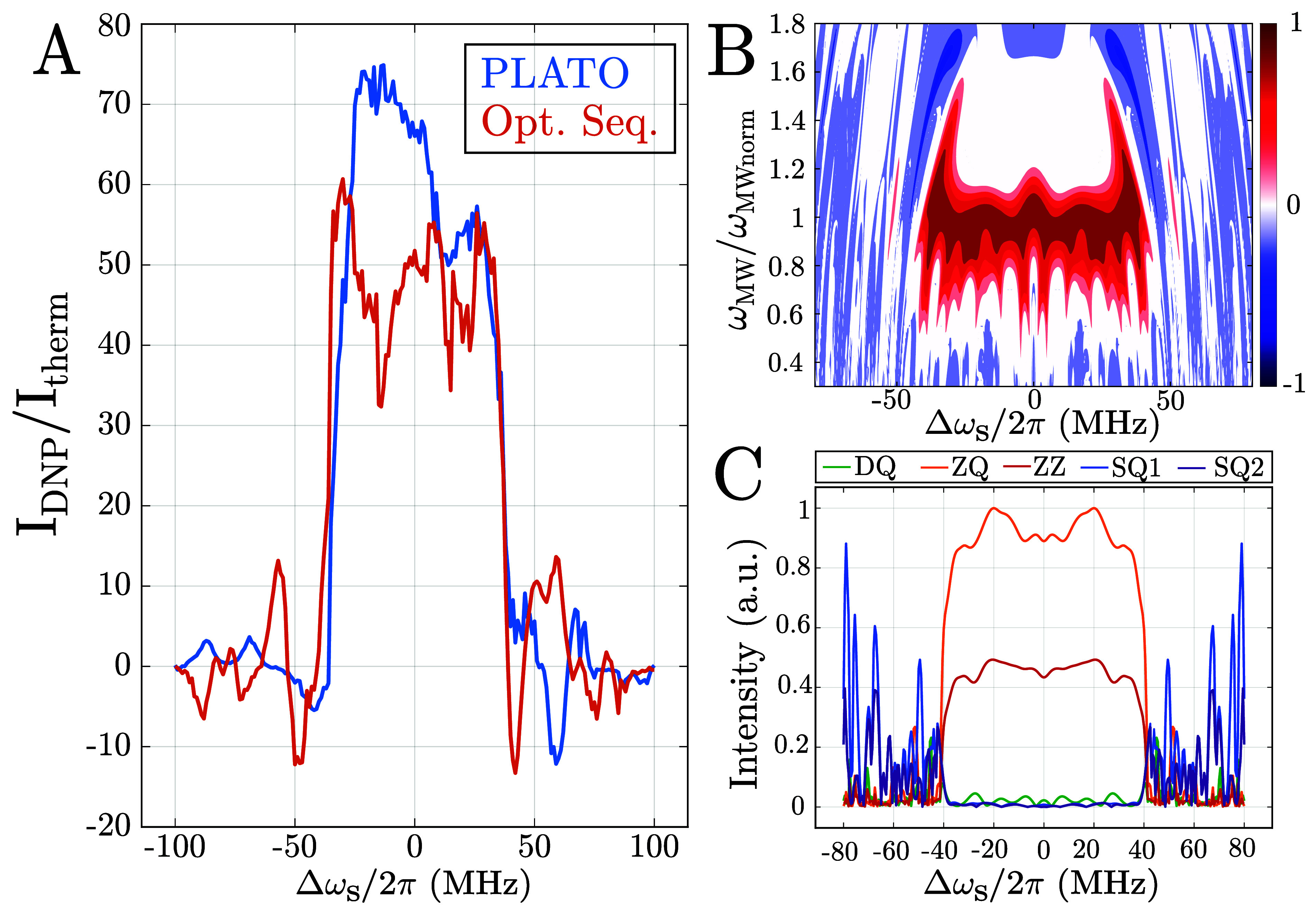 Figure 3
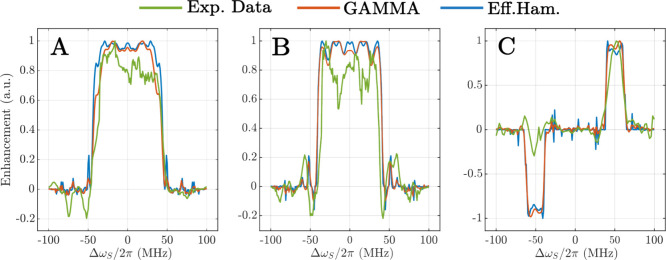 Figure 4
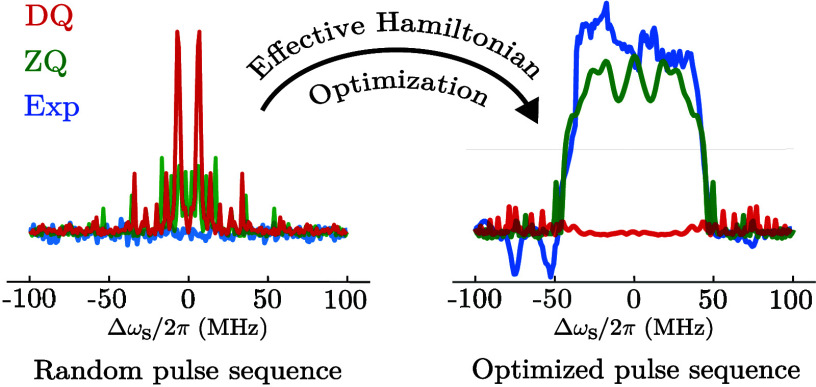 Figure 5
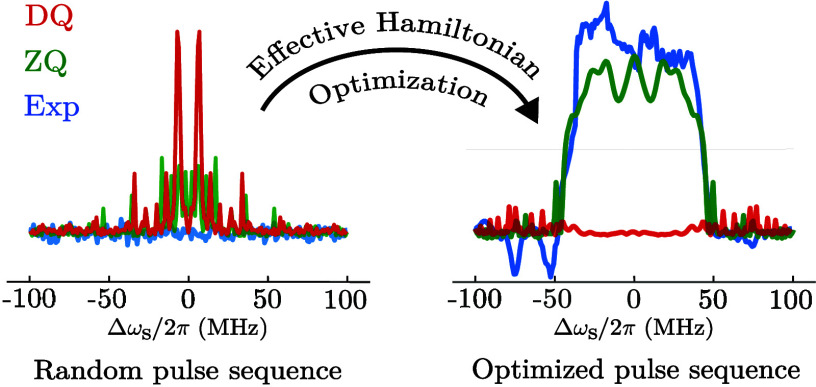 Figure 6
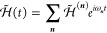 Figure 7
 Figure 8
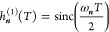 Figure 9
 Figure 10
 Figure 11
 Figure 12
 Figure 13
- —Schweizerischer Nationalfonds zur Förderung der Wissenschaftlichen Forschung10.13039/501100001711
Peer Reviews
No public reviews on file for this paper yet. If you reviewed it on a platform where reviews are public (OpenReview, ICLR, NeurIPS, ICML), you can paste yours below so the community can read it here.
Videos
No videos yet. Explain this paper in a talk, walkthrough, or lecture? Add one.
Taxonomy
TopicsAdvanced NMR Techniques and Applications · Electron Spin Resonance Studies · Atomic and Subatomic Physics Research
Dynamic nuclear polarization (DNP) is a powerful technique to enhance the NMR signals beyond the thermal equilibrium by transferring polarization from unpaired electrons to surrounding nuclei via suitable microwave (MW) irradiation. ?−? ? ? ? ? ? ? Common applications of DNP rely on continuous-wave (CW) microwave irradiation to saturate certain transitions and have already extended NMR capabilities significantly by providing signal enhancement up to 3–4 orders of magnitude. ?−? ? ?
Besides the development of CW based DNP methodologies, there is increasing interest in pulsed DNP methods, because they allow better control of spin dynamics, in a similar fashion as in the transformation of NMR from CW to pulsed operation. Various DNP sequences have been developed, including NOVEL,? off-resonance NOVEL,? TOP-DNP,? XiX-DNP,? TPPM-DNP,? BEAM? and frequency-swept DNP.? Currently many of the pulsed DNP sequences are limited to low magnetic fields due to the restricted availability of high-power amplifiers in the high GHz spectral range. Similar limitations in microwave power also affect CW-DNP experiments, particularly at high magnetic fields.
Modern pulsed EPR spectrometers use arbitrary waveform generators (AWGs) to generate the microwave pulses with precise control over phase, amplitude, and frequency.? The capabilities of modern AWGs open up new avenues to design pulse sequences for DNP. A recent example of such an approach is the PLATO sequence which can provide an excitation bandwidth of about 80 MHz across the electron resonance frequency.?
Pulse sequence optimization is a wide area of research in magnetic resonance based on theorical frameworks such as the average Hamiltonian theory, ?,? Floquet theory, ?−? ? or single-spin vector effective Hamiltonian theory (SSV-EHT). ?,? However, most of these theoretical approaches work well for resonant and nonresonant terms in the effective Hamiltonian but do not provide a smooth transition between them. The recently introduced continuous Floquet theory ?,? provides a more complete description of the spin dynamics by enabling also a good description in the near-resonance case which improves the description of recoupling sequence, e.g., symmetry-based C- and R- pulse schemes including resonance offsets.?
In this manuscript, we present a method that allows the generation of optimized pulse sequences by employing standard gradient-based optimization algorithms to effective Hamiltonians derived from continuous Floquet theory. We demonstrate that this methodology enables the design of on- and off-resonance DNP sequences capable of achieving efficient polarization transfer. We show an on-resonance sequence with a bandwidth of 100 MHz and an off-resonance sequence that allows a 20 MHz bandwidth centered at an electron offset of 50 MHz, employing 25 and 20 MHz of microwave amplitude, respectively. We also compare this sequence optimization method with the one based on a figure-of-merit used for generating the PLATO sequence, by optimizing a sequence that aims for the same bandwidth which provided a similar enhancement but with about 20% lower microwave amplitude.
Continuous Floquet theory can be pictured as an extension of operator-based Floquet theory ?,?,? by taking into account the finite length of pulse sequences. It requires a continuous frequency space description and not a discrete Fourier series representation. The finite length of pulse sequences leads to a broadening of resonance conditions, i.e., a convolution of the discrete Fourier series representation with a sinc function, enabling the correct description of near-resonance conditions and short nonperiodic sequences. Calculation of the effective Hamiltonians is based on single-spin interaction-frame trajectories which makes the calculation of the effective Hamiltonian more efficient than exact multispin numerical simulations.
For a periodic time-dependent Hamiltonian of the form:
the first order, closed-form effective Hamiltonian is given in continuous Floquet theory by
with:
Here, we used a multi-index notation to write the Hamiltonian, where * n
- is a tuple containing all the indices, * n
- = (n, k, l) and ω_
n * _ = nω _ n _ + kω _ k _ + lω _ l _ is the weighted sum of all the characteristic frequencies. In eqs–? are the Fourier coefficient and T is the length of the sequence. It is important to realize that all Fourier coefficients potentially contribute to the first-order effective Hamiltonian, though their weight varies based on whether they are resonant (ω_ * n * _ = 0 → sinc(0) = 1) or nonresonant (ω_ * n * _ ≠ 0 → |sinc(0)| ≤ 1) terms. For the description of the pulsed DNP experiments eq can be adapted considering all the relevant contributing frequencies in the interaction frame:?
where ω_m_ is the modulation frequency and ω_eff_ is the effective field of the sequence while ω_ I,0_ is the ^1^H Larmor frequency and T is the length of the sequence defined by T = (∑_ i τ i ) · n r where τ i _ is the pulse length of each pulse and n r is the number of times the sequence is repeated.
All the effective Hamiltonian calculations and optimization were conducted using MATLAB (The MathWorks Inc., Natick, MA, U.S.A). The effective Hamiltonian used for optimizations contains only the first-order term, as it has already been shown that is sufficient for accurately describing recoupling in NMR if resonance offsets are included in the interaction frame.? The optimization process involves minimizing the difference between the coefficients of the zero-quantum (ZQ) and double-quantum (DQ), two-spin longitudinal order (ZZ), and single quantum (SQ1, SQ2) components of the effective Hamiltonian. There are two single-quantum components corresponding to single-quantum coherence on the electron (Ŝ ^+^ Î _ z _) and the nuclear spin (Ŝ _ z _ Î ^+^), respectively. The optimization procedure starts from generating 6000 random initial pulse sequences and optimizing each of them with the gradient-based optimization algorithm fmincon. The input parameters for the optimization are the bandwidth of the sequence in MHz and the pulse sequence parameters (the number of pulses, the pulse duration, and the maximum microwave power). The sequences were allowed to vary the normalized amplitude in the [-1,1] range, i.e., corresponding to an amplitude of [0, 1] with phases of ±x. The effective Hamiltonian is only calculated for a single crystal orientation (β = 45°) as different crystallites have the same effective Hamiltonian except for a scaling factor.? For the calculation of the interaction-frame trajectory, the time step was set to 0.1 ns and the number of Fourier coefficient used to 30. The microwave inhomogeneity in the optimization procedure was accounted for by using a simple power distribution model. ?,? This is implemented in the optimization procedure via a normalized pulse amplitude vector (1.05, 1.00, 0.95, 0.85) with weights (0.1783, 0.3856, 0.2461, 0.1900) of the corresponding cost function.
The initial magnetization and the quantization axis of the effective Hamiltonian vary depending on the sequence type: in on-resonance sequences, it is aligned along the x-axis; in off-resonance sequences, it is aligned along the z-axis. At the end of the optimization procedure, the sequences with the largest difference between the ZQ and the sum of the ZZ, DQ, SQ1, SQ2 terms are selected. Our method is different from typical pulse-sequence optimization techniques? because it focuses on a cost function designed to maximize the components of the effective Hamiltonian that drive the polarization transfer and not the transferred polarization.
The experimental evaluation of the optimized DNP sequences was conducted with a home-build X-band spectrometer analogous to the one described by Doll et al.,? at 80 K, on a sample of Trityl OX063 (5 mM) in glycerol-d_8_/D_2_O/H_2_O (“DNP juice”, 60/30/10, v/v/v) using a protocol as described in Camenisch et al.? A schematic representation of the DNP experiments used for the acquisition of the on-resonance and the off-resonance sequences is shown in FigureA. Each DNP sequence was started with a ^1^H saturation pulse train consisting of 11 100° pulses to erase any proton thermal equilibrium polarization. A basic DNP block consists of N pulses, each with a duration of τ_p_. Thus, the modulation period is τ_m_ = Nτ_p_. Subsequently, each basic DNP block was repeated n r times to give a total contact time τ_con_ = n r_τ_m. The total DNP experiment was then repeated m times to give a total build-up time τ_DNP_ = m τ rep where the shot repetition time τ_rep_ was 2 ms. For the on-resonance experiment a 90° pulse with a length of 6 ns and a phase +y was inserted before the DNP module. The number of repetitions, m, was 1000. The number of DNP cycles per repetition was optimized experimentally and a value of n r = 3 was found to perform best for both the on- and off-resonance sequence. All the sequences were evaluated at their optimized power level. To account for the limited width of the microwave resonator mode and differences in nonlinearity of the traveling wave tube (TWT) amplifier at different frequencies, echo-detected nutation experiments were performed as described in Doll et al.? The hyperpolarized NMR signal was detected using a solid echo with pulse length of 2.5 μs spaced by 20 μs. For the solid echo an eight-step phase cycle was used with {x, x, y, y, -x, -x, -y, -y} for the first pulse and detection and {y, -y, x, -x, y, -y, x, -x} for the second pulse. The thermal-equilibrium reference experiment was recorded in the same way with the MW irradiation turned off and a delay of 180 s (≈ 5 · T _1,n _ where T _1,n _ is the nuclear longitudinal relaxation time) was used between two consecutive scans. A total of 512 scans were recorded and accumulated for the reference experiment. The data has been processed as in Camenisch et al.? More details about the experimental setup, including the resonator profile and characterization of the TWT nonlinearity can be found in the Supporting Information.
We optimized both on-resonance and off-resonance sequences targeting the largest electron offset possible while aiming to use as little microwave power as possible. The on-resonance DNP sequences were designed to target a bandwidth of 100 MHz, using a maximum microwave power corresponding to a Rabi frequency of 25 MHz. The sequence is composed of 72 pulses, each with a duration of 5 ns, leading to a basic DNP block lasting 360 ns. The off-resonance sequence also consists of 72 pulses of 5 ns each and the center was set at an electron offset of 50 MHz aiming for a bandwidth of 20 MHz, i.e., from an electron offset ranging from 40 to 60 MHz, using a microwave power corresponding to a Rabi frequency of 20 MHz. Both sequences have a modulation frequency of . The maximum rf-field amplitude for the sequences was chosen based on the resonator profile such that the Rabi frequency was accessible for the required offset range.
The experimental profiles for both sequences as a function of the electron offset are shown in FiguresA-B, and have been acquired with a repetition rate (τ_rep_) of 2 ms, i.e., τ_DNP_ = 6 s, resulting in peak enhancement values of about 23 and 70. FiguresB and ?E show the transfer efficiency of the two sequences as a function of the microwave amplitude and the electron spin offset. For the on-resonance sequence there is good transfer efficiency within the optimized area and a satisfactory (±5%) tolerance to microwave inhomogeneity. FiguresC and ?F show the magnitude of the relevant terms in the effective Hamiltonian as a function of the electron offset frequency. In both cases, the ZQ term dominates over the DQ, SQ1 and SQ2 terms, and these undesired terms are well suppressed across the selected bandwidth.
In order to compare our results to sequences described in the literature, we also optimized an on-resonance sequence that covered a bandwidth of 80 MHz but using a maximum MW amplitude of 25 MHz, and compared it with the recently published PLATO sequence (FigureA) that was optimized within the framework of SSV-EHT. The PLATO sequence was acquired with a microwave power of 32 MHz, which is consistent with the value it was originally optimized for and is accessible over the relevant offset range on our experimental setup. The experimental comparison shows that our sequence can cover the same bandwidth using about 20% less microwave amplitude. However, the maximum achieved enhancement is approximately 20% lower (60 vs 72). This illustrates the trade-off between maximum achievable bandwidth and enhancement, which becomes particularly relevant at larger magnetic fields. In FigureB, we show the dependence of the transfer efficiency of the new sequence as a function of the microwave amplitudes and the electron offset frequency. The new sequence provides an optimal transfer across the offset frequency for microwave amplitudes in the range of 23–27 MHz, i.e., ± 10% of the nominal value. The magnitude of the effective Hamiltonian term (FigureC) clearly shows that our optimization procedure provides a good suppression of the unwanted DQ and SQ terms. In contrast, the PLATO sequence shows a contribution of the DQ term of around 7% compared to the ZQ term (see Figure S5 of the ). All the evaluated optimized DNP sequence, including PLATO, show a build-up time of about 6 s, which were recorded by incrementing the loop m in Figure at a given electron offset (0 MHz for the on-resonance sequence and 50 MHz for the off-resonance sequence) and keeping all the other parameter constant.
Besides the experimental characterization of the sequences, we have also characterized them by numerical simulations based on the calculated effective Hamiltonians and full numerical spin-dynamics simulations. Thus, effective Hamiltonian calculations have been compared to two-spin (1 electron, 1 proton) numerical simulations performed with the GAMMA? spin-simulation environment. The hyperfine coupling was calculated in ORCA 5 ?,? following the procedure described by Jeschke et al.? and was set to 2.64 MHz (more details are reported in the ). In Figure we compare the experimental DNP profiles with profiles calculated both based on effective Hamiltonians and full numerical simulations. Each profile has been normalized to their respective maximum value to allow comparison. The comparison clearly shows that both the calculations based on the effective Hamiltonian and the simulations using full spin-dynamics simulations in a two-spin system are generally in good agreement with the experimental profiles, accurately reproducing the bandwidth. We note that the off-resonance sequence shows the biggest deviation from the experimental profile, especially in the range between −60 and −40 MHz. We attribute this discrepancy to the fact that the optimization procedure targeted the area between +40 and +60 MHz, but the precise causes of this discrepancy are not yet understood. Other discrepancies between the simulated and measured results can be tentatively attributed to experimental imperfections, primarily phase transients and B 1 inhomogeneity, but their exact origin is still under evaluation. We also remark that power droop during the pulse sequence may play a significant role, as the power reduction over the time scale of the sequence could impact the transfer efficiency. Another reason for the discrepancy between experimental profiles and simulated ones may result from three-spin effects? as such effects are not covered in our two-spin simulations.
Besides the sequences presented above, we further explored the capabilities of the optimization procedure by optimizing additional on-resonance and off-resonance pulse sequences targeting different bandwidths and using different numbers of pulses (48 or 96 each 5 ns long). For the on-resonance case, the optimized sequences span bandwidths of 80 or 120 MHz using microwave amplitudes of 25 or 30 MHz. The off-resonance sequences target bandwidths of 20 or 40 MHz, centered at electron offsets of 40 or 50 MHz. A comparison between the experimental results and the corresponding effective Hamiltonian and GAMMA simulations for these sequences is shown in Figure S4 of the . For all these additional sequences we find good agreement between effective Hamiltonian and full spin-dynamic simulations. In most cases (e.g., , sequences A and C), the targeted bandwidth was achieved, although the agreement between experiment and calculation was less satisfactory than for the sequences discussed in the main text. In other cases (e.g., , sequence D), the discrepancies were more pronounced. Regarding the off-resonance sequence, despite a good agreement between experiments and simulations (, sequences E and F), we found lower enhancement values in the optimized region than for the off-resonance reported in Figure. The underlying causes of all these discrepancies are still under investigation.
In summary, we have introduced on-resonance and off-resonance DNP pulse sequences at EPR X-band frequency (0.35 T), optimized within the framework of continuous Floquet theory. Our approach is based on the optimization of the first-order effective Hamiltonian terms, i.e. DQ or ZQ, that promote the polarization transfer. Specifically, the optimized on-resonance sequence demonstrates a bandwidth of approximately 100 MHz using 25 MHz of microwave amplitude and the off-resonance sequence spans 20 MHz centered at an offset of 50 MHz. To benchmark our approach, we also optimized a sequence covering an 80 MHz bandwidth and compared it with the PLATO sequence designed for the same range. Our optimized sequence uses about 20% less microwave amplitude and, therefore, yields about 20% less enhancement, but achieves the same bandwidth. This result illustrates the interplay between the maximum achievable bandwidth and enhancement at a given available microwave amplitude. The first order effective Hamiltonian calculations were compared with numerical GAMMA simulations, and both were consistent with experiments, confirming the robustness of continuous Floquet theory to optimize pulsed DNP experiments. This proof-of-concept study demonstrates that the theoretical framework provided by continuous Floquet theory can be combined with gradient-based optimization algorithms, making it an additional tool for designing new DNP and NMR sequences. Nevertheless, we acknowledge cases in which significant discrepancies arise between the experimental data and calculations () which are not fully understood. Starting from these observations, our current work focuses on developing additional sequences to further increase the achievable bandwidth and investigating the theoretical and experimental factors that influence the performance of the optimized DNP sequences. In principle, such sequences could also be implemented in an adiabatic fashion by sweeping through the resonance condition. This could be implemented by scaling the length and the amplitude of the pulses such that the effective flip angle remains unchanged or by sweeping the static magnetic field. Both options would generate a sweep through the resonance condition which is required for an adiabatic transfer. However, none of these options have been explored so far and we are not sure whether the complete interaction frame used in this work is the best framework to describe such adiabatic sequences.
Supplementary Material
The reference list from the paper itself. Each links out to its DOI / PubMed record.
- 1Carver T. R.Slichter C. P.Polarization of Nuclear Spins in Metals Phys. Rev.195392121221310.1103/Phys Rev.92.212.2 · doi ↗
- 2Overhauser A. W.Polarization of Nuclei in Metals Phys. Rev.195392241141510.1103/Phys Rev.92.411 · doi ↗
- 3Becerra L. R.Gerfen G. J.Temkin R. J.Singel D. J.Griffin R. G.Dynamic Nuclear Polarization with a Cyclotron Resonance Maser at 5 T Phys. Rev. Lett.199371213561356410.1103/Phys Rev Lett.71.356110055008 · doi ↗ · pubmed ↗
- 4Ardenkjær-Larsen J. H.Fridlund B.Gram A.Hansson G.Hansson L.Lerche M. H.Servin R.Thaning M.Golman K.Increase in Signal-to-Noise Ratio of > 10,000 Times in Liquid-State NMR Proc. Natl. Acad. Sci. U.S.A.200310018101581016310.1073/pnas.173383510012930897 PMC 193532 · doi ↗ · pubmed ↗
- 5Lilly Thankamony A. S.Wittmann J. J.Kaushik M.Corzilius B.Dynamic Nuclear Polarization for Sensitivity Enhancement in Modern Solid-State NMR Prog. Nucl. Magn. Reson. Spectrosc.2017102–10312019510.1016/j.pnmrs.2017.06.00229157490 · doi ↗ · pubmed ↗
- 6Moroz I. B.Leskes M.Dynamic Nuclear Polarization Solid-State NMR Spectroscopy for Materials Research Annu. Rev. Mater. Res.202252255510.1146/annurev-matsci-081720-085634 · doi ↗
- 7Pinon A. C.Capozzi A.Ardenkjær-Larsen J. H.Hyperpolarization via Dissolution Dynamic Nuclear Polarization: New Technological and Methodological Advances Magn. Reson. Mater. Phys.202134152310.1007/s 10334-020-00894-w 33185800 · doi ↗ · pubmed ↗
- 8Eills J.Budker D.Cavagnero S.Chekmenev E. Y.Elliott S. J.Jannin S.Lesage A.Matysik J.Meersmann T.Prisner T.Reimer J. A.Yang H.Koptyug I. V.Spin Hyperpolarization in Modern Magnetic Resonance Chem. Rev.202312341417155110.1021/acs.chemrev.2c 0053436701528 PMC 9951229 · doi ↗ · pubmed ↗