Post‐Discharge Opioid Prescribing After Elective Colorectal Resection: An International Survey
Ghadeer Olleik, Hiba Elhaj, Samin Shirzadi, Francesca Fermi, Maxime Lapointe‐Gagner, Sender Liberman, Mohsen Alhashemi, Tahereh Najafi Ghezeljeh, Fatemeh Rajabiyazdi, Nawar Touma, Pepa Kaneva, Agnihotram V. Ramanakumar, Badma Bashankaev, Alexandra Sidorova, Stephen J. Chapman

TL;DR
This study shows that opioid prescriptions after colorectal surgery vary widely across the world, with some regions prescribing much more than others.
Contribution
The study provides the first international survey on post-discharge opioid prescribing after elective colorectal resection.
Findings
Opioid prescribing at discharge ranged from 0% in Northern Africa to 100% in Australia and New Zealand.
Region of practice was the only factor independently associated with opioid prescribing.
The median quantity of opioids prescribed varied widely, from 30 to 200 MMEs.
Abstract
Excessive opioid prescribing after colorectal surgery can lead to adverse events and contribute to the opioid crisis. Understanding international prescribing patterns is essential for guiding practice and future research. The Analgesia After Colorectal Surgery (ACORE) survey aimed to characterize international opioid prescribing practices after elective colorectal resection. This international cross‐sectional survey followed established methodological guidelines. Eligible participants were colorectal, gastrointestinal, and general surgeons, as well as surgery trainees. Recruitment followed snowball sampling via international surgical societies' mailing lists, social media, and personal networks. The primary outcome of interest was post‐discharge opioid prescribing after open and MIS elective colorectal resection. Secondary outcomes included prescription quantity in morphine milligram…
Genes, proteins, chemicals, diseases, species, mutations and cell lines named across the full text — each resolved to its canonical identifier and authoritative record.
Click any figure to enlarge with its caption.
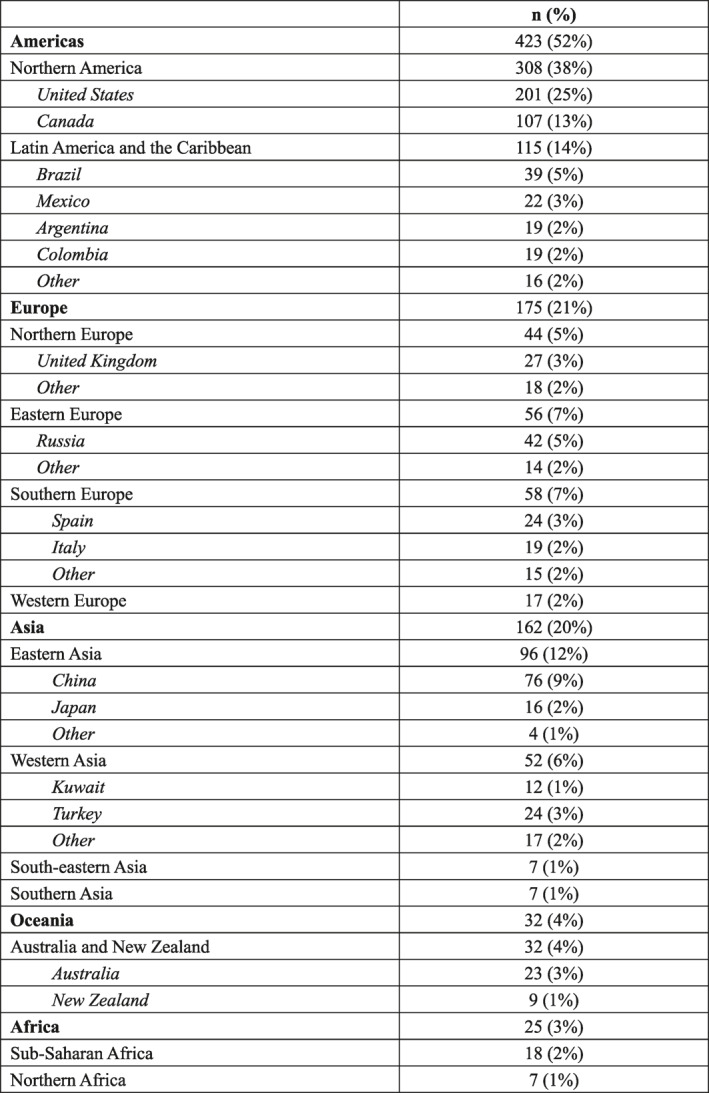 Figure 1
|
| |
|---|---|
| Americas | 423 (52) |
| Northern America | 308 (38) |
| United States | 201 (25) |
| Canada | 107 (13) |
| Latin America and the Caribbean | 115 (14) |
| Brazil | 39 (5) |
| Mexico | 22 (3) |
| Argentina | 19 (2) |
| Colombia | 19 (2) |
| Other | 16 (2) |
| Europe | 175 (21) |
| Northern Europe | 44 (5) |
| United Kingdom | 27 (3) |
| Other | 18 (2) |
| Eastern Europe | 56 (7) |
| Russia | 42 (5) |
| Other | 14 (2) |
| Southern Europe | 58 (7) |
| Spain | 24 (3) |
| Italy | 19 (2) |
| Other | 15 (2) |
| Western Europe | 17 (2) |
| Asia | 162 (20) |
| Eastern Asia | 96 (12) |
| China | 76 (9) |
| Japan | 16 (2) |
| Other | 4 (1) |
| Western Asia | 52 (6) |
| Kuwait | 12 (1) |
| Turkey | 24 (3) |
| Other | 17 (2) |
| South‐eastern Asia | 7 (1) |
| Southern Asia | 7 (1) |
| Oceania | 32 (4) |
| Australia and New Zealand | 32 (4) |
| Australia | 23 (3) |
| New Zealand | 9 (1) |
| Africa | 25 (3) |
| Sub‐Saharan Africa | 18 (2) |
| Northern Africa | 7 (1) |
| Current position | |
| Practicing colorectal surgeon/proctologist | 486 (59%) |
| Practicing gastrointestinal surgeon | 85 (10%) |
| Practicing general surgeon | 152 (19%) |
| Trainee (resident/registrar/fellow) | 94 (12%) |
| Junior (≤ 3 years of training) | 21 (3%) |
| Senior (> 4 years of training) | 73 (9%) |
| Predominant practice/training location | |
| Academic hospital | 507 (62%) |
| Community hospital | 214 (26%) |
| Other (including private practice) | 96 (12%) |
| Years of independent practice | |
| None | 94 (11%) |
| ≤ 5 years | 179 (22%) |
| 6–10 years | 153 (19%) |
| 11–20 years | 213 (26%) |
| ≥ 21 years | 178 (22%) |
| Procedures performed annually | |
| 1–10 | 95 (11%) |
| 11–30 | 234 (29%) |
| 31–60 | 219 (27%) |
| 61–100 | 154 (19%) |
| > 100 | 115 (14%) |
| Surgical approach used in practice | |
| Both open and minimally invasive | 583 (71%) |
| Only minimally invasive (unless converted) | 177 (22%) |
| Only open | 57 (7%) |
| Use of enhanced recovery pathways | |
| Yes | 639 (78%) |
| No | 178 (22%) |
| Length of hospital stay, median (IQR) | |
| Open surgery | 5 (5–7) |
| Minimally invasive surgery | 4 (3–5) |
| All (%) | Open (%) | MIS (%) | |
|---|---|---|---|
| Americas ( | 313 (74) | 219 (73) | 288 (71) |
| Northern America ( | 283 (92) | 195 (92) | 270 (89) |
| United States ( | 187 (93) | 144 (94) | 180 (90) |
| Canada ( | 96 (90) | 51 (88) | 90 (87) |
| Latin America and the Caribbean ( | 30 (26) | 24 (27) | 18 (18) |
| Brazil ( | 15 (38) | 10 (37) | 8 (25) |
| Mexico ( | 5 (23) | 5 (24) | 3 (16) |
| Argentina ( | 4 (21) | 3 (21) | 3 (18) |
| Colombia ( | 3 (16) | 3 (23) | 1 (6) |
| Other ( | 3 (19) | 3 (21) | 3 (21) |
| Europe ( | 56 (32) | 48 (33) | 46 (28) |
| Northern Europe ( | 30 (68) | 28 (68) | 25 (64) |
| United Kingdom ( | 21 (78) | 19 (79) | 18 (72) |
| Other ( | 9 (53) | 9 (53) | 7 (50) |
| Eastern Europe ( | 6 (11) | 3 (7) | 4 (8) |
| Russia ( | 6 (14) | 3 (9) | 4 (11) |
| Other ( | 0 (0) | 0 (0) | 0 (0) |
| Southern Europe ( | 11 (19) | 10 (20) | 8 (14) |
| Spain ( | 2 (8) | 2 (10) | 2 (8) |
| Italy ( | 3 (16) | 2 (13) | 3 (16) |
| Other ( | 6 (40) | 6 (40) | 3 (23) |
| Western Europe ( | 9 (53) | 7 (64) | 9 (53) |
| Asia ( | 54 (33) | 48 (34) | 44 (29) |
| Eastern Asia ( | 21 (22) | 17 (21) | 19 (20) |
| China ( | 19 (25) | 15 (23) | 17 (23) |
| Japan ( | 0 (0) | 0 (0) | 0 (0) |
| Other ( | 2 (50) | 2 (50) | 2 (50) |
| Western Asia ( | 24 (46) | 22 (47) | 20 (43) |
| Kuwait ( | 6 (50) | 4 (40) | 5 (50) |
| Turkey ( | 8 (33) | 8 (33) | 7 (32) |
| Other ( | 10 (63) | 10 (77) | 8 (57) |
| South‐eastern Asia ( | 5 (71) | 5 (71) | 3 (43) |
| Southern Asia ( | 4 (57) | 4 (57) | 2 (40) |
| Oceania ( | 32 (100) | 27 (100) | 28 (90) |
| Australia and New Zealand ( | 32 (100) | 27 (100) | 28 (90) |
| Australia ( | 23 (100) | 18 (100) | 21 (91) |
| New Zealand ( | 9 (100) | 9 (100) | 7 (88) |
| Africa ( | 11 (44) | 11 (44) | 3 (23) |
| Sub‐Saharan Africa ( | 11 (61) | 11 (61) | 3 (50) |
| Northern Africa ( | 0 (0) | 0 (0) | 0 (0) |
| Open | MIS | |
|---|---|---|
| All regions | 105 MMEs [63–162.5] | 90 MMEs [60–150] |
| Americas | ||
| Northern America | 120 MMEs [75–162.5] | 90 MMEs [60–150] |
| Latin America and the Caribbean | 50 MMEs [21.25–77.5] | 63 MMEs [30–140] |
| Europe | ||
| Northern Europe | 140 MMEs [70–262.5] | 129.5 MMEs [63–213.5] |
| Eastern Europe | 86.4 MMEs [5–90] | 30 MMEs [15–55] |
| Southern Europe | 90 MMEs [63–200] | 86.4 MMEs [42–100] |
| Western Europe | 120 MMEs [18–191.4] | 70 MMEs [37.5–150] |
| Asia | ||
| Eastern Asia | 86.4 MMEs [30–210] | 86.4 MMEs [30–210] |
| Western Asia | 40 MMEs [9–70] | 60 MMEs [25–107.5] |
| South‐eastern Asia | 75 MMEs [75–75] | 45 MMEs [25–75] |
| Southern Asia | 72.5 MMEs [60–87.5] | 85 MMEs [70–100] |
| Oceania | ||
| Australia and New Zealand | 186.4 MMEs [89–560] | 200 MMEs [92.5–518.75] |
| Africa | ||
| Sub‐Saharan Africa | 70 MMEs [50–136.4] | 100 MMEs [100–200] |
| Northern Africa | — | — |
| Potential predictor | OR [95% CI] | PEP |
|---|---|---|
| Subregion of practice | 100 | |
| Northern America | Reference | |
| Latin America and the Caribbean | 0.03 [0.02–0.06] | |
| Western Asia | 0.08 [0.04–0.15] | |
| South‐eastern Asia | 0.22 [0.04–1.21] | |
| Southern Asia | 0.12 [0.02–0.56] | |
| Eastern Asia | 0.02 [0.01–0.05] | |
| Northern Europe | 0.19 [0.09–0.40] | |
| Eastern Europe | 0.01 [0.00–0.03] | |
| Western Europe | 0.10 [0.03–0.28] | |
| Southern Europe | 0.02 [0.01–0.04] | |
| Sub‐Saharan Africa | 0.14 [0.05–0.39] | |
| Australia and New Zealand | 100% opioid prescription rate | |
| Northern Africa | 0% opioid prescription rate | |
| Years of independent practice | 0 | |
| 0 | Reference | |
| 1–6 | 1 | |
| 6–10 | 1 | |
| 11–20 | 1 | |
| > 20 | 1 | |
| Practice setting | 0 | |
| Academic | Reference | |
| Community or other | 1 | |
| Average length of stay, days | 1 | 0 |
| Procedures performed annually | 0 | |
| < 11 | Reference | |
| 11–30 | 1 | |
| 31–60 | 1 | |
| 61–100 | 1 | |
| > 100 | 1 | |
| NSAIDs prescription at discharge (yes) | 0.98 [0.82–1.17] | 8 |
- —Fonds de Recherche du Québec—Santé10.13039/501100000156
Peer Reviews
No public reviews on file for this paper yet. If you reviewed it on a platform where reviews are public (OpenReview, ICLR, NeurIPS, ICML), you can paste yours below so the community can read it here.
Videos
No videos yet. Explain this paper in a talk, walkthrough, or lecture? Add one.
Taxonomy
TopicsOpioid Use Disorder Treatment · Anesthesia and Pain Management · Pain Management and Opioid Use
Introduction
1
Postoperative opioid prescribing can lead to adverse events and contribute to the opioid crisis, which originated in North America but now poses a global threat, with rising opioid‐related morbidity and mortality worldwide [1, 2]. Patients undergoing colorectal resection are particularly vulnerable to opioid‐related harms. Compared with other procedures, they have among the highest rates of new persistent opioid use, with approximately 10% continuing opioid therapy beyond 3 months after surgery [3, 4]. Moreover, opioid use may lead to postoperative ileus, prolonging hospital stay and increasing healthcare costs [5]. While opioid‐sparing strategies including non‐steroidal anti‐inflammatory drugs (NSAIDs) are recommended [6, 7], they are often overlooked due to concerns about anastomotic leakage [8, 9, 10]. Therefore, colorectal surgeons face the complex challenge of ensuring adequate postoperative pain relief while minimizing harm.
Pain management after colorectal surgery is continually evolving, with no clear consensus on the safest and most effective approach [6, 7]. Analgesic choices often depend on surgeons' preferences and local care culture [11], yet international prescribing variations remain poorly understood. This knowledge is essential for guiding practice and future research, particularly in settings where certain analgesic approaches remain over‐ or under‐utilized. The Analgesia After Colorectal Surgery (ACORE) survey aimed to assess international patterns of analgesia prescribing after elective colorectal resection.
Material and Methods
2
The ACORE survey followed best‐practice survey guidelines [12, 13, 14] and was approved by McGill University's ethics board (A04‐E29‐19B). Informed consent was implied through participation. Reporting adhered to the Consensus‐Based Checklist for Reporting of Survey Studies (CROSS) [15] (Supporting Information S1: Table S1) and the Checklist for Reporting Results of Internet E‐Surveys (CHERRIES) [16] (Supporting Information S1: Table S2).
Survey Design
2.1
A web‐based survey (LimeSurvey v.5) was designed by a team of colorectal surgeons, general surgeons, anesthetists, pharmacists, and scientists representing eight countries (Brazil, Canada, China, Kuwait, Mexico, Russia, United Kingdom [U.K.], and the United States [U.S.]). The survey content was informed by previous literature [11, 17], the team's clinical and methodological expertise, and pilot testing. The final version of the survey (Supporting Information S1: Table S3) contained 31 questions eliciting participants' characteristics and analgesia prescribing practices in‐hospital and post‐discharge. Participants could report the use of different analgesia approaches for open and minimally invasive surgery (MIS; i.e., laparoscopic, robotic).
The survey was designed in English and pilot tested by ten native‐speaking surgeons and five trainees, with revisions based on their feedback. Bilingual team members translated it into French, Arabic, Spanish, Portuguese, Russian, and Mandarin. These languages were chosen because they are spoken in over 75% of the global land area [18]. Translations were pilot‐tested by at least five native‐speaker surgeons or trainees to ensure conceptual and linguistic equivalence with the original survey.
To facilitate participation, the survey required no access password and could be completed in approximately 5 min [19, 20]. Adaptive questions (i.e., displayed based on previous responses) reduced response burden. Most questions were multiple‐choice, with open‐text fields used for drug dosages and comments. All questions (except text fields) were mandatory, presented in fixed order, and could be reviewed before submission. To ensure data integrity, the two “captcha” questions assessing colorectal surgery technical knowledge were used to validate responses (Supporting Information S1: Table S3), and a digital cookie prevented multiple submissions from the same IP address.
Survey Validity
2.2
Because the survey aimed to capture descriptive data on prescribing practices rather than quantifying latent constructs (e.g., pain, quality of life), formal psychometric testing (e.g., reliability, construct validity) was not appropriate [13]. Following guidelines for survey research [12, 13, 14], face and content validity were established through literature review, expert input, and pilot testing to confirm item relevance, clarity, and flow. For translated versions, native‐speaking clinicians confirmed conceptual equivalence and linguistic accuracy, supporting the survey's robustness and cross‐cultural relevance.
Participants and Eligibility Criteria
2.3
Colorectal, gastrointestinal, general surgeons, and surgical trainees (residents, registrars, and fellows) were eligible to participate. We excluded those who (1) indicated not performing colorectal resections, (2) exited the survey prior to completing all the questions, and (3) did not answer both “captcha” questions correctly. Participation was voluntary and not compensated. Responses were automatically anonymized in LimeSurvey, with no identifiable personal information collected.
Survey Dissemination
2.4
To reach a large, geographically dispersed participant sample, we employed non‐probabilistic snowball sampling [12, 21, 22, 23] using the following approaches:
- Contacting colorectal/proctology and general surgery societies identified through a targeted Google search and inviting them to distribute the survey via email or social media.
- Creating an X (formerly Twitter) account to disseminate the survey (Supporting Information S1: Figure S1) [24, 25]. Survey‐related posts were shared via team members' personal and institutional accounts. Partner surgical societies, colleagues, and survey participants were encouraged to repost. X accounts of self‐identified colorectal, gastrointestinal, and general surgeons were followed to raise survey awareness.
- Inviting colleagues within team members' professional networks to complete and circulate the survey via email and social media.
Data Analysis
2.5
Given the exploratory and descriptive nature of the study and the use of snowball sampling, no formal power calculation was performed [21]. This approach aligns with recommendations for international surveys where the objective is to capture diverse, real‐world practices and probabilistic sampling is not feasible [21].
Responses were analyzed by continental region, subregion, and country according to United Nations (U.N.) codes [26]. Participation (survey initiations/visitors) and completion rates (completed/initiated surveys) were calculated according to CHERRIES recommendations [16]. The primary analysis focused on the rate of surgeons who prescribed opioids at discharge (yes/no), analyzed overall and stratified by open versus MIS. Opioid quantities were calculated in morphine milligram equivalents (MME) [27]. For countries where opioid pills are pre‐packed (i.e., prescribers do not determine the number of pills dispensed at the pharmacy), a 3‐day opioid supply was assumed (∼4 pills/day; standard pack of 14 pills), with sensitivity analysis considering a 6‐day supply (28 pills). Missing data were minimal (n = 4 open‐text fields, < 1%) and therefore not imputed.
Factors associated with opioid prescribing were evaluated using multivariable logistic regression with Bayesian model averaging (BMA), which integrates multiple models into the predictive process to account for model uncertainty and identify the most probable predictors across competing models [28, 29, 30]. Potential predictors included surgeons' subregion of practice, years of experience, number of annual resections, practice setting (academic vs. non‐academic), length of stay, and NSAID prescribing. Odds ratios (OR) were derived from averaged coefficients, with OR = 1 indicating no association [28, 29, 30]. To assess the robustness of observed associations, posterior effect probabilities (PEP) were calculated and classified as: “no evidence” of association (PEP < 50%), “weak evidence” (50%–75%), “positive evidence” (75%–95%), “strong evidence” (95%–99%), and “very strong evidence” (> 99%) [30, 31]. All statistical analyses were conducted by G.O. and F.F (graduate trainees), under supervision of J.F. (surgical outcomes researcher) and A.V.R. (biostatistician), using Stata 18 (StataCorp) and R 3.4.0 (R Foundation).
Results
3
Among 29 surgical societies contacted, 13 shared the survey via email (n = 10), X (n = 1), or both (n = 2) (participating societies listed in the Acknowledgment section). Our X account followed 2691 potential participants' accounts and was followed back by 589. We received 1225 survey‐site visits and 1025 responses from October 21, 2021, until April 8, 2022. After excluding 208 responses (107 incomplete, 39 non‐colorectal surgeons, and 62 incorrect “captcha”), 817 were included in the analysis (Supporting Information S1: Figure S2), corresponding to a participation rate of 84% and a completion rate of 80%.
Participants represented 67 countries across 5 continental regions and 13 subregions (Table 1 and Supporting Information S1: Table S4). Most respondents were from the Americas (n = 423 [52%]), Europe (n = 175 [21%]) and Asia (n = 162 [20%]). The most represented subregions were Northern America (n = 308 [38%]), Latin America/Caribbean (n = 115 [14%]), Eastern Asia (n = 96 [12%]), and Southern Europe (n = 58 [7%]). The countries most represented were the United States (n = 201 [25%]), Canada (n = 107 [13%]), China (n = 79 [9%]), Russia (n = 42 [5%]), and Brazil (n = 39 [5%]).
Participants' Demographic and Practice Characteristics
3.1
Overall, 88% of the participants were practicing surgeons (colorectal n = 486 [59%], general n = 152 [19%], gastrointestinal n = 85 [10%]), and 12% were trainees (senior n = 73 [9%], junior n = 21 [3%]) (Table 2). Most practiced in academic (n = 507, [62%]) or community hospitals (n = 214 [26%]), performed more than 30 colorectal resections annually (n = 488 [60%]), and had more than 5 years in practice (n = 544 [67%]). The majority used both open and MIS approaches (n = 583 [71%]) and prescribed the same analgesia regimen for both approaches in‐hospital (n = 353 [61%]) and post‐discharge (n = 445 [76%]). Use of enhanced recovery pathways varied by region (e.g., < 50% in Sub‐Saharan Africa and Latin America/Caribbean, > 90% in Northern America and Northern Europe). The typical length of stay was widely variable (e.g., median of 5 days after open surgery and 3 after MIS in Northern America; median of 10 days after open and 7 after MIS in Eastern Asia; Supporting Information S1: Table S5).
In‐Hospital Analgesia
3.2
Peripheral nerve blocks were commonly used in Northern America, Northern Europe, Australia/New Zealand (> 50%) but were less frequent elsewhere (< 20% in Latin America/Caribbean, Eastern and Western Europe, and Western Asia) (Supporting Information S1: Table S5). Epidural analgesia was frequently used in many regions (> 60% in Eastern, Southern, and Western Europe), particularly after open procedures. In Eastern Europe, many surgeons (> 50%) reported using epidural analgesia after MIS. There were wide variations in the use of in‐hospital spinal analgesia (0%–50%), wound infiltration (7%–100%), intravenous (64%–100%), and oral analgesia (40%–100%).
In‐hospital opioid prescribing was common in most regions (> 80% in Northern America, Northern and Western Europe, Western, South‐eastern, and Southern Asia, Australia/New Zealand, and Sub‐Saharan and Northern Africa) but less common in Eastern (39%) and Southern Europe (45%). In‐hospital NSAID use was common in Northern America, Eastern Europe, South‐eastern and Southern Asia, Sub‐Saharan and Northern Africa (≥ 70%) but less common elsewhere (41% in Western Europe, 48% in Australia/New Zealand). Gabapentinoids were predominantly prescribed in Northern America (48%) but rarely elsewhere (0%–14%). Dipyrone/metamizole was predominantly prescribed in Latin America/Caribbean, and Southern and Western Europe (> 40%) but not elsewhere (0%–21%). There were regional variations in the use of traditional local anesthetics (19%–86%), sustained release local anesthetics (0%–29%), and intravenous acetaminophen/paracetamol (27%–86%; Supporting Information S1: Table S5).
Post‐Discharge Analgesia
3.3
Overall, 57% of the participants reported prescribing opioids at discharge (55% after open and 54% after MIS procedures). Prescription rates were higher in Australia/New Zealand (100%), Northern America (92%), Northern Europe (68%), and South‐eastern Asia (71%), but markedly lower in Eastern Europe (11%), Eastern Asia (22%), Latin America/Caribbean (26%), Southern Europe (19%), and Northern Africa (0%; Table 3 and Supporting Information S1: Table S4). Countries with the highest rates of opioid prescribing were Australia (100%), the U.S. (93%), Canada (90%), and the U.K. (78%). The lowest rates were observed in Japan (0%), Spain (8%), Russia (14%), Italy (16%), and Colombia (16%; Supporting Information S1: Table S4). Oxycodone was most commonly prescribed in Northern America (46%) and Australia/New Zealand (47%), codeine in Northern Europe (50%), and tramadol in all other subregions (> 60%; Supporting Information S1: Table S6).
The median quantity of opioids prescribed post‐discharge varied widely, ranging from 30 to 200 MMEs. The highest amounts were reported in Australia/New Zealand (median 186.4 MMEs [89–560] after open, 200 MMEs [92.5–518.75] after MIS), Northern Europe (median 140 MMEs [70–262.5] after open, 129.5 MMEs [63–213.5] after MIS), and Northern America (median 120 MMEs [75–162.5] after open, 90 MMEs [60–150] after MIS; Table 4). Notably, wide IQRs indicate substantial variability in prescribing practices within regions. Results were consistent in sensitivity analyses (Supporting Information S1: Table S7).
Post‐discharge acetaminophen/paracetamol was prescribed in most regions (> 70% in Northern America, Northern and Southern Europe, Western, South‐eastern and Southern Asia, Northern Africa, Australia/New Zealand). NSAIDs prescribing was common in Latin America/Caribbean, Eastern Europe, Western Asia, South‐Eastern Asia, Sub‐Saharan, and Northern Africa (≥ 60%) but not elsewhere (< 50% in Western Europe, Australia/New Zealand; Supporting Information S1: Table S8). Types of NSAIDs prescribed varied across different subregions (Supporting Information S1: Table S9). Gabapentinoids were predominantly prescribed in Northern America (19%) but rarely elsewhere (0%–7%). Dipyrone/metamizole use was common in Latin America/Caribbean and in Southern and Western Europe (> 30%) but rare elsewhere (0%–6%; Supporting Information S1: Table S8). Non‐pharmacological pain interventions were used by 144 participants (18%), most commonly cold therapy (53%), physical activity (45%), localized heat (42%), and relaxation techniques (33%).
Factors Associated With Post‐Discharge Opioid Prescribing
3.4
In BMA analysis focused on overall opioid prescribing (regardless of surgical approach), subregion of practice was the only factor independently associated with opioid prescribing (PEP = 100%, supporting very strong evidence of association; Table 5). Similar results were observed in subgroup analyses focused on open and MIS procedures, with region of practice remaining the sole factor associated with opioid prescribing (PEP = 100%; Supporting Information S1: Tables S10 and S11).
Discussion
4
The ACORE survey revealed substantial regional differences in post‐discharge opioid prescribing after elective colorectal resection, with higher prescription rates in Australia/New Zealand, Northern America, Northern Europe, and South‐eastern Asia. In contrast, prescription rates were lower in Eastern Europe, Eastern Asia, Latin America/Caribbean, Southern Europe, and Northern Africa. The quantity of opioids prescribed varied widely across and within regions, suggesting limited standardization. While acetaminophen/paracetamol was commonly prescribed globally, NSAID prescribing was considerably variable. Dipyrone/metamizole, an atypical NSAID that targets COX‐3 enzymes in the central nervous system [32], was frequently prescribed in several regions. Non‐pharmacological pain interventions were rarely prescribed.
Previous cohort studies have revealed international disparities in postoperative pain management, typically focusing on head‐to‐head comparisons between the U.S. and other countries [23, 33, 34, 35]. However, this literature has not focused specifically on colorectal surgery and has not examined opioid prescribing across diverse international settings. The main strength of our study is its global scope: broad dissemination of our multilingual survey through surgical societies, social media, and professional networks enabled participation from more than 800 surgeons representing 67 countries across five continents. The participation of surgeons from academic and non‐academic settings, with varying levels of experience and case volumes, contributes to a comprehensive overview of prescribing practices. The study adhered to best‐practice guidelines for the conduct [12, 13, 14] and reporting [15, 16] of survey research. Given these strengths, this study contributes novel, colorectal resection–specific insights into global variations in analgesia prescribing, offering valuable knowledge to inform prescribing practices and future research.
Our survey revealed that pain management discrepancies emerge early during hospital stay. While multimodal analgesia was common, specific modalities varied widely. Current guidelines recommend the use of peripheral nerve blocks and local wound infiltration after open and MIS colorectal procedures; [6, 7] however, their use was largely limited to Northern America, Northern Europe, and Australia/New Zealand. Conversely, despite guidelines discouraging epidural analgesia after MIS procedures [6, 7], this practice remains common in Eastern, Southern, and Western Europe. These findings highlight the need for better translation of evidence into routine care to ensure optimal in‐hospital analgesia practices globally.
Northern America has long been recognized as an outlier in postoperative opioid prescribing [23, 33, 34, 35]. However, in colorectal surgery, similar patterns were observed in Australia/New Zealand, South‐eastern Asia, and Northern Europe. Since the early 2000s, these regions have experienced sharp increases in opioid prescribing [2, 36, 37, 38]. The higher prescription rates in these regions may reflect shared cultural perceptions of pain (i.e., fatalistic, requiring prompt intervention) and beliefs about opioid efficacy and safety [39]. In contrast, the lower prescription rates in Latin America/Caribbean, Eastern Asia, and Southern and Eastern Europe may reflect different cultural attitudes toward pain, stricter opioid prescribing regulations, and greater reliance on non‐opioid strategies. Variations in prescribing may also reflect differences in individual surgeon, hospital, and care characteristics (i.e., length of stay); however, in our regression analysis, region of practice was the only factor independently associated with opioid prescribing.
NSAID prescribing varied widely, likely reflecting conflicting evidence on the risk of anastomotic leaks [8, 9, 10]. Despite this concern, current guidelines recommend their use [6, 7] as the risk appears limited to specific agents (e.g., diclofenac) [10, 40]. Surgeons in Latin America/Caribbean, Southern and Western Europe, frequently prescribe dipyrone/metamizole for postoperative analgesia. While this drug is banned in the U.S., Canada, and the U.K. due to concerns about agranulocytosis [32], recent literature challenges the stigma around its use [32, 41]. Finally, non‐pharmacological interventions (e.g., ice‐packs, relaxation) were rarely prescribed by surgeons despite evidence supporting their potential benefits [42, 43], underscoring the need for greater awareness and integration of these strategies in perioperative care.
Our study has limitations inherent to survey‐based research. Snowball sampling may have introduced response bias, leading to clustered responses within regions, institutions, and networks of surgeons with greater interest in postoperative analgesia. This approach may also have led to uneven geographic dissemination, with greater representation from North American surgeons. Similarly, academic practitioners may be overrepresented and their prescribing practices may differ from those in non‐academic settings. The survey captured surgeons' self‐reported practices, which may not reflect real‐world prescribing behaviors due to reporting and recall bias. In some countries, surgeons do not determine the amount of opioids dispensed, limiting the analysis of prescribing amounts. The survey was open‐access, and preventive measures (i.e., captcha questions) may not have fully prevented invalid entries. As a cross‐sectional study, it reflects practices at a single time point and does not account for evolving guidelines or changes in prescribing over time. Differences in national opioid regulations, formularies, and drug availability may have influenced responses. Assessing the impact of specific non‐opioid analgesic approaches on opioid prescribing behaviors was beyond the scope of this study but remains an important area for future research. Finally, because the total number of surgeons reached through snowball sampling is unknown, a precise response rate (surveys completed/recipients) could not be calculated. Although participation rate (survey initiations/visitors = 84%) and completion rate (surveys completed/initiated = 80%), calculated according to CHERRIES guidelines [16], support strong engagement among respondents, these metrics do not reflect representativeness of the target population and should be interpreted accordingly [44].
As W. Edwards Deming, a pioneer in quality management, famously stated, “uncontrolled variation is the enemy of quality [45].” We hypothesize that the marked global variations in opioid prescribing are largely influenced by differences in care culture rather than patient need alone. The finding that 43% of participants manage post‐discharge pain without opioids highlights clinical equipoise and challenges the assumption that opioids are necessary for all patients undergoing colorectal resection. Clinically, our data provide international benchmarking that may prompt surgeons and institutions to re‐evaluate local prescribing practices. At a policy level, the observed variations underscore a lack of consensus and the need for further evidence to inform prescribing guidelines. From a research perspective, our results support the prioritization of robust comparative‐effectiveness trials evaluating opioid versus opioid‐free discharge analgesia after colorectal resections [11].
Conclusions
5
Findings from the ACORE survey revealed considerable global variations in opioid prescribing after elective colorectal resection. Notably, 43% of participants reported managing post‐discharge pain without opioids, underscoring clinical equipoise and challenging the assumption that opioids are universally necessary for all patients.
Author Contributions
Ghadeer Olleik: conceptualization, methodology, investigation, data curation, formal analysis, writing – original draft, writing – review and editing. Hiba Elhaj: investigation, resources, writing – review and editing, data curation. Samin Shirzadi: investigation, data curation, writing – review and editing, resources. Francesca Fermi: investigation, data curation, writing – review and editing, formal analysis. Maxime Lapointe‐Gagner: investigation, data curation, writing – review and editing. Sender Liberman: investigation, data curation, writing – review and editing. Mohsen Alhashemi: investigation, data curation, writing – review and editing. Tahereh Najafi Ghezeljeh: investigation, data curation, writing – review and editing, resources. Fatemeh Rajabiyazdi: investigation, data curation, writing – review and editing. Nawar Touma: investigation, data curation, writing – review and editing. Pepa Kaneva: investigation, data curation, writing – review and editing. Agnihotram V. Ramanakumar: methodology, formal analysis, writing – review and editing, resources. Badma Bashankaev: investigation, data curation, writing – review and editing. Alexandra Sidorova: investigation, data curation, writing – review and editing. Stephen J. Chapman: investigation, data curation, writing – review and editing. Chuan‐Gang Fu: investigation, data curation, writing – review and editing. Lucia Oliveira: investigation, data curation, writing – review and editing. Sofia Valanci: investigation, data curation, writing – review and editing. Audrius Dulskas: investigation, writing – review and editing, data curation. Steven Wexner: conceptualization, investigation, writing – review and editing, supervision. Lawrence Lee: conceptualization, investigation, writing – review and editing, supervision. Liane S. Feldman: conceptualization, investigation, writing – review and editing, supervision. Marylise Boutros: conceptualization, investigation, writing – review and editing, supervision. Julio F. Fiore Jr.: conceptualization, methodology, investigation, formal analysis, supervision, writing – original draft, writing – review and editing.
Funding
Ms. Olleik was supported by a studentship offered by Fonds de recherche du Québec‐Santé (FRQ‐S). Dr. Fiore received salary support from the Fonds de Recherche du Québec‐Santé (FRQ‐S). Funders had no role in the collection, analysis, interpretation of data, writing of the report, or decision to submit the article for publication.
Ethics Statement
This study was approved by the McGill University ethics board (REB# A04‐E29‐19B).
Consent
Informed consent was obtained from all individual participants included in the study.
Conflicts of Interest
Ghadeer Olleik, Hiba Elhaj, Samin Shirzadi, Francesca Fermi, Maxime Lapointe‐Gagner, Mohsen Alhashemi, Tahereh Najafi Ghezeljeh, Fatemeh Rajabiyazdi, Nawar Touma, Pepa Kaneva, Agnihotram V. Ramanakumar, Alexandra Sidorova, Stephen J. Chapman, Chuan‐Gang Fu, Lucia Oliveira, Sofia Valanci, and Audrius Dulskas have no relevant disclosures or conflicts of interest. Sender Liberman has received research grants from Takeda and speaker fees from Abbott Nutrition. Steven Wexner is a consultant for ActivSurgical, Arthrex, Baxter, Becton Dickinson and Company, Intuitive Surgical, OstomyCure, Takeda, and Virtual Ports; receives royalties from Intuitive Surgical, Karl Storz Endoscopy America, and Unique Surgical Innovations; holds stock or stock options in GI View, OstomyCure, and Virtual Ports; and serves as chair of the data safety monitoring board for Polypid. Lawrence Lee is the recipient of an investigator‐initiated research grant from Johnson & Johnson and receives speaker fees from Stryker and Johnson & Johnson. Liane S. Feldman receives speaker fees and an investigator‐initiated research grant from Theator. Marylise Boutros receives a speaker honorarium from Johnson & Johnson. Julio F. Fiore Jr. is the recipient of an investigator‐initiated research grant from Merck.
Compliance With Sex‐Inclusive SJEG Guidelines
Sex and gender were not relevant to this study, which examined surgeons' prescribing practices rather than patient‐level characteristics or outcomes. No sex‐ or gender‐based data were collected or analyzed.
Supporting information
Supporting Information S1
The reference list from the paper itself. Each links out to its DOI / PubMed record.
- 1M. D. Neuman , B. T. Bateman , and H. Wunsch , “Inappropriate Opioid Prescription After Surgery,” Lancet 393, no. 10180 (2019): 1547–1557, 10.1016/s 0140-6736(19)30428-3.30983590 PMC 6556783 · doi ↗ · pubmed ↗
- 2K. Humphreys , C. L. Shover , C. M. Andrews , et al., “Responding to the Opioid Crisis in North America and Beyond: Recommendations of the Stanford‐Lancet Commission,” Lancet 399, no. 10324 (2022): 555–604, 10.1016/s 0140-6736(21)02252-2.35122753 PMC 9261968 · doi ↗ · pubmed ↗
- 3C. M. Brummett , J. F. Waljee , J. Goesling , et al., “New Persistent Opioid Use After Minor and Major Surgical Procedures in US Adults,” JAMA Surgery 152, no. 6 (2017): e 170504, 10.1001/jamasurg.2017.0504.28403427 PMC 7050825 · doi ↗ · pubmed ↗
- 4A. C. Fields , P. M. Cavallaro , D. J. Correll , et al., “Predictors of Prolonged Opioid Use Following Colectomy,” Diseases of the Colon & Rectum 62, no. 9 (2019): 1117–1123, 10.1097/dcr.0000000000001429.31318765 · doi ↗ · pubmed ↗
- 5S. J. Chapman , A. Pericleous , C. Downey , and D. G. Jayne , “Postoperative Ileus Following Major Colorectal Surgery,” British Journal of Surgery 105, no. 7 (2018): 797–810, 10.1002/bjs.10781.29469195 · doi ↗ · pubmed ↗
- 6J. L. Irani , T. L. Hedrick , T. E. Miller , et al., “Clinical Practice Guidelines for Enhanced Recovery After Colon and Rectal Surgery From the American Society of Colon and Rectal Surgeons and the Society of American Gastrointestinal and Endoscopic Surgeons,” Surgical Endoscopy 37, no. 1 (2023): 5–30, 10.1007/s 00464-022-09758-x.36515747 PMC 9839829 · doi ↗ · pubmed ↗
- 7U. O. Gustafsson , M. J. Scott , M. Hubner , et al., “Guidelines for Perioperative Care in Elective Colorectal Surgery: Enhanced Recovery After Surgery (ERAS(®)) Society Recommendations: 2018,” World Journal of Surgery 43, no. 3 (2019): 659–695, 10.1007/s 00268-018-4844-y.30426190 · doi ↗ · pubmed ↗
- 8M. Klein , I. Gögenur , and J. Rosenberg , “Postoperative Use of Non‐Steroidal Anti‐Inflammatory Drugs in Patients With Anastomotic Leakage Requiring Reoperation After Colorectal Resection: Cohort Study Based on Prospective Data,” BMJ 345, no. 3 (2012): e 6166, 10.1136/bmj.e 6166.23015299 PMC 3458793 · doi ↗ · pubmed ↗