Systemic lupus erythematosus: Auditing standard of care in Qatar
Mohamad Safieh, Abdul-Wahab Al-Allaf

TL;DR
This study evaluates how well a hospital in Qatar follows international guidelines for treating systemic lupus erythematosus, finding some areas needing improvement.
Contribution
The paper provides a first-of-its-kind audit of SLE care standards in Qatar, highlighting adherence gaps and patient demographics.
Findings
Hydroxychloroquine was initiated in all patients, but 11.5% discontinued it due to adverse effects.
Ophthalmologic screening for retinopathy was documented in only 65% of patients.
The patient cohort included 31% Qataris, higher than their population proportion in Qatar.
Abstract
Systemic lupus erythematosus (SLE) is a complex autoimmune disease with heterogeneous clinical presentations influenced by ethnicity, geography, and healthcare practices. This audit evaluated adherence to key quality indicators for SLE management at Hamad General Hospital (HGH), a major public tertiary care center in Doha, Qatar, in line with international standards. A retrospective cross-sectional audit was conducted between March and July 2024 involving 61 patients with SLE attending the rheumatology clinic at HGH. This audit assessed adherence to four selected key quality indicators: hydroxychloroquine (HCQ) use, annual proteinuria screening, annual ophthalmologic screening for HCQ-related retinopathy, and medication reconciliation documentation during the most recent clinic visit. All patients were initiated on HCQ, with 11.5% discontinuing it due to adverse effects. Annual…
Genes, proteins, chemicals, diseases, species, mutations and cell lines named across the full text — each resolved to its canonical identifier and authoritative record.
Click any figure to enlarge with its caption.
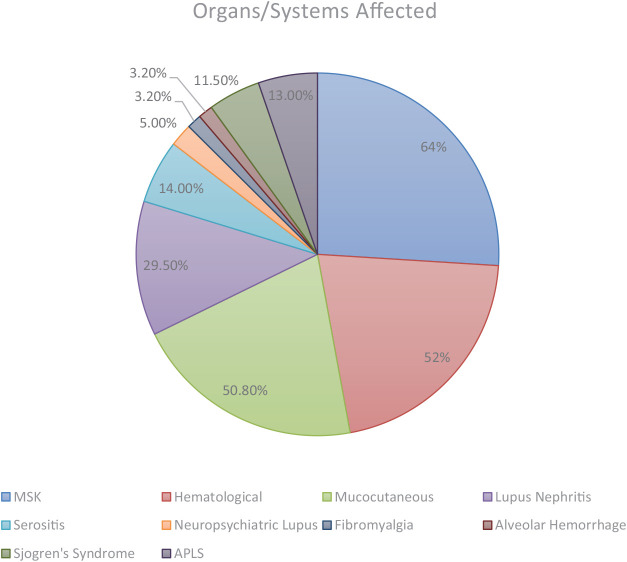 Figure 1
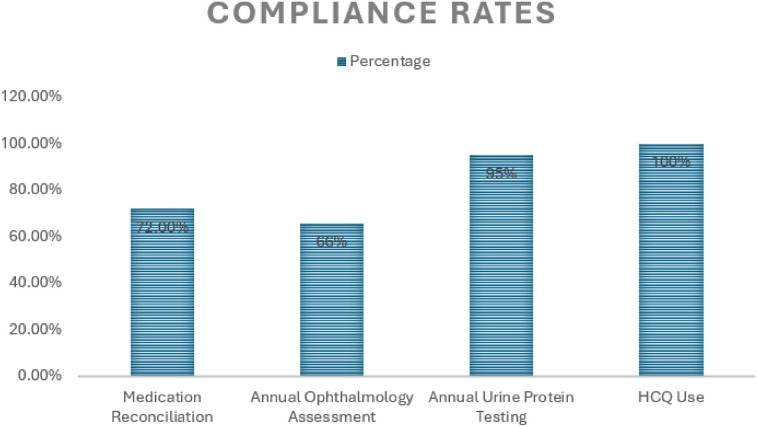 Figure 2
Peer Reviews
No public reviews on file for this paper yet. If you reviewed it on a platform where reviews are public (OpenReview, ICLR, NeurIPS, ICML), you can paste yours below so the community can read it here.
Videos
No videos yet. Explain this paper in a talk, walkthrough, or lecture? Add one.
Taxonomy
TopicsSystemic Lupus Erythematosus Research · Musculoskeletal Disorders and Rehabilitation · Rheumatoid Arthritis Research and Therapies
1. INTRODUCTION
Systemic lupus erythematosus (SLE) is a chronic, multisystem autoimmune disease characterized by diverse clinical and laboratory manifestations.^B1^ Studies from North America, Europe, and the Arab world have highlighted the heterogeneity of SLE, which is influenced by genetic, ethnic, and environmental factors, leading to variations in disease phenotype and severity among different populations.^B2^^–^^B6^ Additionally, race was associated with differences in the severity of the disease and associated mortality.^B7^ In the Arab Gulf region, including Saudi Arabia, Oman, and the United Arab Emirates, research underscored these racial and ethnic differences in SLE presentation and outcomes.^B8^^–^^B10^
This audit aims to evaluate adherence to internationally recognized key performance indicators (KPIs) for SLE management at Hamad General Hospital (HGH), a major public hospital in Doha, Qatar, based on the European Alliance of Associations for Rheumatology (EULAR) and the American College of Rheumatology (ACR) guidelines. The selected KPIs include hydroxychloroquine (HCQ) use in all eligible patients, annual screening for proteinuria, annual screening for HCQ-related retinopathy, and documentation of medication reconciliation at the most recent visit. The current audit also showed significant clinical variability among the multiethnic SLE patient population in Qatar.
2. METHODS
A retrospective cross-sectional audit was conducted between March and July 2024 involving 61 patients with SLE, all of whom attended the rheumatology outpatient clinic at HGH, a public tertiary care facility in Doha, Qatar. This audit was conducted as part of the rheumatology department’s quality improvement activities and, in line with local regulations, did not require formal approval from the institutional review board and the medical research center.
Clinical and demographic data were extracted from the electronic medical record system, including age, sex, nationality, clinical manifestations, and treatment regimens. Compliance with the following quality indicators was assessed: HCQ use—percentage of patients initiated on HCQ unless contraindicated; annual ophthalmology screening—for HCQ-related retinopathy; annual proteinuria screening—via urinalysis or urine protein-to-creatinine ratio; and medication reconciliation—conducted electronically at the most recent visit. Medication reconciliation was validated only when documented through the designated electronic workflow in the hospital’s standard electronic medical record system, not through free-text documentation.
The EULAR and the ACR guidelines were used as a benchmark for the selected quality indicators, including the HCQ use for all SLE patients unless contraindicated, annual screening for lupus nephritis, and ophthalmic screening for patients on HCQ.^B11^,^B12^
3. RESULTS
The audit included 61 patients, of whom 94% were female (female-to-male ratio, 7.7:1). The mean age was 43.3 years. Qataris represented 31% of the cohort, a proportion higher than their approximately 12% representation in Qatar’s national population, while the remaining 42 patients represented 20 additional different nationalities (Table 1).
The most frequently observed clinical manifestations were musculoskeletal involvement (64%), hematological abnormalities (52.4%), mucocutaneous manifestations, including Raynaud phenomenon (50.8%), and lupus nephritis (29.5%). Less common findings included serositis (14.7%), neuropsychiatric lupus (5%), fibromyalgia (3.2%), pulmonary hemorrhage (3.2%), Sjögren’s syndrome (11.5%), and antiphospholipid syndrome (13%); (Table 2; Figure 1).
HCQ was initiated in 100% of patients; however, 11.5% discontinued the drug due to adverse effects. Other commonly used agents included mycophenolic acid (26.2%), azathioprine (24.5%), tacrolimus (6.5%), rituximab (6.5%), and belimumab (5%); (Table 3).
Compliance with the predefined key quality indicators assessed in this audit is comprehensively detailed in Table 4 below and Figure 2.
4. DISCUSSION
This audit highlights the ethnic and clinical diversity of SLE patients in Qatar, reflecting the country’s multinational profile. Despite the modest sample size, our findings affirm the heterogeneous nature of SLE, consistent with prior studies. Qataris accounted for 31% of our sample—more than double their estimated 11.6% representation in Qatar’s total population.^B13^ This overrepresentation might reflect that nationals have greater familiarity with the healthcare system compared to expatriate groups. An earlier population-based study conducted during 2006 to 2010 reported statistically significantly higher inpatient and outpatient service utilization among Qatari nationals compared with non-nationals.^B14^ Given the substantial population growth and healthcare system expansion in Qatar since that period, these findings should be interpreted cautiously and may not fully reflect current utilization patterns, though.
4.1 Review of quality indicators
4.1.1 HCQ use for all SLE patients
Universal initiation of HCQ suggests strong adherence to EULAR/ACR recommendations.^B11^^,^^B12^ The 11.5% discontinuation rate was attributable to documented adverse effects or patient-reported inefficacy. One patient discontinued HCQ due to intolerable dizziness and blurred vision. Other Adverse events leading to discontinuation included allergic reaction, pruritus with skin pigmentation and dryness, HCQ-associated retinopathy, and intolerable nausea. In addition, two patients stopped the drug because they perceived it as ineffective.
4.1.2 Annual proteinuria screening
Achieving 95% compliance aligns with EULAR/ACR recommendations for early detection and management of lupus nephritis.^B11^^,^^B12^
4.1.3 Ophthalmologic screening for HCQ retinopathy
At 65%, this falls short of the American Academy of Ophthalmology (AAO) recommendations. The latest AAO guidelines recommend HCQ retinopathy screening during the first year of HCQ use for all patients, regardless of risk, and yearly screening after 5 years of continuous use of HCQ medication.^B15^ Contributing factors may include poor patient follow-up, missed referrals, and non-captured external assessments. Our rate, while better than regional benchmarks (e.g., a 2024 Saudi study reporting 36.5% compliance),^B16^ still requires improvement.
4.1.4 Medication reconciliation
With 72% compliance, performance remains below our institutional target of 90%. Factors include physician rotation, lack of uniform training in the electronic patient record system, and reliance on narrative documentation rather than structured entries.
4.2 Recommendations and quality improvement plan
We propose implementing standardized referral protocols between rheumatology and ophthalmology, creating Electronic Medical Records (EMR) alerts for overdue screenings, and strengthening patient education on the importance of regular eye examinations. For medication reconciliation, targeted training sessions for clinicians, integration of reconciliation checklists into EMR templates, and periodic audit-feedback cycles are recommended.
4.3 Audit strengths and limitations
This audit was conducted at one of Qatar’s largest tertiary care centers, providing access to a diverse patient population and a wide spectrum of SLE phenotypes. It offers valuable insights into real-world practice patterns and adherence to guidelines within a multicultural healthcare setting. The main limitation is the relatively small sample size, which may affect the generalizability of findings. Future audits with larger cohorts, particularly focusing on Qatari nationals, could provide more robust epidemiological and clinical insights.
5. CONCLUSION
This audit underscores the significant ethnic diversity and clinical heterogeneity among SLE patients receiving care at HGH in Qatar. While adherence to international recommendations for HCQ initiation and renal monitoring was high, ophthalmologic screening for HCQ-related retinopathy and medication reconciliation fell short of international benchmarks. Addressing these issues is important because it will enhance early detection of treatment-related toxicity, improve medication safety, and optimize long-term outcomes for SLE patients. This will require targeted system-level interventions, such as standardized referral protocols, EMR-based alerts, and clinician education programs, alongside patient engagement strategies to improve follow-up adherence. We plan to revisit these indicators in one year to evaluate the impact of the recommended changes and to guide further improvements in care.
CONFLICT OF INTEREST
The authors declare no conflicts of interest.
INFORMED CONSENT
Informed consent is not required for this study.
AUTHOR CONTRIBUTION
MS and AA-A conceptualized the study and contributed to the development of the study design. MS collected and curated the data, participated in the interpretation and discussion of the findings, and drafted the initial manuscript. AA-A provided methodological oversight, contributed to the interpretation and discussion of the results, critically revised the manuscript for important intellectual content, and supervised the overall conduct of the project. Both authors reviewed and approved the final manuscript
The reference list from the paper itself. Each links out to its DOI / PubMed record.
- 1Hay EM Snaith MLABC of rheumatology. Systemic lupus erythematosus and lupus-like syndromes BMJ 19950531069891257–6110.1136/bmj.310.6989.12577767201 PMC 2549624 · doi ↗ · pubmed ↗
- 2Reveille JD Moulds JM Ahn C Friedman AW Baethge B Roseman J Systemic lupus erythematosus in three ethnic groups: I. The effects of HLA class II, C 4, and CR 1 alleles, socioeconomic factors, and ethnicity at disease onset. LUMINA Study Group. Lupus in minority populations, nature versus nurture Arthritis Rheum 1998074171161–7210.1002/1529-0131(199807)41:7<1161∷AID-ART 4>3.0.CO;2-K 9663471 · doi ↗ · pubmed ↗
- 3Adwan M Clinical and serologic characteristics of systemic lupus erythematosus in the Arab world: a pooled analysis of 3,273 patients Arch Rheumatol 201803334455–6310.5606/Arch Rheumatol.2018.683230874242 PMC 6409177 · doi ↗ · pubmed ↗
- 4Pons-Estel BA Catoggio LJ Cardiel MH Soriano ER Gentiletti S Villa A Ron behalf of the Grupo Latinoamericano de Estudio del Lupus (GLADEL). The GLADEL multinational Latin American prospective inception cohort of 1,214 patients with systemic lupus erythematosus: ethnic and disease heterogeneity among “Hispanics”Medicine (Baltimore)2004018311–1710.1097/01.md.0000104742.42401.e 214747764 · doi ↗ · pubmed ↗
- 5Maningding E Dall’Era M Trupin L Murphy LB Yazdany J Racial and ethnic differences in the prevalence and time to onset of manifestations of systemic lupus erythematosus: the California Lupus Surveillance Project Arthritis Care Res (Hoboken)202005725622–2910.1002/acr.2388731115180 PMC 6872905 · doi ↗ · pubmed ↗
- 6Gudmundsson S Kristjan S Systemic lupus erythematosus in Iceland 1975 through 1984. A nationwide epidemiological study in an unselected population J Rheumatol 1990091791162–72290155 · pubmed ↗
- 7Kaslow RA High rate of death caused by systemic lupus erythematosus among U. S. residents of Asian descent Arthritis Rheum 198204254414–810.1002/art.17802504097073774 · doi ↗ · pubmed ↗
- 8al-Attia HM George S Characterization of systemic lupus erythematosus in patients in U.A.E Clin Rheumatol 199503142171–510.1007/BF 022149387789058 · doi ↗ · pubmed ↗