Editorial: Exploring the role of stem cells in bone health and regeneration
Elena Stocco, Adam Qingsong Ye, Guangxu He, Fangfang Song, Chanyuan Jin

Abstract
Click any figure to enlarge with its caption.
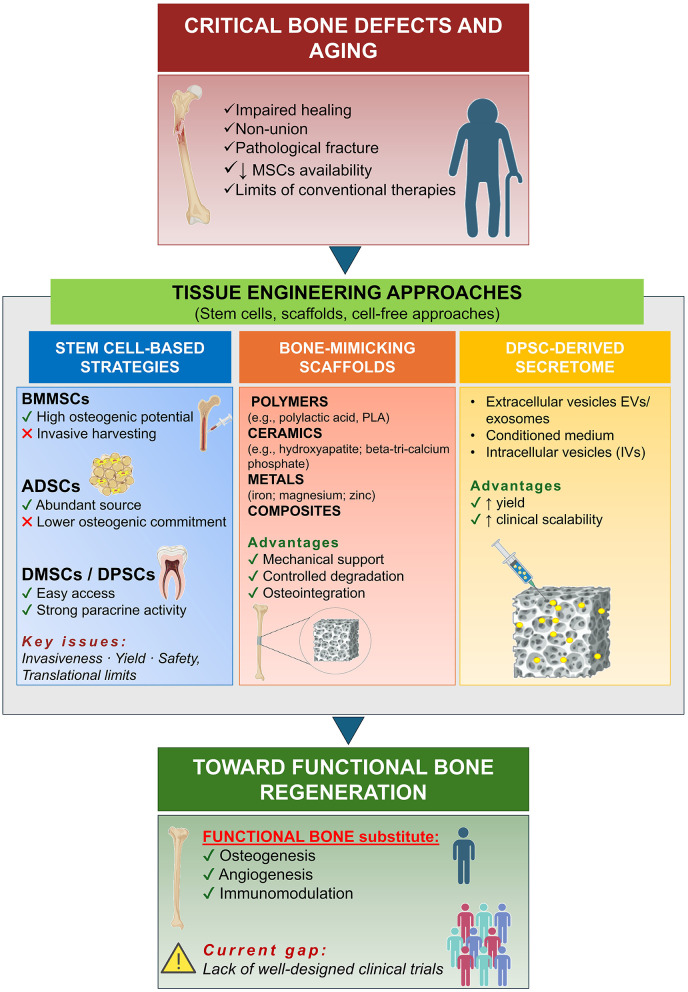 Figure 1
Peer Reviews
No public reviews on file for this paper yet. If you reviewed it on a platform where reviews are public (OpenReview, ICLR, NeurIPS, ICML), you can paste yours below so the community can read it here.
Videos
No videos yet. Explain this paper in a talk, walkthrough, or lecture? Add one.
Taxonomy
TopicsMesenchymal stem cell research · Extracellular vesicles in disease · Planarian Biology and Electrostimulation
Successful bone regeneration for large defects, particularly those involving substantial bone loss or occurring at load-bearing sites, remains a significant clinical challenge (1, 2). Bone remodeling and turnover result from coupled bone resorption/formation (3); however, there are events/conditions impairing this process. Additionally, with advancing age, bone structure undergoes mass decrease, microarchitecture modification, and a reduction/alteration in Mesenchymal Stromal Cells (MSCs) presence/phenotype (4, 5). Accelerated biological aging has been identified as an independent predictor of osteoporosis and premature mortality, highlighting the profound impact of systemic aging on skeletal health (6). Certainly, such conditions require additional support to re-establish bone architecture and function (7) and in this critical context tissue engineering (1) and stem cell-based therapies have emerged as appealing for bone regeneration. In particular, dental pulp stem cells (DPSCs) have garnered significant attention due to their easy accessibility, minimal collection-associated risks, and demonstrated potential for osteogenic differentiation, as well as their secretion of developmental-stage–specific bioactive components, including extracellular vesicles (EVs). In addition, MSCs cell lysates have also been explored for their therapeutic potential Liu et al.. Furthermore, the application of dental pulp stem cell-conditioned medium (DPSC-CM) has shown superior efficacy in preserving autologous bone grafts and enhancing bone healing in vivo, suggesting its potential as a novel osteogenic and angiogenic therapeutic strategy (11).
Within tissue engineering strategies, several materials can be adopted for fabrication of bone-like scaffolds with hierarchical microarchitecture. Further, MSCs play a leading role in this by promoting osteogenesis and modulating the immune response; as it occurs in the physiological environment (4). Finally, growth factors can be incorporated to guide and boost bone regeneration (8). Overall, the primary aim of tissue engineering is to overcome conventional therapeutic strategies limitations; however, to achieve this, a clear understanding of the mechanisms/events regulating bone regeneration, the behavior of bone-forming cells, and their activity within inflammatory environments still needs to be elucidated (12), thus representing the goal of this special issue (Figure 1).
In their Review article, Jiao et al. provide a comprehensive overview of bone tissue engineering approaches. Preliminarily, various stem cell sources have been explored for bone regeneration, highlighting the specific advantages and limitations. MSCs, including bone marrow (BMMSCs), adipose tissue (ADSCs), and dental tissue stem cells (DMSCs), are the most studied. BMMSCs are easily induced toward osteogenesis but collection is painful with low yield; ADSCs are abundant and minimally invasive to isolate but have lower osteogenic potential and tend to differentiate into adipocytes; DMSCs are easily harvested with high proliferation but lower osteogenic capacity. Embryonic stem cells are pluripotent with unlimited self-renewal, useful for disease modeling, but their use is limited by ethical issues, low availability, and risks of mutation or teratoma formation. Induced pluripotent stem cells overcome ethical issues, are versatile, and are compatible with human leukocyte antigens; nevertheless, they carry risks of genomic instability and tumorigenesis, along with high associated costs. Cell-free therapies using MSC-derived EVs also promote bone regeneration with lower immune risk, but production and donor variability remain a challenge. Toward this broad overview of cells and their derivatives for bone regeneration, attention was also given to biomaterials. Bone scaffolds are made of polymers (e.g., polylactic acid, PLA), ceramics (e.g., hydroxyapatite; beta-tri-calcium phosphate), metals (iron; magnesium; zinc), and composites. In particular, composites combine ceramics bioactivity with the polymers' flexibility, optimizing scaffold strength, degradation, osteointegration and support for bone tissue growth. An interesting overview of human clinical trials employing MSCs embedded in scaffolds for bone regeneration is reported. The 14 studies considered (138 patients), involved BMMSCs, DMSCs, and ADSCs combined with natural, synthetic, and hybrid scaffolds. Results showed significant bone regeneration, improved density, soft tissue healing, and implant integration, with low, mostly mild adverse events.
Chen et al. performed bibliometric analysis of research on MSC-based bone regeneration being conducted globally (years: 2013–2023). A total of 8,070 articles from the Web of Science Core Collection were considered and systematically evaluated. Publication output showed an increasing trend overall, peaking in 2020. China and the United States were the leading contributors in terms of publication volume and collaboration networks. The dominant research fields were cell biology, material science and engineering. Keyword and citation analyses highlighted emerging hotspots including EVs and bone tissue engineering. Interestingly, it appears that the research focus has progressively shifted from basic MSC biology to translational and clinical applications. Overall, this study provides a comprehensive overview of current trends and future directions in MSC-based bone regeneration research.
Liu et al., describe the major signaling pathways involved in bone tissue regeneration (Hedgehog, Notch, WNT, and BMP/TGF-β pathways and others). The review identifies DPSCs as a promising therapeutic option for bone regeneration mediated by osteogenic differentiation, paracrine mechanisms and secretion of EVs. Interestingly, cell-free therapeutic strategies, based on the DPSC secretome, are gaining importance as they can overcome stem cell transplantation safety issues. Furthermore, combining DPSC-derived secretome with biomaterials seems to enhance regenerative outcomes. These approaches are promising despite being mostly at a preclinical stage.
Finally, Zhao et al. described trends in MSCs-based therapies for intervertebral disc degeneration treatment, through a bibliometric analysis. A steady increase in research activity was demonstrated in this area from the 931 publications evaluated (years 2000–2024). China and the United States confirmed their leading role in overall publication output (as in Chen et al.), whereas the United Kingdom showed the highest citation impact. Additionally, early studies mainly focused on gene expression and extracellular matrix regulation, and then interest moved to autophagy, oxidative stress, apoptosis, and cell-free strategies involving EVs and exosomes. Significantly, this evolution aligns with the recent emergence of novel nanovesicle platforms. Beyond conventional EVs, intracellular vesicles (IVs) derived from cell lysates represent a promising advancement. IVs not only exhibit bioequivalence to traditional EVs in promoting tissue regeneration and modulating inflammation but also offer a substantially higher (16-fold) acquisition efficiency, addressing a critical bottleneck for clinical translation (9). IVs are increasingly recognized as novel nanovesicles with superior potential for translational medicine and clinical applications compared to standard EVs (10). Overall, future research is expected to improve knowledge on MSCs for development of cell-free therapies, also targeting molecular pathways driving disc degeneration and regeneration (Zhao et al.).
To date, effective bone tissue regeneration suffers from limits of conventional therapies. Considering this critical scenario, tissue engineering approaches have emerged, providing promising solutions. More recently, cell-free therapies (EVs, stem cells conditioned media and secretome, or scaffolds conditioned with secretome), have gained increasing attention as they avoid the complexities and risks associated with live cell transplantation. Despite these advances, a critical gap remains in translating these strategies into clinical practice. Well-designed, large-scale clinical trials are still lacking, highlighting the urgent need for rigorous studies to prove their safety and efficacy in humans.
The reference list from the paper itself. Each links out to its DOI / PubMed record.
- 1Li JJ Ebied M Xu J Zreiqat H. Current approaches to bone tissue engineering: the interface between biology and engineering. Adv Healthc Mater. (2018) 7:e 1701061. doi: 10.1002/adhm.20170106129280321 · doi ↗ · pubmed ↗
- 2Sun J Chen C Zhang B Yao C Zhang Y. Advances in 3D-printed scaffold technologies for bone defect repair: materials, biomechanics, and clinical prospects. Biomed Eng Online. (2025) 24:51. doi: 10.1186/s 12938-025-01381-w 40301861 PMC 12042599 · doi ↗ · pubmed ↗
- 3Unnanuntana A Rebolledo BJ Khair MM Di Carlo EF Lane JM. Diseases affecting bone quality: beyond osteoporosis. Clin Orthop Relat Res. (2011) 469:2194–206. doi: 10.1007/s 11999-010-1694-921107923 PMC 3126973 · doi ↗ · pubmed ↗
- 4Mi B Xiong Y Knoedler S Alfertshofer M Panayi AC Wang H . Ageing-related bone and immunity changes: insights into the complex interplay between the skeleton and the immune system. Bone Res. (2024) 12:42. doi: 10.1038/s 41413-024-00346-439103328 PMC 11300832 · doi ↗ · pubmed ↗
- 5Stocco E Barbon S Piccione M Belluzzi E Petrelli L Pozzuoli A . Infrapatellar Fat pad stem cells responsiveness to microenvironment in osteoarthritis: from morphology to function. Front Cell Dev Biol. (2019) 7:323. doi: 10.3389/fcell.2019.0032331921840 PMC 6914674 · doi ↗ · pubmed ↗
- 6Zhang R Zhong W Gao Y Duan X Ye Q. Biological age acceleration predicts osteoporosis and reduced longevity in a large prospective cohort. Bone. (2025) 200:117609. doi: 10.1016/j.bone.2025.11760940816510 · doi ↗ · pubmed ↗
- 7Dec P Modrzejewski A Pawlik A. Existing and novel biomaterials for bone tissue engineering. Int J Mol Sci. (2022) 24:529. doi: 10.3390/ijms 2401052936613972 PMC 9820083 · doi ↗ · pubmed ↗
- 8Jagadale S Damle M Joshi MG. Bone tissue engineering: from biomaterials to clinical trials. Adv Exp Med Biol. (2025) 1479:73–115. doi: 10.1007/5584_2024_84139881051 · doi ↗ · pubmed ↗