Views and experiences regarding workplace genetic testing: findings from a national survey of U.S. employees
Drew Blasco, Sarah McCain, Subhamoy Pal, Wendy R. Uhlmann, Rebecca Ferber, Kunal Sanghavi, Elizabeth Charnysh, Anya E.R. Prince, Charles Lee, J. Scott Roberts

TL;DR
This study explores U.S. employees' views on workplace genetic testing, finding significant interest in testing for common diseases despite limited availability.
Contribution
The paper provides novel insights into employee interest and experiences with workplace genetic testing using a large national survey.
Findings
54.1% of participants expressed interest in workplace genetic testing, especially for cancer, heart disease, and Alzheimer’s.
Younger age, Hispanic ethnicity, and prior genetic testing experience were linked to higher interest in workplace genetic testing.
Among those offered testing, 60% had undergone it, with factors like personal medical history and health familiarity influencing uptake.
Abstract
The emergence of voluntary health-related genetic testing in workplace wellness programs indicates a need to understand employees’ views and experiences regarding workplace genetic testing (wGT). A large, diverse national sample of employed adults (N=2000; median age=43 years; 51.1% female; 33% non-white) completed a web survey of their wGT views and experiences. Although 80% of participants indicated their employer did not offer wGT, 54.1% were interested in testing, especially (somewhat/very) for cancer (89.2%), heart disease (93.1%), and Alzheimer’s disease (85.3%). Characteristics associated with wGT interest included younger age (<55 years), Hispanic/Latino ethnicity, genetic testing experience or familiarity, and a positive family medical history (all p<0.05). Reasons for pursuing wGT (e.g., inform health behaviors) were endorsed more frequently than reasons for declining (e.g.,…
Genes, proteins, chemicals, diseases, species, mutations and cell lines named across the full text — each resolved to its canonical identifier and authoritative record.
Click any figure to enlarge with its caption.
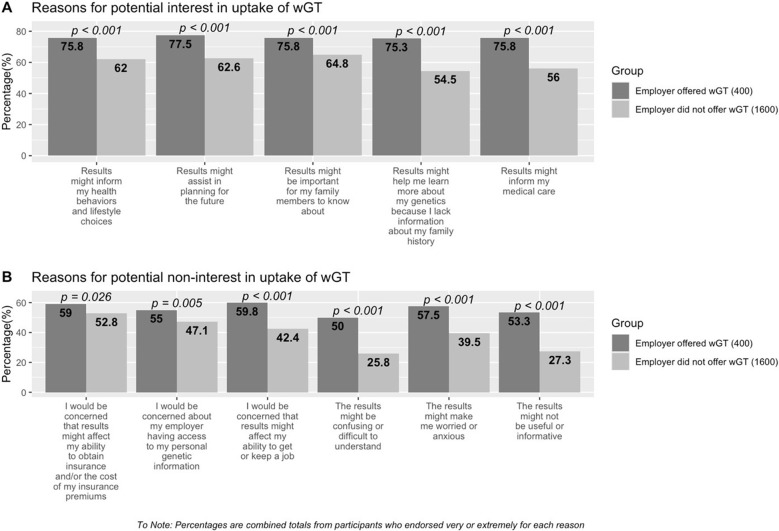 Figure 1
Peer Reviews
No public reviews on file for this paper yet. If you reviewed it on a platform where reviews are public (OpenReview, ICLR, NeurIPS, ICML), you can paste yours below so the community can read it here.
Videos
No videos yet. Explain this paper in a talk, walkthrough, or lecture? Add one.
Taxonomy
TopicsBRCA gene mutations in cancer · Genetics and Physical Performance · Cognitive Abilities and Testing