Blink parameters are confounded by vertical eye orientation in video-based eye tracking: Comparing pupil- and eyelid-based methods
Wolf Culemann, Ignace T. C. Hooge, Diederick C. Niehorster, Angela Heine, Marcus Nyström

TL;DR
This study shows that vertical eye position affects blink measurements in video-based eye tracking, with different methods being affected to varying degrees.
Contribution
The study identifies vertical eye orientation as a confounding factor in modern video-based blink measurement methods.
Findings
Vertical eye orientation systematically influences blink parameters like duration, amplitude, and velocity.
Pupil-based blink duration measurements are more sensitive to vertical eye orientation than eyelid-based methods.
Eye openness decreases and closing velocity increases with downward eye orientation.
Abstract
Blink characteristics such as duration, amplitude, and eyelid velocity are widely used indicators of cognitive and physiological states. While early magnetic search coil studies suggested that vertical eye orientation relative to the head influences blink measurements, subsequent research has largely ignored this factor. No studies have investigated whether vertical eye orientation effects replicate in modern video-based methods or whether different video-based blink-detection approaches show similar sensitivities to changes in vertical eye orientation. In this study, we investigated how vertical eye orientation affects blink parameters estimated using both pupil-based and eyelid-based detection. We recorded pupil diameter and estimated eye openness from video data as seventeen participants performed voluntary blinks from three vertical eye orientations while keeping their heads…
Genes, proteins, chemicals, diseases, species, mutations and cell lines named across the full text — each resolved to its canonical identifier and authoritative record.
Click any figure to enlarge with its caption.
 Figure 1
 Figure 2
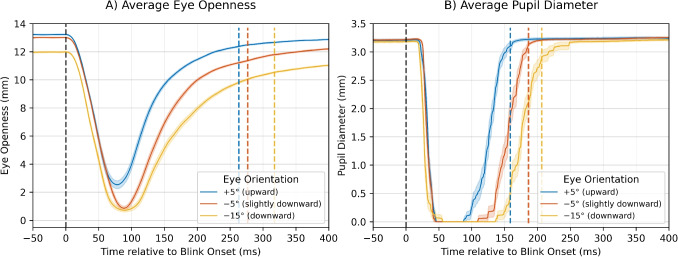 Figure 3
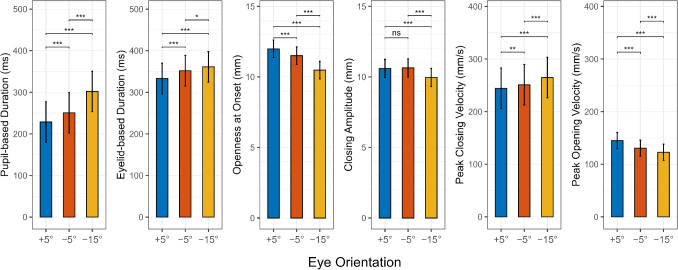 Figure 4
Peer Reviews
No public reviews on file for this paper yet. If you reviewed it on a platform where reviews are public (OpenReview, ICLR, NeurIPS, ICML), you can paste yours below so the community can read it here.
Videos
No videos yet. Explain this paper in a talk, walkthrough, or lecture? Add one.
Taxonomy
TopicsOcular Surface and Contact Lens · Gaze Tracking and Assistive Technology · Mind wandering and attention