First evidence of polyandry for amazonian stingray (Potamotrygon wallacei Carvalho, Rosa & Araújo 2016) based on genome-wide SNP data
Larissa Emily Santos da Silva, Pedro Senna Taylor Bittencourt, Fábio de Lima Muniz, Wallice Luiz Paxiúba Duncan, Tomas Hrbek, Izeni Pires Farias

TL;DR
This study provides the first evidence of polyandry in the Amazonian stingray using SNP data, revealing new insights into its reproductive behavior.
Contribution
The study presents the first molecular evidence of polyandry in the freshwater stingray Potamotrygon wallacei.
Findings
Polyandry was detected in three out of five family groups of P. wallacei.
The study used SNP markers to analyze kinship patterns in wild-caught individuals.
The findings contribute to understanding mating system evolution in Neotropical elasmobranchs.
Abstract
The Amazonian freshwater stingray Potamotrygon wallacei, endemic to the Rio Negro basin, although heavily exploited in ornamental fish trade, is largely neglected in terms of basic biology, including its reproductive system. Polyandry is a widespread reproductive strategy in elasmobranchs, however, evidence from freshwater potamotrygonids is scarce. To address this knowledge gap, the present study developed highly polymorphic single nucleotide polymorphism (SNP) genomic markers for P. wallacei and applied them to investigate kinship patterns in wild-caught gravid females and their litters. This study used genomic polymorphic SNP markers in 18 individuals from five family groups to assess kinship patterns. The average gene diversity was low, however, He (0.435–0.476) and Ho (0.530–0.653) were higher, with Ho > He, suggesting small-sample bias or heterozygote excess from family-level…
Genes, proteins, chemicals, diseases, species, mutations and cell lines named across the full text — each resolved to its canonical identifier and authoritative record.
Click any figure to enlarge with its caption.
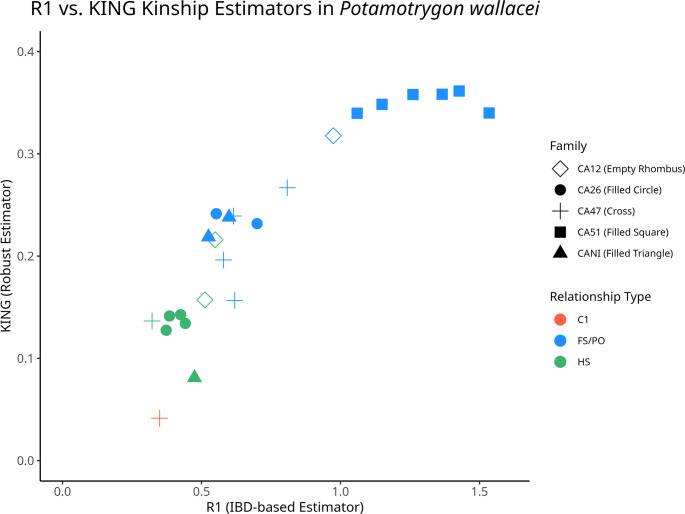 Figure 1
Peer Reviews
No public reviews on file for this paper yet. If you reviewed it on a platform where reviews are public (OpenReview, ICLR, NeurIPS, ICML), you can paste yours below so the community can read it here.
Videos
No videos yet. Explain this paper in a talk, walkthrough, or lecture? Add one.
Taxonomy
TopicsFish biology, ecology, and behavior · Ichthyology and Marine Biology · Genetic diversity and population structure