Moving Toward a Near-Total Reduction, Refinement, and Replacement of Live Animal Use in Microvascular Training
Danny Kazzazi, Fawz Kazzazi, Georgios Pafitanis

TL;DR
A new hybrid microsurgery training curriculum significantly reduces live animal use while maintaining educational quality through non-living models and objective assessments.
Contribution
A hybrid microvascular training curriculum that reduces live animal use by up to 80% while maintaining skill acquisition and educational outcomes.
Findings
Trainees using non-living models achieved comparable physiological patency rates to those using live animals.
The curriculum reduced live animal use from 10 to 2 per trainee while maintaining high educational value.
Objective assessments showed improvements in hand motion, time efficiency, and movement economy.
Abstract
Simulation training in microsurgery primarily relies on live rat models due to their high-fidelity physiological characteristics, which presents ethical and educational challenges. The increasing emphasis on reducing, replacing, and refining (3Rs) animal use calls for alternative training models that can offer similar educational benefits. We developed a hybrid microvascular training curriculum incorporating non-living models, such as chicken thigh abductor profundus muscle flaps, pork belly intramuscular perforator flap models, and the Micropump for flow-capable microvascular anastomosis training. Trainees progress from basic instrument handling and 2D suturing to more complex microvascular dissections and anastomoses. Skills are evaluated using objective measures such as hand motion analysis, time, economy of movement, and both structural and physiological patency outcomes. The hybrid…
Genes, proteins, chemicals, diseases, species, mutations and cell lines named across the full text — each resolved to its canonical identifier and authoritative record.
Click any figure to enlarge with its caption.
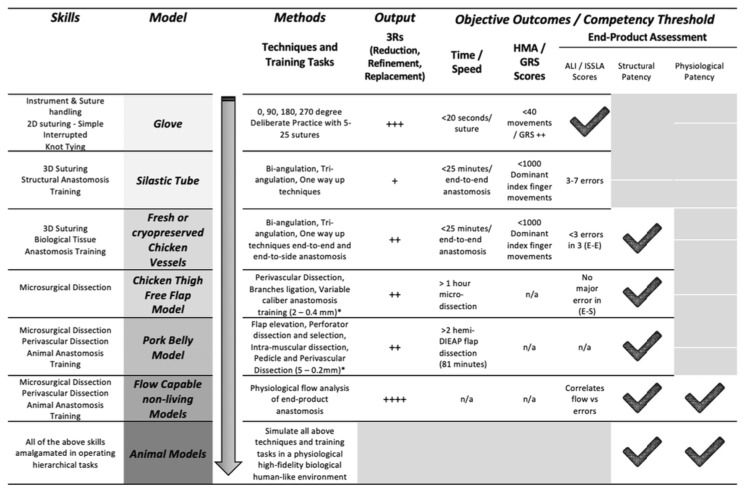 Figure 1
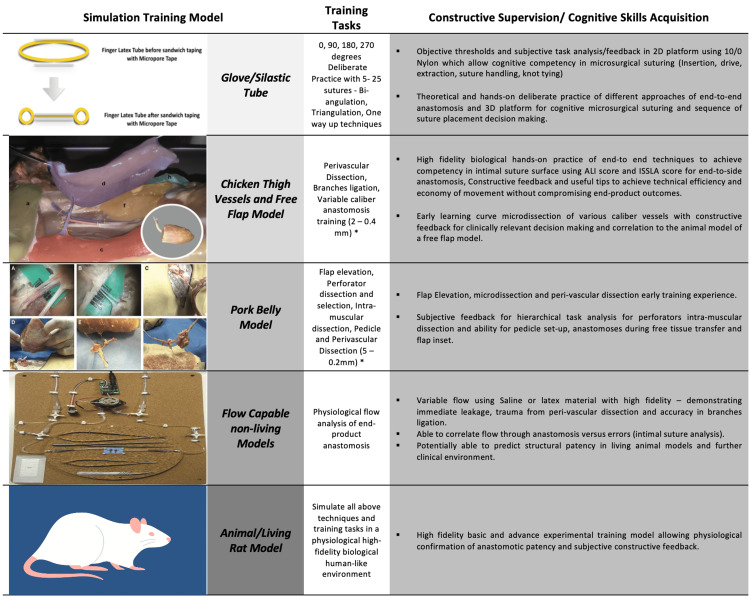 Figure 2
Peer Reviews
No public reviews on file for this paper yet. If you reviewed it on a platform where reviews are public (OpenReview, ICLR, NeurIPS, ICML), you can paste yours below so the community can read it here.
Videos
No videos yet. Explain this paper in a talk, walkthrough, or lecture? Add one.
Taxonomy
TopicsSurgical Simulation and Training · Anatomy and Medical Technology · Simulation-Based Education in Healthcare