Association between the 20-minute whole blood clotting test and fibrinogen concentrations in green pit viper envenomations in Bangkok
Supa Niruntarai, Sivilai Hengtrakul, Rittirak Othong

TL;DR
This study clarifies how to interpret a 20-minute blood clotting test for green pit viper bites, showing that 'partially clotted' results should be treated as 'clotted' to guide antivenom use.
Contribution
The study provides a clear interpretation framework for the 20WBCT in green pit viper envenomation, improving antivenom decision-making in resource-limited settings.
Findings
Unclotted 20WBCT results correlate with very low fibrinogen concentrations (<70 mg/dL).
Partially clotted samples have fibrinogen levels similar to completely clotted samples.
Reclassifying partially clotted as clotted improves the test's reliability for antivenom decisions.
Abstract
The 20-minute whole blood clotting test (20WBCT) is widely used in patients with viper envenomation in resource-limited settings. The unclotted result guides the need for antivenom administration. Confusion has arisen on how to interpret “partially clotted” for the test due to a paucity of data. This study’s primary aim was to evaluate the association between fibrinogen concentrations (FC) and states of clotting from the 20WBCT in green pit viper (GPV) envenomation. Patients aged ≥18 years who presented to our hospital with GPV bites were enrolled between September 2022 and November 2023. All 20WBCT were done by laboratory technicians and the results were video recorded. Corresponding blood samples were quantified for FC. Two investigators, blinded to clinical/laboratory data, interpreted clotting results from recordings. A third investigator resolved conflicts. Thirty-nine patients…
Genes, proteins, chemicals, diseases, species, mutations and cell lines named across the full text — each resolved to its canonical identifier and authoritative record.
Click any figure to enlarge with its caption.
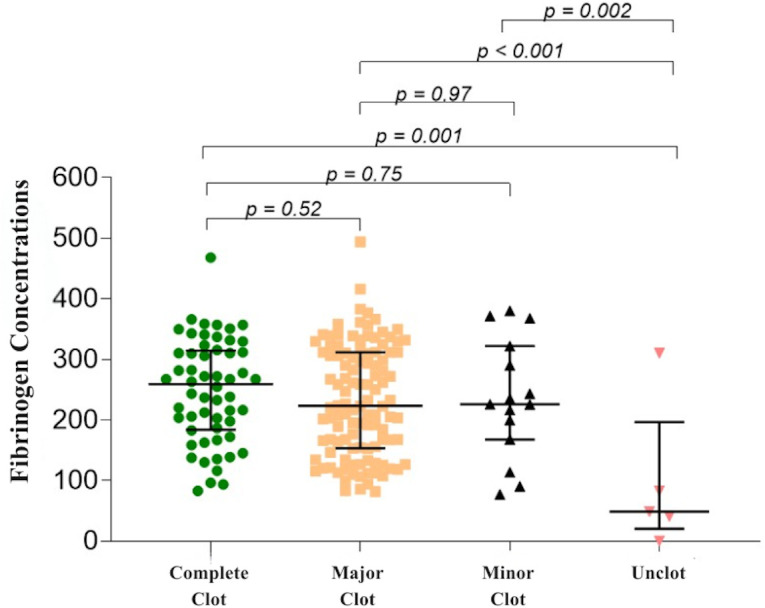 Figure 1
 Figure 2
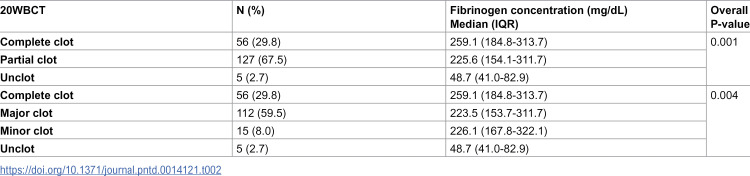 Figure 3
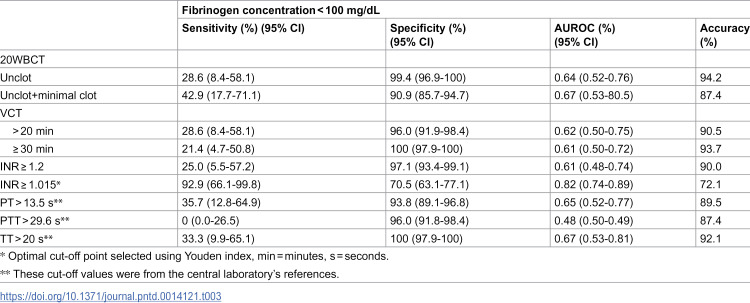 Figure 4
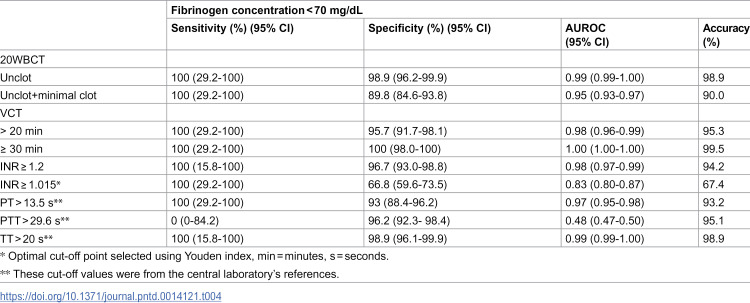 Figure 5
Peer Reviews
No public reviews on file for this paper yet. If you reviewed it on a platform where reviews are public (OpenReview, ICLR, NeurIPS, ICML), you can paste yours below so the community can read it here.
Videos
No videos yet. Explain this paper in a talk, walkthrough, or lecture? Add one.
Taxonomy
TopicsVenomous Animal Envenomation and Studies · Healthcare and Venom Research · Ion channel regulation and function